

White House threatens further military action if Syria uses chemical weapons
Lines of communication with Russia still open, despite Moscow’s fury over US strike
 Add ToI as a Preferred Source on Google
WASHINGTON — The White House on Monday warned Syria that further use of chemical weapons or barrel bombs could bring US military retaliation.
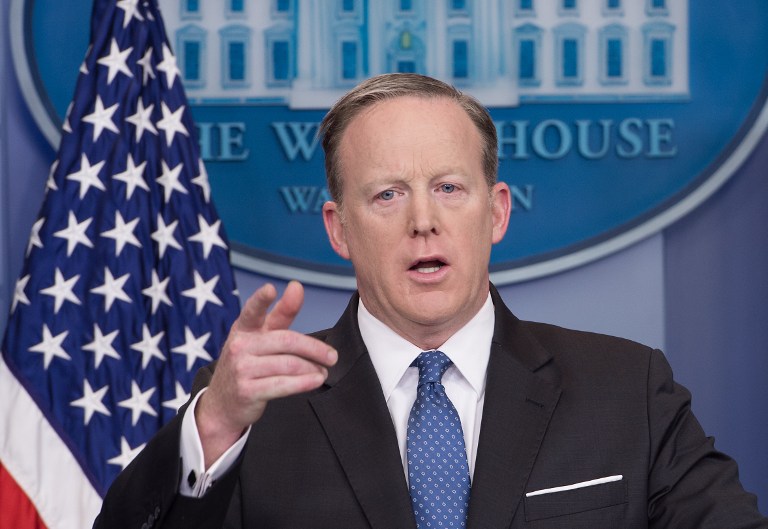
Broadening its warning to Syrian President Bashar Assad, White House spokesman Sean Spicer indicated that such attacks were unacceptable.
“If you gas a baby or drop a barrel bomb onto innocent people, you will see a response from this president,” Spicer said.
Trump last week ordered missile strikes against an air field in Syria that US intelligence believes was used to carry out an attack with the chemical agent sarin.
But this was the first mention of the use of barrel bombs, crude munitions notorious for causing indiscriminate casualties.
The Pentagon said it believes the Syrian regime likely has additional chemical weapons stocks at the Shayrat airfield near Homs in central Syria struck by US missiles last week, but these were deliberately left untouched, an official indicated Monday.
US intelligence experts assess Syrian President Bashar al-Assad’s military is probably hoarding the weapons in munitions depots at the airfield , the US military’s Central Command spokesman Colonel John Thomas said.
“We suspected there was a significant probability there could be other chemical weapons which would be ready to go, weaponized in those facilities, and so we didn’t strike those,” Thomas told reporters.
The chemical stocks were left untouched because the Pentagon did not want to risk unintentionally sending a plume of toxic gas across parts of Syria.
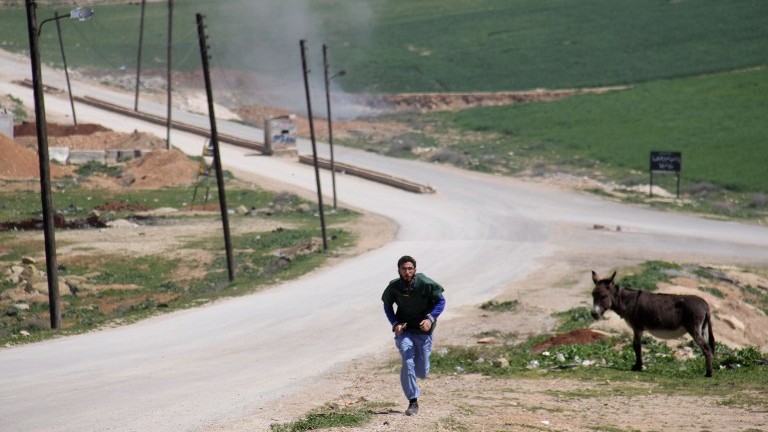
The Pentagon has said it is sure Assad unleashed a chemical attack on April 4 that killed at least 87 civilians in the rebel-held Syrian town of Khan Sheikhoun.
“Our advice was to make sure we didn’t inflict any greater damage by touching any of the chemical weapons in the area,” Thomas added.
“We were trying to degrade their capability to launch aircraft and to load them up with chemical weapons.”
The Pentagon said the strike destroyed more than 20 Syrian jets but the military has come under criticism for not targeting Shayrat’s runways, amid reports regime planes were again using the base hours after the attack by 59 Tomahawk cruise missiles.
Thomas said the runways were deliberately avoided because the United States was trying to draw a clear line that its military action was in response to the suspected chemical attack, and not signal a willingness to get more involved in Syria’s brutal civil war.
US forces gave Moscow a heads up shortly before Friday’s strike, as Russian personnel and equipment were based at Shayrat under Russia’s ongoing military intervention to prop up Assad.

Moscow reacted furiously to the US strike and immediately threatened to suspend a vital hotline established to avoid mishaps between the two powers in Syria.
Thomas refused to confirm whether the so-called “deconfliction line” remains operational, but said that even without it, “there are still ways for the pilots to hail each other.”
While US and Russian pilots can use radar to see each other, the lack of a direct line of communication would further heighten the risks of misunderstandings or accidents in Syria’s already crowded skies.
Assad denies his forces use the chemical weapons in Khan Sheikhoun.
The White House on Monday also doubled down on its rhetoric on the need for Syria’s leader to step down.
“You can’t imagine a stable and peaceful Syria with Assad in charge,” said Spicer.




The Times of Israel Community.