

Japan, US seek to up pressure after North Korea missile launch
Security Council to hold emergency meeting as region fumes over ballistic missile test overflying Japanese island
 Add ToI as a Preferred Source on Google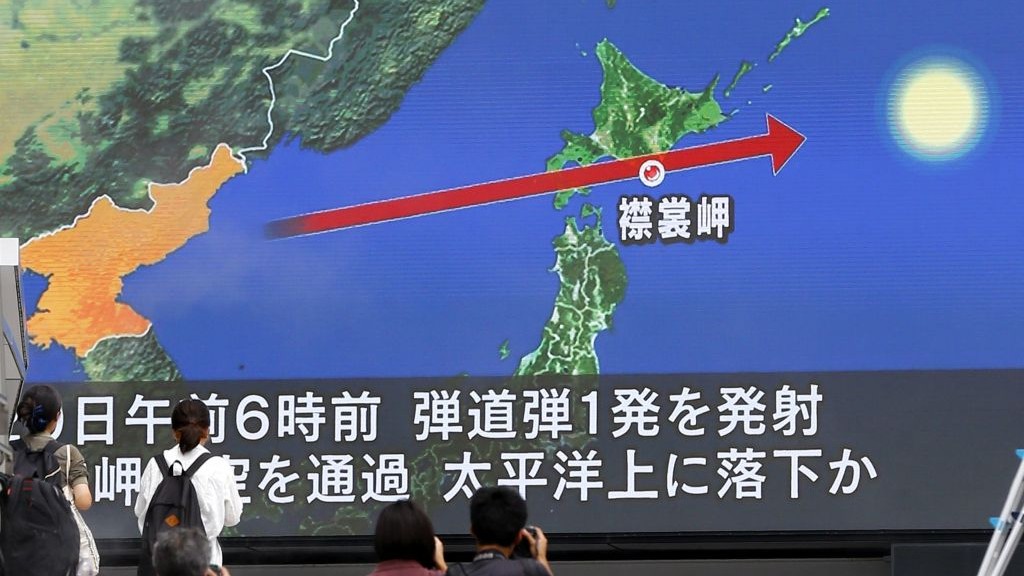
TOKYO, Japan — Japanese Prime Minister Shinzo Abe said Tuesday that he and US President Donald Trump agreed to hike pressure on North Korea after it launched a ballistic missile over Japan, in Pyongyang’s most serious provocation in years.
Diplomats said the UN Security Council would hold an emergency meeting Tuesday afternoon over the missile launch at the request of Japan and the United States.
Abe said the international community must “further strengthen pressure against North Korea,” after a 40-minute phone call with Trump.
“Increasing pressure — Japan and the United States are in complete agreement about this,” he added, without elaborating on proposed measures.
He added that Trump — who has been embroiled in an escalating war of words with Pyongyang over its weapons development — said Washington would stand by its ally Japan.
“President Trump made a very strong commitment that the United States is with Japan 100 percent,” Abe quoted Trump as saying.
“We will cooperate among Japan, the US and South Korea. We will also reach out to China, Russia and the international community and apply strong pressure on North Korea to change their policy.”
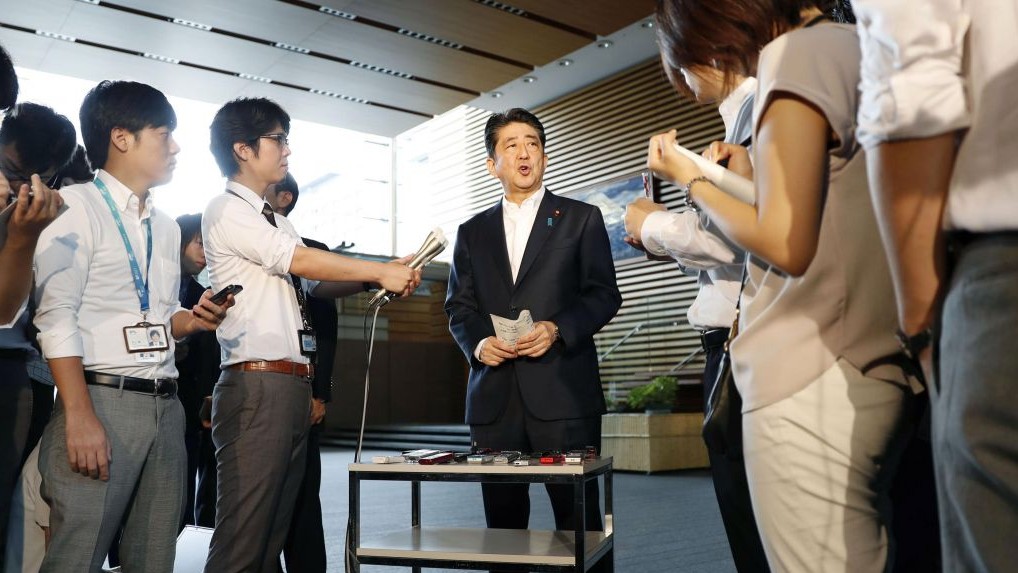
Abe had earlier described the missile, which landed in the Pacific Ocean off Hokkaido, as an “outrageous act” that “greatly damages regional peace and security.”
Seoul’s Joint Chiefs of Staff said the missile traveled around 2,700 kilometers (1,677 miles) and reached a maximum height of 550 kilometers (341 miles) as it flew over the northern Japanese island of Hokkaido. The launch, which appears to be the first to cross over Japan since 2009, will rattle a region worried that each new missile test puts the North a step closer toward its goal of an arsenal of nuclear missiles that can reliably target the United States. It appeared to be the North’s longest-ever missile test, but South Korean officials couldn’t immediately confirm.
North Korean missile launches have been happening at an unusually fast pace this year, and some analysts believe the North could have viable long-range nuclear missiles before the end of President Donald Trump’s first term in early 2021.
The South Korean military said it is analyzing the launch with the United States and had strengthened its monitoring and preparation in case of further actions from North Korea. Analysts speculate the North may have tested a new intermediate-range missile that Pyongyang recently threatened to fire toward the US territory of Guam, which hosts a major military base.
This missile landed nowhere near Guam, which is about 2,500 kilometers (1,550 miles) south of Tokyo, but the length of Tuesday’s launch may have been designed for the North to show it could follow through on its threat. Seoul said the missile was launched from Sunan, which is where Pyongyang’s international airport is, opening the possibility that North Korea launched a road-mobile missile from an airport runway.
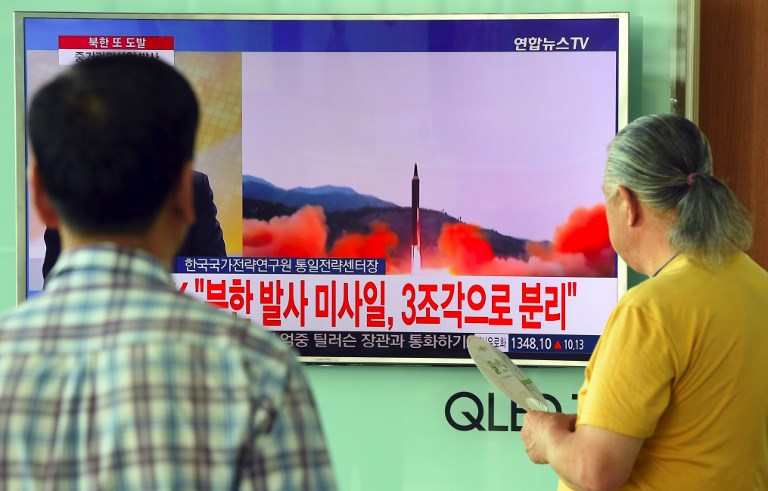
It was North Korea’s 13th launch of ballistic missiles this year, said Roh Jae-cheon, spokesman of Seoul’s JCS.
North Korea will no doubt be watching the world’s reaction to see if it can use Tuesday’s flight over Japan as a precedent for future launches.
“Today is really quite a horrible day for Japan,” security commentator Ankit Panda said on Twitter following Tuesday’s overflight.
“If North Korea assesses the costs of overflying Japan to be *anything* but intolerable, we’ll see more of these kinds of tests.”
Japan has in the past vowed to shoot down North Korean missiles or rockets that threaten to hit its territory.
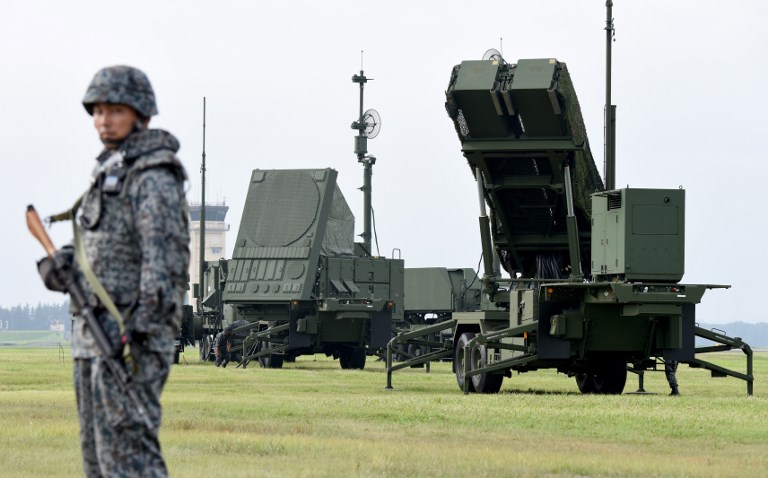
But it made no attempt to do so on Tuesday — when the missile flew over the country for two minutes — with defense minister Itsunori Onodera saying generals believed it “posed no risk of flying into our country.”
But as a precaution, millions of residents in northern Japan received an early morning text message from the government warning them to take cover.
When the North sent a missile into Japan’s exclusive economic zone — waters extending 200 nautical miles from its coast — last year it only triggered protests and anger, and it subsequently carried out several similar launches.
Tuesday’s launch comes days after the North fired what was assessed as three short-range ballistic missiles into the sea and a month after its second flight test of an intercontinental ballistic missile, which analysts say could reach deep into the US mainland when perfected.
Pyongyang says it needs nuclear weapons to protect itself against the US, and the firing comes during the annual Ulchi Freedom Guardian South Korean-US joint military exercise, which the North always condemns as rehearsals for invasion.
South Korea’s Foreign Ministry warned that the North will face a “strong response” from the US-South Korean alliance if what it called nuclear and missile provocations continue. The ministry also urged Pyongyang to accept talks over its nuclear program and acknowledge that abandoning its nuclear ambitions is the only way to guarantee its security and economic development.
South Korea also said its air force conducted a live-fire drill involving four F-15 fighters dropping eight MK-84 bombs that accurately hit targets at a military field near the country’s eastern coast. Park Su-hyun, spokesman of South Korean President Moon Jae-in, said the exercise was conducted after Moon directed the military to “display a strong capability to punish” the North.
Park also said Moon’s national security director Chung Eui-yong and Seoul’s Foreign Minister Kang Kyung-hwa called Trump’s national security adviser H.R. McMaster and US Secretary of State Rex Tillerson, respectively, to discuss the launch.
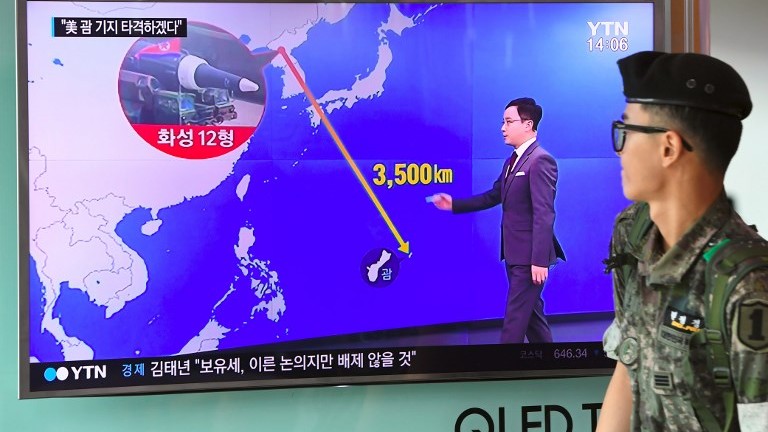
The launch over Japan isn’t a total surprise. Earlier this month, when threatening to lob four Hwasong-12s, which are new intermediate-range missiles, into the waters near Guam, North Korea specifically said they would fly over Japanese territory. North Korea in June also angrily reacted to the launch of a Japanese satellite it said was aimed at spying on the North and said Tokyo was no longer entitled to fault Pyongyang “no matter what it launches or whether that crosses the sky above Japan.”
North Korea typically reacts with anger to US-South Korean military drills, which are happening now, often testing weapons and threatening Seoul and Washington in its state-controlled media.
But animosity is higher than usual following threats by Trump to unleash “fire and fury” on the North, and Pyongyang’s stated plan to consider firing some of its missiles near Guam.

Kim Dong-yub, a former South Korean military official who is now an analyst at Seoul’s Institute for Far Eastern Studies, said the early flight data suggests the North Korean missile was likely a Hwasong-12. Other possibilities, he said, include a midrange Musudan, a missile with a potential 3,500-kilometer (2,180-mile) range that puts much of the Asia-Pacific region within reach, or a Pukguksong-2, a solid-fuel missile that can be fired faster and more secretly than weapons using liquid fuel.
South Korea’s military didn’t immediately confirm whether the North Korean missile was fired from Pyongyang’s airport. Moon Seong Mook, a former South Korean military official and current analyst for the Seoul-based Korea Research Institute for National Strategy, said the airport’s runways could provide the ideal space to launch a road-mobile missile like the Hwasong-12. By launching from its capital, the North might have been trying to demonstrate the ability to launch its missiles from anywhere, Moon said.
“The launch doubled as a threat to Washington, not only because of the US military bases in Japan, but also that the North showed it has the real capability to fire missiles to waters near Guam if it chose to shoot them in that direction,” Moon said.
North Korea first fired a rocket over Japanese territory in August of 1998 when a multistage rocket that outside experts called “Taepodong-1” flew about 1,500 kilometers (932 miles) before landing in the Pacific Ocean. The North later said it launched a satellite.
North Korea flew another rocket over Japan again in April 2009 and said that, too, was carrying a satellite. The North claimed success, but the US North American Aerospace Defense Command says no satellite reached orbit. The United Nations has repeatedly condemned North Korean satellite launches as covers meant to test banned long-range missile technology. Some parts of a space launch vehicle reportedly flew over Okinawa last year after separating from the rocket.
Pyongyang regularly claims the US-South Korean military exercises are an invasion rehearsal, although analysts say the North’s anger is partly because the impoverished country must react with its own expensive drills and weapons tests. The allies say the war games are defensive and meant to counter North Korean aggression.
North Korea’s UN ambassador, Ja Song Nam, wrote recently that the exercises are “provocative and aggressive” at a time when the Korean Peninsula is “like a time bomb.”
Last week, Japan said it would impose fresh sanctions on North Korea by freezing the assets of Chinese and Namibian firms doing business with the nuclear-armed state.
The move against a half dozen organizations and a couple of individuals comes days after Washington expanded its own punitive measures against Chinese and Russian firms, as well as people linked to Pyongyang over its weapons development.
The sanctions are aimed at disrupting the flow of cash funding North Korean weapons programs, which are in violation of United Nations resolutions.









The Times of Israel Community.