

Weizmann team says it can finally prove supernovae give birth to black holes
Researchers say dance between dead star and surviving companion in aftermath of explosive end, 75 million lightyears away, provides first direct evidence of elusive link
 Add ToI as a Preferred Source on Google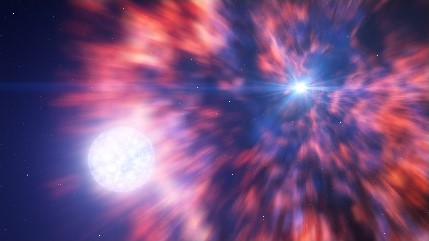
No light can escape black holes, dead stars compacted to such high density that their pull is literally irresistible. But researchers at an Israeli university say they have managed to tease out the first-ever direct evidence of the mysterious object being left behind by an exploding star, or supernova.
The breakthrough, published in the scientific journal Nature, confirms the long-held suspicion that black holes and neutron stars, another super-dense object, are created in the aftermath of giant stars going out with a bang, according to lead author Ping Chen, a postdoctoral fellow at the Weizmann Institute of Science in Rehovot.
“Researchers have long believed that a compact remnant is produced at the center of a massive star explosion, but a direct link between supernova explosions and newly formed compact objects has been elusive,” Chen said in a university statement. “In this work, we establish such a direct link.”
Chen, working in the lab of Prof. Avishay Gal-Yam, and an international team, managed to observe a rare instance where a companion to a massive star managed to survive its partner’s violent death, or supernova.
Evidence of the survivor’s continuing interaction with its erstwhile sidekick showed that a super-compact vestige was still there.
An object is called compact when its density, measured as the ratio of the object’s mass to its volume, is particularly high. The neutron star is so dense that “a teaspoon of its material would weigh as much as Mount Everest,” according to Weizmann. Still denser is the black hole, whose gravity is so strong that even light is swallowed by it, making direct observation impossible.
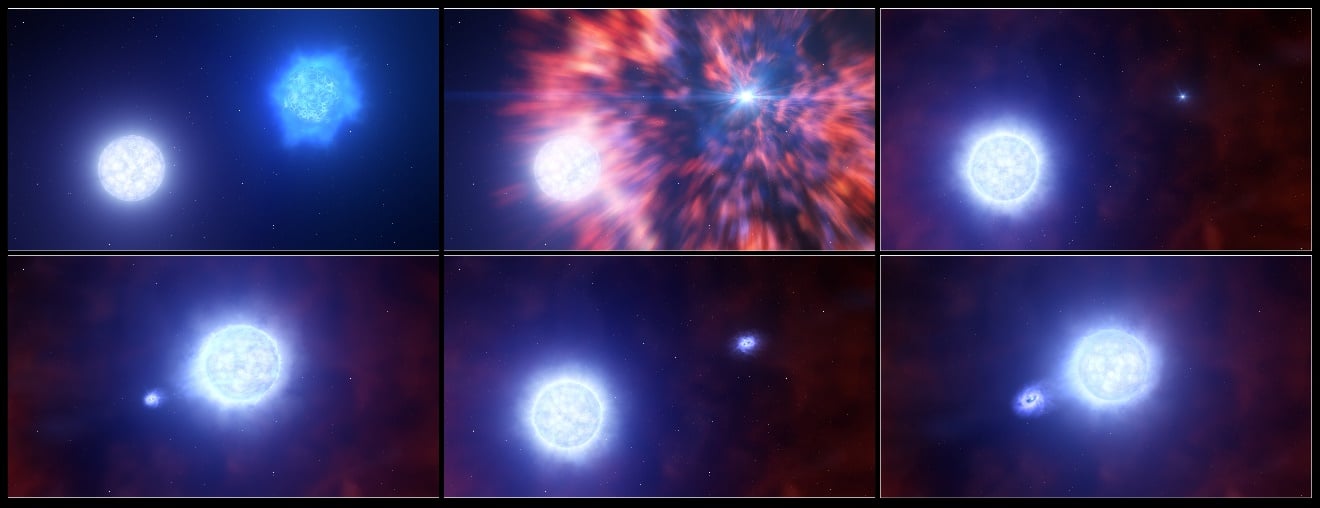
The supernova, dubbed SN2022jli, was found in May 2022 in a galaxy some 75 million lightyears away. Using the European Southern Observatory’s Very Large Telescope, the team watched the binary system’s continued interplay, during which material expelled during the explosion would cause the companion star’s hydrogen atmosphere to puff up, the university said.
When the remnant would pass through the puffy atmosphere, the researchers could see that hydrogen was being sucked up by what could only be a black hole or neutron star.
“Our research was like solving a puzzle by gathering all possible evidence,” Chen said. “All these pieces lined up, leading to the truth.”
A direct link between supernovae and compact remnants has been claimed in the past. In 2002, astronomers from the European Space Agency registered a black hole traveling at 400,000 kilometers an hour, some four times the usual speed. Researchers attributed the velocity to an earlier supernova that had shot the black hole like a cannon, providing what was touted as a “missing link” between supernovae and compact objects.










The Times of Israel Community.