

IDF hotline lets West Bank residents inform on agitators
Army seals village of Hizmeh over stone-throwing, faces watchdog accusation of ‘collective punishment’
 Add ToI as a Preferred Source on Google
Elhanan Miller is the former Arab affairs reporter for The Times of Israel
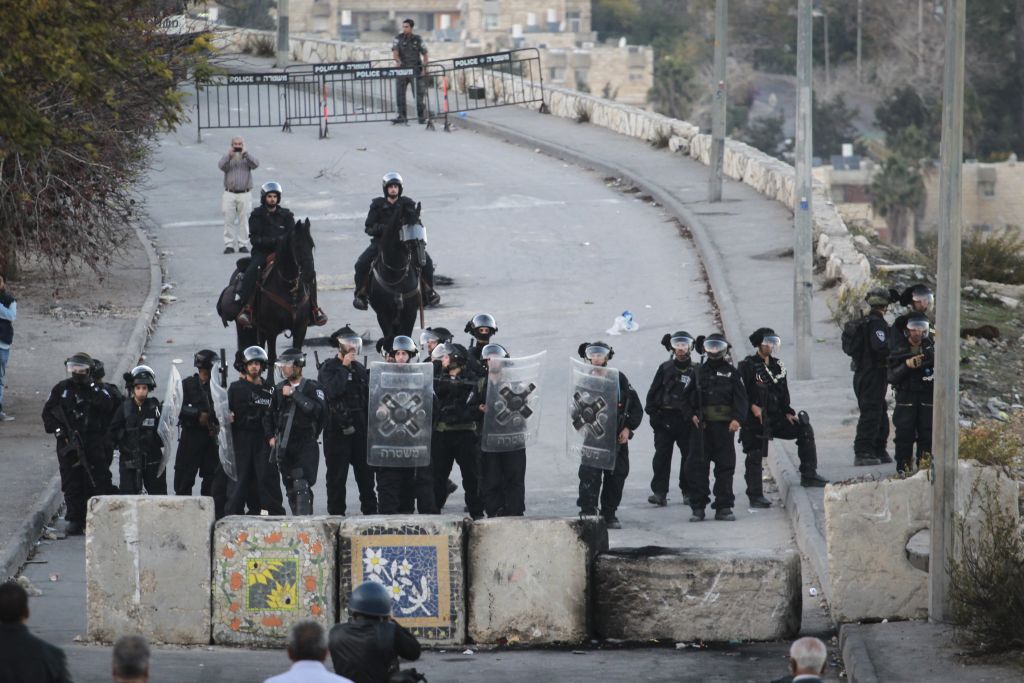
The IDF has closed the roads leading to a Palestinian village outside Jerusalem in response to violent disturbances, and is calling on the local public to divulge information on agitators to a hotline in order to return normal life to the area.
On April 13, Fatah’s official Facebook page posted a photo of a large sign placed next to a concrete barricade blocking the road leading into the village of Hizmeh, northeast of Jerusalem. According to the post, a similar barricade was placed at the other entrance to the village.
“To the residents of the area: a minority among you is responsible for disturbances and the disruption of [public] order. They are the reason for this barricade, and you must not cooperate with them!” the sign read in Arabic, accompanied by an image of the IDF symbol. “Stop these actions that disrupt your daily lives. For your safety and in order to return peace and security to your area, send any information on agitators and their actions to this number: 072-2587990 or the following email: Makeitstop2015@gmail.com.”
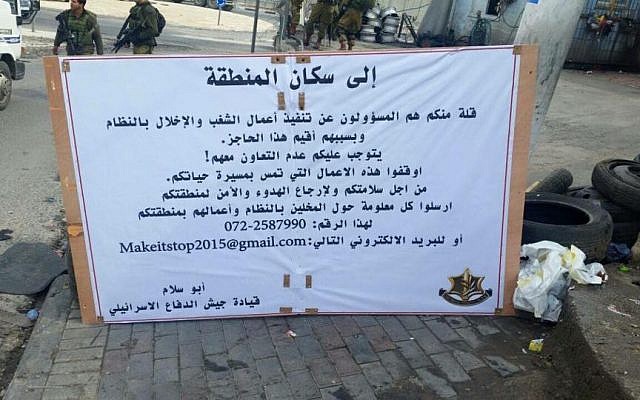
The message is signed by “Abu Salem, command of the Israeli Defense Forces.” The IDF spokesman’s office did not respond to repeated requests by The Times of Israel for clarification. Multiple attempts to call the hotline number resulted in a generic English voice mail announcement requesting callers to leave a message.
According to B’Tselem, an Israeli watchdog dealing with Palestinians in the West Bank, the concrete barricades at Hizmeh were removed by the army on Monday night, but replaced on Tuesday morning with traffic spikes, leaving a dirt road near the village of Anata as the sole access route for vehicles into the village.
In a statement published on Tuesday, B’Tselem said it wasn’t the first time the road to Hizmeh was closed by the IDF following stone-throwing. It was, however, the first time village residents were being explicitly informed of a punishment for actions they did not collectively commit.
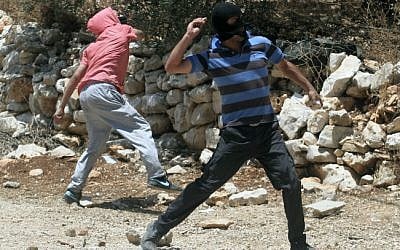
“Restricting the freedom of movement of 7,000 people, the majority of whom have nothing to do with the stone-throwing, constitutes collective punishment; as such, it is prohibited under international law,” the statement read. “Such restrictions always take the heaviest toll on the most vulnerable members of society, whose mobility is limited to begin with, and on all residents’ income and daily lives. If the military has any information regarding village residents who committed offenses, it has various enforcement measures at its disposal that can be adopted without using scare tactics against an entire population.”
While such measures are rarely implemented, B’Tselem documented nine similar cases in the village of Azoun in the northwestern West Bank during 2013. In the wake of Palestinian rioting in East Jerusalem in October 2014, the police placed concrete barricades at the entrances to the East Jerusalem neighborhoods of Issawiya, Abu Tor and Jabel Mukaber.
Responding to an appeal by the Association for Civil Rights in Israel asking that Jerusalem police immediately remove the concrete cubes, a police attorney insisted they were there for security reasons, not collective punishment.
“Israel police does not take the distress caused to East Jerusalem residents lightly, but is determined to carry out its duty in safeguarding the public order and protecting lives and property,” wrote attorney Michael Frankenburg, Jerusalem Police’s legal adviser, on November 20, 2014.
“It is not punishment or abuse we are dealing with, heaven forbid, but rather security,” he added.








The Times of Israel Community.