

Kerry says he’s ‘driving toward finish’ on Iran nuke deal
As November 24 deadline looms, US steps up demands for Tehran to prove nuclear program is peaceful, insists there will be no extension
 Add ToI as a Preferred Source on Google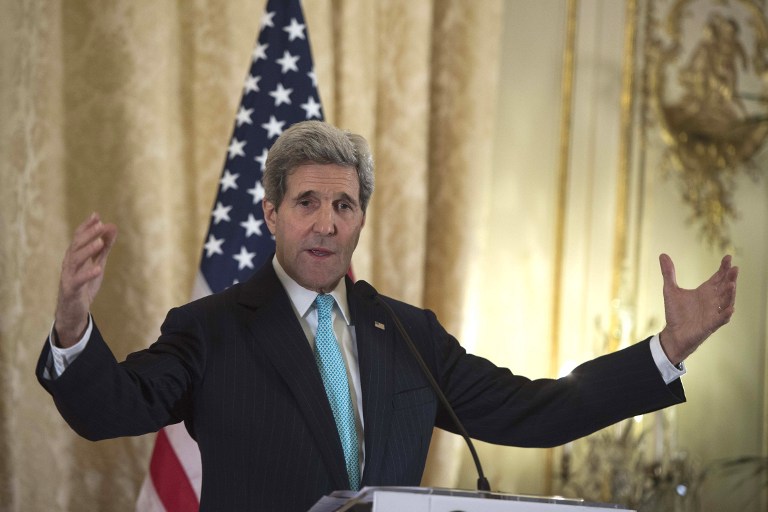
US Secretary of State John Kerry claimed Wednesday he was “driving toward the finish” to secure what would be a historic deal with Iran over its nuclear program as a November 24 deadline looms.
Speaking to reporters in Paris, Kerry said there was “no intention at this point of talking about an extension” as ministers stepped up shuttle diplomacy ahead of the deadline.
“We are not contemplating an extension,” stressed Kerry, ahead of what are likely to be crunch talks with Iranian Foreign Minister Mohammad Javad Zarif and outgoing EU foreign policy chief Catherine Ashton in Muscat on November 9-10.
“We are driving towards the finish with the view we are to trying to get it done,” he said.
The meeting in Oman comes amid recognition that serious gaps still remain between global powers grouped under the so-called P5+1 powers — Britain, China, France, Russia and the United States plus Germany — and Iran.
Kerry has previously warned that the coming weeks will finally reveal whether the Islamic Republic is truly prepared to make the tough decisions needed to curb its suspect nuclear program and win a lifting of international sanctions.
“They have a right to a peaceful program but not a track to a bomb,” Kerry said after his meeting. “We believe it is pretty easy to prove to the world that a plan is peaceful.”
Months of intense negotiations, including between Kerry and Zarif in mid-October in Vienna, have made some progress but appear deadlocked on the key issues of uranium enrichment and the pace of any sanctions relief.
Enrichment renders uranium suitable for nuclear power generation and other peaceful uses but also, at high purities, for a nuclear bomb.
France and the US both stepped up their demands Wednesday for Iran to prove that its nuclear program is peaceful — or risk scuttling the closest chance for a deal in years and losing a chance to ease crippling sanctions on Tehran’s economy.
“We have presented to them a framework that would allow them to meet their peaceful energy needs,” President Barack Obama said Wednesday. “Whether they can manage to say yes to what clearly would be better for Iran, better for the region, and better for the world, is an open question.”
In Paris, Kerry met with French Foreign Minister Laurent Fabius and placed the burden to complete a deal on Iran.
Fabius called it “very important” for the US and France to keep a united front as the negotiations enter the final stretch.
The French diplomat’s comments underscored concerns that Washington could change course on its diplomacy with Iran after January 1, when Republicans will control both houses of Congress. Many Republican leaders have criticized the Obama administration’s desire to ease sanctions on Iran while the talks are underway, or to embrace any agreement that would allow Tehran to continue generating nuclear power.
If that’s the case, the November deadline may represent the last shot the White House will get at securing a deal with Iran — a major foreign policy legacy issue for Obama. But Obama also said that internal politics in Iran could also affect the negotiations.
“They have their own politics and there’s a long tradition of mistrust between the two countries,” he said. “And there’s a sizable portion of the political elite that, you know, cut its teeth on anti-Americanism and still finds it convenient to blame America for every ill that there is.”
Kerry dismissed questions about whether the GOP’s command of Congress would derail the nuclear deal, and said the same sticking points would remain no matter which US political party was in power. “I don’t believe that changes either side,” he said. “I honestly don’t.”
Congress has very limited power to influence a potential deal. It could refuse to lift sanctions imposed on Iran, but it can’t stop the president from suspending or relieving some of the sanctions by executive order.
And, he noted: “As we have learned in the last few years, the minority has enormous power to stop things from happening.” Obama’s party, the Democrats, will be in the minority in Congress next year.
On-and-off negotiations between Iran and world powers have languished for years without resolution, and the last time the two sides came close to a deal was in 2008.
But world powers saw a new opening with the 2013 election of Iranian President Hassan Rouhani, who campaigned to end bruising Western sanctions to punish Tehran for its nuclear production.
Israel has also objected to the negotiations, which have become a sore point between Washington and Israel. Prime Minister Benjamin Netanyahu wants to see Iran stripped of its entire “military nuclear” capabilities, including all uranium enrichment capacity.




The Times of Israel Community.