

The press looks at itself, through a funhouse mirror
As a government mouthpiece makes a Kafkaesque case for free speech, some quotable quotes show that ‘independent’ papers are still printing whatever they are told to
 Add ToI as a Preferred Source on Google
Joshua Davidovich is The Times of Israel's Deputy Editor
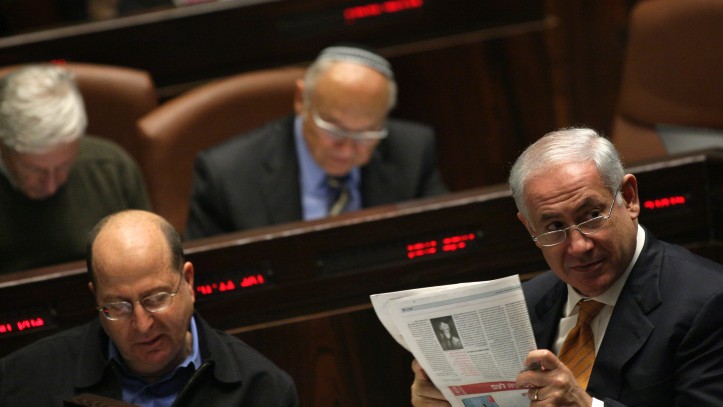
The strange Israeli obsession with the Theater of the Absurd, and Eugene Ionescu’s “Rhinoceros” in particular, can seem a bit overwrought at times. But with the press being forced to look inward in recent days as it covers a government fight over how much the government can, should and does control the media, the analogy to the play about a town turning into a rhinoceros but not being able to see itself seems an apt analogy.
On the one hand, when looking at blisteringly critical publications like Haaretz and – to a lesser extent – Yedioth Ahronoth, both of which focus their lead stories on a growing coalition fissure over the issue, it’s hard to argue with Prime Minister Benjamin Netanyahu’s contention that Israel has a thriving and boisterous free press that is under no pressure or threat of being silenced by broadcasting reforms.
On the other hand, when one looks at the fact that Israel Hayom, the country’s most popular paper, is little more than a mouthpiece for the prime minister, made free and widely distributed (and thus popular) through the largess of Netanyahu backer Sheldon Adelson, it’s hard not to think that there’s some truth behind the concerns about Netanyahu consolidating influence over the press.
What’s hardest not to think of, though, is Franz Kafka when looking at the cover of Israel Hayom on Tuesday, which sheds any pretension of being free and takes on an activist role in the service of the government to sing the praises of the free press. Eschewing pictures, the main headline is the words “No more, stop the hypocrisy.” What follows, though, on A1 is not a mea culpa but Israel Hayom making like a rapist ex-president and pulling the victim card, telegraphed via a teletype-esque list of all the ways it and the government are right and Netanyahu’s critics in the other papers as well as Education Minister Naftali Bennett are wrong.
“In Israel there is no fascism and no silencing of criticism, despite the failed attempt to shut up Israel Hayom,” reads one snippet from the front page’s bout of verbal diarrhea.
The paper devotes its first seven pages to covering the donnybrook between Netanyahu and Bennett and makes it pretty clear which side it’s on.
A good chunk of that real estate is also taken up by commentaries that give the paper a bit more leeway to lay its position out. In one such column, taking up a full page, columnist Dror Eydar lets his fury fly against Channel 2 commentator Amnon Abramovich for daring to question the prime minister (under a picture of Abramovich a caption reads “lies and more lies”). But Eydar also seems to contradict himself, saying the new station won’t be right-leaning, but it will be right-leaning because nothing else is.
“The case of the broadcasting corp. is a litmus test for the long years of corruption in the media. Despite the whining propaganda of leftist journalists, there is no diktat here for a single-viewpoint broadcasts. Just the opposite,” he writes. “It’s possible to say that the public broadcaster will air the whole spectrum of public opinions, and not just the well-known faces of the worldview of the Yedioth and Haaretz house of study. Experience teaches that we can’t rely on the kindheartedness of the managers and editors to bring in viewpoints not their own. That’s what happened with Channels 2 and 10 and with Army Radio and Israel Radio over decades. The representatives of the majority were left out of the fold.”
That refusal to allow in other voices is probably why Israel Hayom (a possible model for what the new corporation under Netanyahu will look like) has so many leftists and Netanyahu critics and why a paper as staunchly left-wing as Haaretz would never allow columns from people like former Likud foreign minister Moshe Arens, former settler leader Israel Harel, and other members of the right-wing and settler community. Oh wait, it lets all those people into its pages? Well, it would never give Netanyahu a fair shake in its coverage. What? Its main front page headline is a paraphrase of Likud’s attack on Bennett that he’s “digging tunnels beneath the coalition?”
The paper’s coverage of the affair is mostly a collection of sordid quotes from politicians firing in all directions, especially those on the right trying to prove how left-wing their counterparts are.
“Bennett and [Justice Minister Ayelet] Shaked are loved by the left and [Yedioth Ahronoth publisher] Nuni Mozes. Bennett is keeping alive the heritage of [Palestinian poet Mahmoud] Darwish in the schools,” the paper quotes “the Likud party” saying. (If there is one valid complaint it’s that the papers are too willing to go without sourcing if a government official tells them to.)
“Netanyahu supported the Gaza disengagement, released the most terrorists, gave away Hebron and surrendered to Hamas,” reads a “Jewish Home” quote.
With quotes as good as the banter between Bennett and Netanyahu, it’s no surprise the coverage is much the same in Yedioth, though it leads off not with Netanyahu or Bennett, but senior coalition partner Moshe Kahlon telling the two to chillax or GTF to government rehab.
“It’s 37 degrees (Celsius, 98.6 Farenheit) in Jerusalem, and it’s seemingly influencing the ministers. It might be good to take a break,” he’s quoted saying, like a grandmother refusing to see that her two grandchildren hate each others’ guts.
Indeed, the paper reports that the bad blood between Netanyahu and Bennett is not new.
“The argument over the character of the new broadcasting corp. developed into a coalition crisis yesterday, against the background of worsening tensions between Netanyahu and Bennett over the state comptroller reports into the Gaza war and the tunnel threat,” the paper writes.
Venting the frustrations of many a joe-shmoe Israeli who just wants to see his government run smoothly without all this bickering, Yoaz Hendel in Yedioth’s op-ed page writes that nobody knows what the hell they are doing besides building their egos. He starts off by attacking Likud for its lack of foreign policy. But then there’s also Bennett and the “red flag” he represents.
“Bennett is a red flag because he’s the one who leads the government…. He only has eight seats, but he determines everything. This isn’t the Public Broadcasting Corp. but right-wing inc.,” he writes. “Kahlon and his Hannibal directives – he doesn’t know what he thinks about matters of state; [defense Minister Avigdor] Liberman is collecting exes week after week as defense minister (and takes the job very seriously); the ultra-Orthodox are busy with ritual baths; and Netanyahu? He has for a year mimicked Bennett. He attacks or defends the army, just to keep his ties with Bennett.
Illustrating the ridiculousness of the whole thing, Haaretz’s editorial cartoon features Netanyahu frantically saying “the nationalists are going in droves to the public broadcaster in the buses of the leftists,” a throwback to his warning about “Arabs voting in droves” on election day.
The paper’s lead editorial, though, gets to the crux of the issue, which goes well beyond egos to what Netanyahu thinks he can do with a potentially game-changing station.
“Netanyahu has developed a deep sense of paranoia in relation to the media and is constantly trying to control it in ways more reminiscent of totalitarian regimes,” the paper writes. “It’s obvious that Netanyahu and his acolytes are refusing to acknowledge the fact that public broadcasting in a democracy is not the government’s mouthpiece or an additional platform for political sparring. Israel now has a historic opportunity to create a high-quality broadcasting service. If politicians persist with their campaigns of unwarranted pressure, this opportunity will be lost.”









The Times of Israel Community.