

UN Syria envoy urges bottom-up peace effort
Staffan de Mistura tells UN Security Council ending the violence begins with ‘incremental freezes’
 Add ToI as a Preferred Source on Google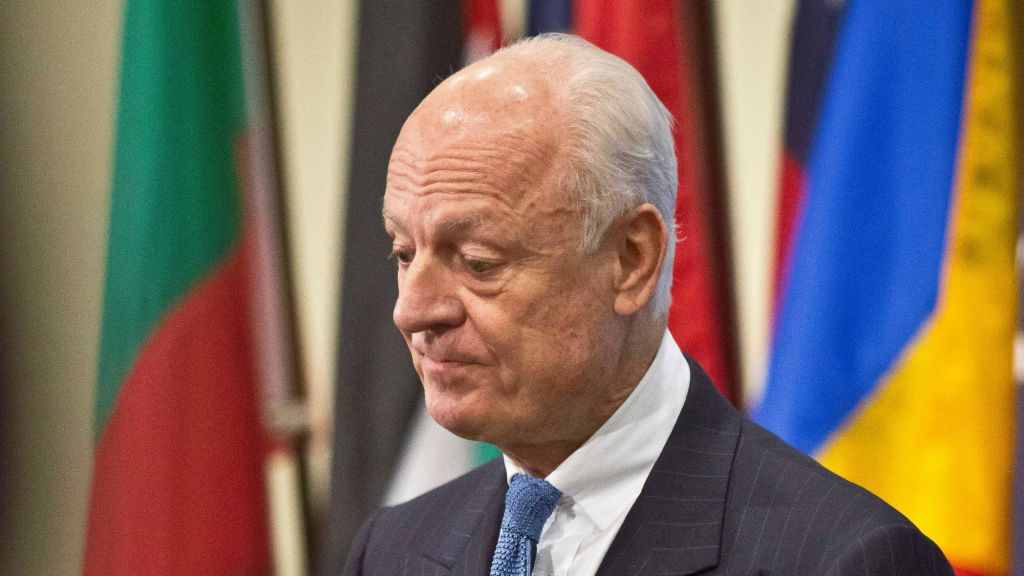
UNITED NATIONS (AP) — The outspoken new UN envoy on Syria said Thursday he is pursuing an “action plan” that involves freezing conflict in certain areas, possibly starting with Aleppo, to allow for humanitarian aid and local steps of a political process toward wider peace.
Staffan de Mistura, in his first briefing to the UN Security Council, said the “horrific trigger” of the Islamic State group’s recent onslaught in the north and east offers an opportunity for another approach to a solution to the deeply entrenched conflict.
De Mistura is the third envoy to try to bring the more than three-year civil war to an end. Activists say more than 200,000 people have been killed since protests against the government of President Bashar Assad spiraled into violence in 2011.
De Mistura briefed the council after visiting key countries with influence on any possible solution to the conflict. De Mistura in recent days has traveled to Iran and Russia to meet with two top allies of Syrian President Bashar Assad. He soon will make another round of visits, including to Damascus.
Observers watching for a sweeping opening move from the new envoy didn’t get one.
“I don’t have at this stage a peace plan, which would be presumptuous,” de Mistura, who was named to the post in July, told reporters. “I do have an action plan.” He argued that previous peace efforts involving major conferences had failed, so he wanted to try a bottom-up approach.
He also stressed that the Geneva communique, agreed on by major powers at a conference in June 2012 calling for the establishment of a transitional governing body for Syria, was still valid — even though Assad was elected this year to another seven-year term.
De Mistura said some council members expressed concern that what he called “incremental freezes” to the conflict in certain areas of Syria would benefit one side or another in the fighting. He did not give details on how the “freezes” would work.
“Daesh is to be stopped,” de Mistura said, using an Arabic name for the Islamic State group. “How? Well, by … seeing whether we can implement some incremental freeze zones, in order to make sure that in those areas, we will be able to build first a political process at the local level and then eventually the national level. Give hope to the local population and avoid a fight which is going on at the moment and, actually, which is giving advantage to Daesh.”
He sees Aleppo as a good first candidate because the historic city has been threatened both by the Syrian government and by Islamic State group fighters.
The city is a symbol “which we hope can become the opportunity of showing that somewhere in Syria, just because everybody feels there are other priorities, and rightly so, in the terrorism threat, there can be some areas that show that some improvement can take place,” de Mistura said.
The envoy is expected to meet again with Assad on his next round of visits.
Already, Assad has expressed his concerns about the Islamic State group to de Mistura. “That would be an opportunity for him to prove that if he is, as I want to believe, against Daesh and al-Nusra [an al-Qaeda-affiliated Islamist group], the next step to do is to actually promote a political process,” the envoy said.
De Mistura’s briefing followed one by the UN’s deputy humanitarian chief, Kyung-wha Kang, who said the suffering in Syria is worsening and that the Islamic State group is “destroying cities and towns with impunity.”
More than three million people have fled Syria during the conflict, and millions more still in the country require urgent aid.
Copyright 2014 The Associated Press.




The Times of Israel Community.