

Arab public opinion of Israel worse than in past Gaza crises — Foreign Ministry
Informal survey of Arabic-language social media shows ‘considerable hostility,’ as social media users justify Hamas attacks on Israelis
 Add ToI as a Preferred Source on Google
Raphael Ahren is a former diplomatic correspondent at The Times of Israel.
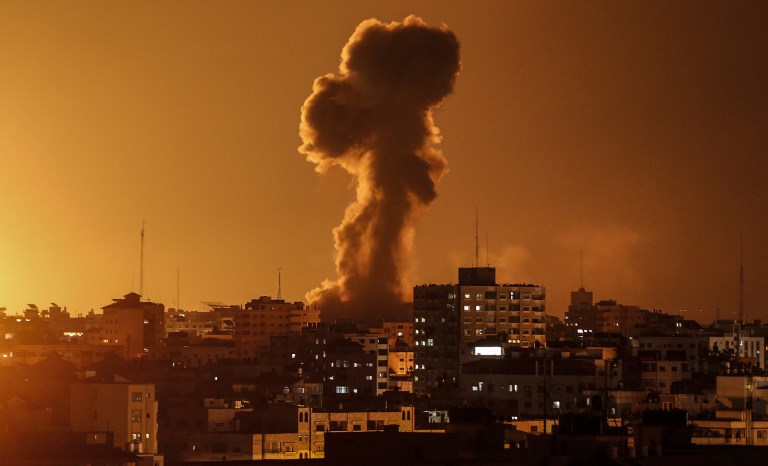
Public opinion in the Arab world has been more hostile toward Israel during this week’s military escalation than in similar previous conflagrations, according to an informal survey conducted Tuesday by the Foreign Ministry.
“A general survey of tweets and posts in Arabic on social networks shows considerable hostility toward Israel, even more than in previous rounds” of violence between Hamas in Gaza in Israel, read the survey, a copy of which was obtained by The Times of Israel.
“A large portion of online users justify the massive rocket fire at Israel with the fact that Israel first carried out an operation inside Gaza the day before the escalation,” the report said, referring to a botched IDF operation during which one Israeli officer and seven Palestinians were killed and which sparked this week’s escalation.
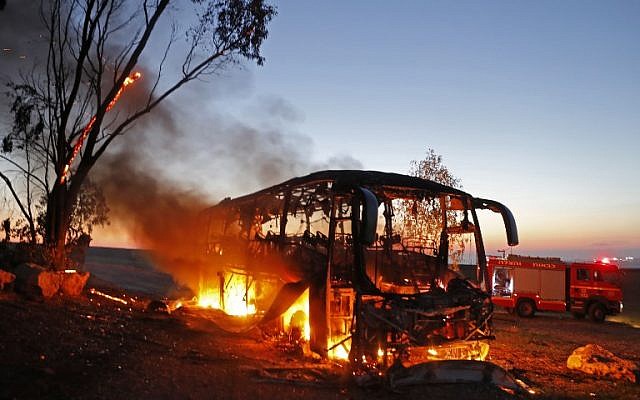
Numerous social media users justified the shooting of an anti-tank missile on a bus Monday at the Gaza border, during which one Israeli soldier was severely wounded, by arguing that it was not an attack on civilians but that the bus was a military target since it carried many soldiers.
Since Sunday, a total of 14 Palestinian were killed by Israeli forces — seven during the failed IDF operation in Khan Younis, three kilometers into Gaza, and seven during subsequent air strikes in retaliation of rockets fired at Israeli civilian centers in the South.
One Palestinian man was killed by a rocket from Hamas in Ashkelon.
More than 100 Israelis were wounded during the unprecedented barrage of rockets fired at Israel.
Many Arabic-speaking users of social media expressed the hope that yet more Israelis would be hurt by the rockets from Gaza, according to the Foreign Ministry report.
“At the same time, there is no great sympathy for Hamas, especially in those countries where it is perceived as a terrorist organization,” it noted.
Many Arab journalists covered the events in and around Gaza, with many of them — especially in Egypt, which was instrumental in brokering a reported ceasefire Tuesday — authoring “very hostile reports about Israel, which they see as an enemy.” The Arab media also criticized their own governments, claiming they are “paralyzed” by the events in Gaza and failed to show enough interest in the matter, according to the survey.
There were also, however expressions of support for Israel and condemnations of Hamas as a terrorist organization doing Iran’s bidding in the Arabic-language social media, but “not many,” the Foreign Ministry found.
The ministry’s various Arabic-language social media accounts have had a steep increase in traffic since the recent uptick in violence on Monday morning, and many made public comments — “of course, a larger majority of them were negative,” the survey notes.
However, it adds, many people sent private messages of support for Israel to the ministry in private channels that cannot be seen by the public.
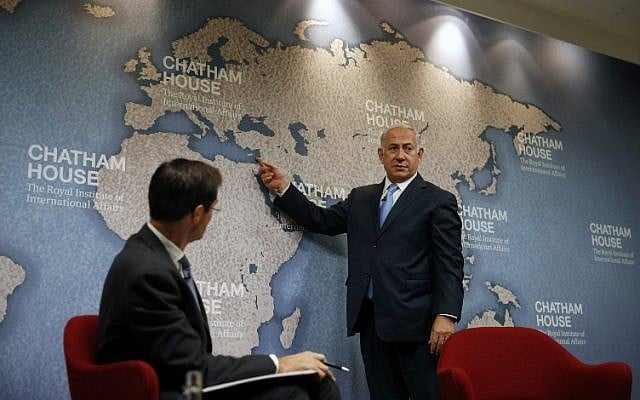
Prime Minister Benjamin Netanyahu has in recent months hailed the Arab world’s increasing openness to Israel, arguing that nearly all governments in the region have understood that Iran, and not Israel, is their true enemy.
He has also repeatedly quoted a Foreign Ministry survey, conducted last year, which purports to show remarkably warm attitudes to Israel in several enemy Arab states.
For instance, staggering 48 percent of respondents in Iraq, 42% in the United Arab Emirates, and 30% in Saudi Arabia and Iran are interested in their governments establishing some kind of “relations” with the Jewish state.
However, several experts criticized the poll’s methodology, calling it “deeply flawed.”
Since Monday morning, more than 460 rockets and mortar shells have been fired at southern Israel, according to the IDF.
The Iron Dome missile defense system intercepted over 100 of them. Most of the rest landed in open fields, but dozens landed inside Israeli cities and towns, killing one person, injuring dozens more, and causing significant property damage.
In response to the rocket and mortar attacks, the Israeli military says it targeted approximately 160 sites in the Gaza Strip connected to the Hamas and Palestinian Islamic Jihad terror groups, including four facilities that the army designated as “key strategic assets.”








The Times of Israel Community.