

Ofer Winter talks like he’s the opposition, but won’t walk away from Netanyahu
Railing against government failures, People of Israel leader promises political overhaul yet rules out any alternative to the current prime minister; the dissonance is not lost on right-wing voters he’s trying to win over

 Add ToI as a Preferred Source on Google
Ariela Karmel is a political correspondent at The Times of Israel. She previously reported for Calcalist and Haaretz. She holds an MA in Middle Eastern and African History from Tel Aviv University and a BA in Political Science from the University of British Columbia.
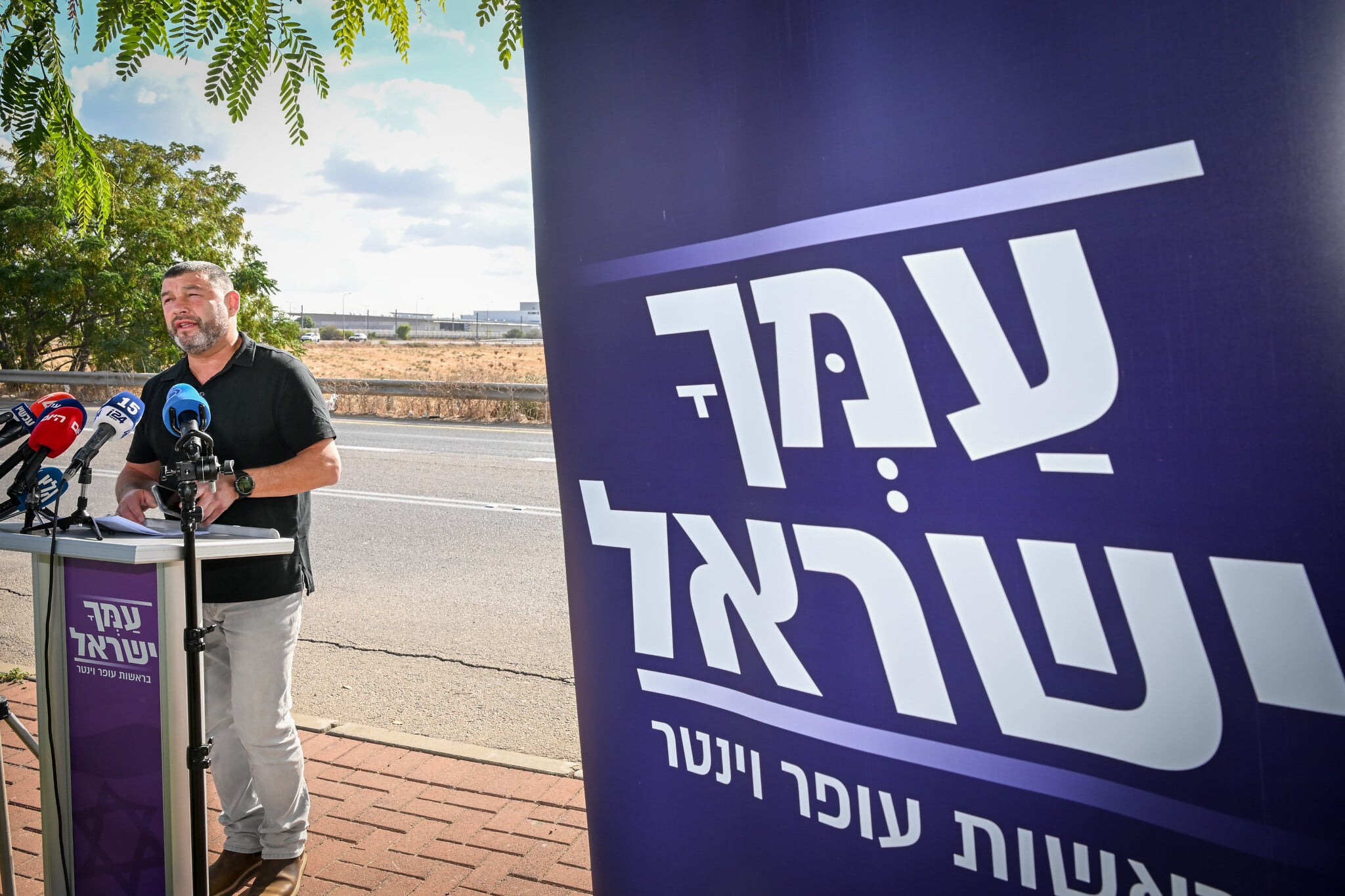
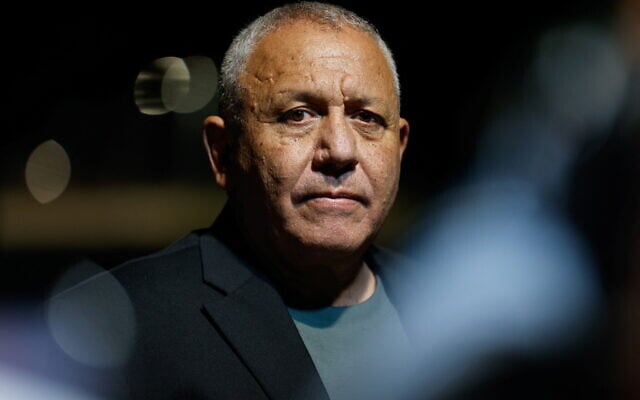
To hear Ofer Winter railing against the failures of Prime Minister Benjamin Netanyahu’s government at a campaign event in Tel Aviv on Monday night, one might reasonably have mistaken him for the leader of an opposition party.
Before a packed, enthusiastic audience of mostly English-speaking immigrants, the former IDF general and leader of the fledgling right-wing People of Israel party promised a break with the political establishment that presided over the failures of October 7, accusing the government of refusing to take responsibility and failing to learn from its mistakes.
“Over the years, I saw how decisions were made. I saw the system, for better and for worse. I believed our enemies when they said they wanted to slaughter us,” Winter said, accusing those in power of being beholden to a conception — in Hebrew, the infamous conceptzia — whereby security is attainable through “containment and appeasement.”
“Then October 7 changed everything, ” he said. “It forced Israel to face reality.”
Israel needs change, he argued, and only his party can bring it. But unlike many other candidates running in the October 27 election, Winter made clear that the change he seeks is less about who is running the country than how it is being run.
“We are a right-wing party committed to Zionism, Israel’s security and the defense of our homeland,” he intoned. “But make no mistake: being right-wing doesn’t mean being stuck with the failed policies of the past.”
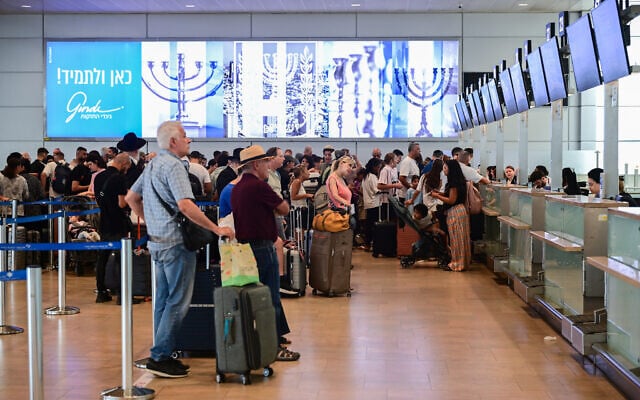
Launched less than two months ago, People of Israel presents itself as a clean break with the political leadership that failed the country on October 7, and its slate deliberately excludes anyone who held political office at the time of the Hamas-led attack. Winter has repeatedly demanded accountability from the country’s leaders, most recently accusing the government of irresponsibility, corruption and incompetence over the flydubai security failure.
His entry into the race initially alarmed Netanyahu and his allies, who feared he would siphon off their votes and weaken the bloc. But those concerns have largely subsided as Winter has made clear that, for all his attacks on the government, he has no intention of replacing Netanyahu. Instead, he has pledged to recommend only the Likud leader for another term as premier and ruled out joining any government led by Netanyahu’s rivals.
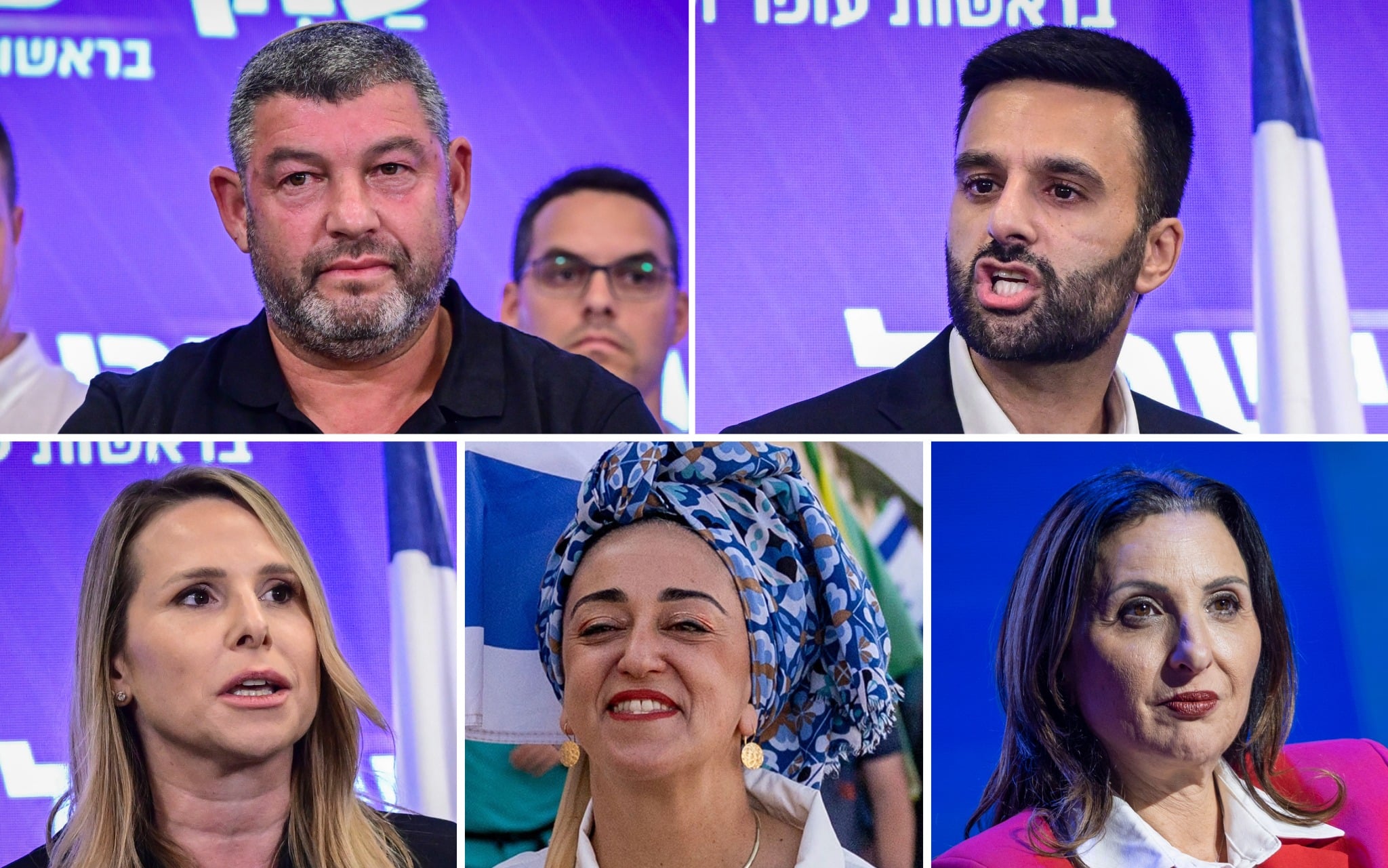
Whether the party will even have the opportunity to join anybody remains uncertain, with polls showing the party hovering around the 3.25% electoral threshold to enter the Knesset. But in a tight election, even a handful of seats could significantly alter the coalition arithmetic and give Winter leverage over the formation of the next government.
For right-wing voters disillusioned with the government after October 7 but unwilling to embrace an opposition bloc they see as leaning toward the left, People of Israel offers a way to vote for change without abandoning the right. Yet despite its promises of a political overhaul, the party has offered little to dispel the impression that it would ultimately serve as another satellite party helping Netanyahu and his allies remain in power.
That contradiction was obvious enough that it was raised multiple times throughout the evening, including by a sympathetic supporter who said she stood behind “every word” the party was saying, but questioned the “dichotomy” between its demand for accountability for October 7 and its determination to align itself with those responsible for it.
It fell largely to Yoseph Haddad, the Arab-Israeli activist and prominent pro-Israel advocate ranked second on the party’s slate, to explain. Despite Winter topping the ticket, much of the audience’s enthusiasm appeared reserved for Haddad, who has built an enormous following online and abroad. (An indictment last year for reckless and negligent use of a firearm following an altercation with a motorcyclist in Jaffa has done little to dent his popularity.)
Winter, whose English is limited, spoke relatively little, struggled at times with questions and left early for another campaign event, leaving Haddad and No. 5 candidate Fleur Hassan-Nahoum, a former Jerusalem deputy mayor, to field most of the questions from the approximately 150 attendees.
Haddad’s response began with the assertion that People of Israel was “not running with Likud” — although he subsequently boasted about how aggressively Likud had tried to recruit him — before shifting to a broader argument that there was effectively no meaningful distinction between the responsibility of the government and that of its opponents.
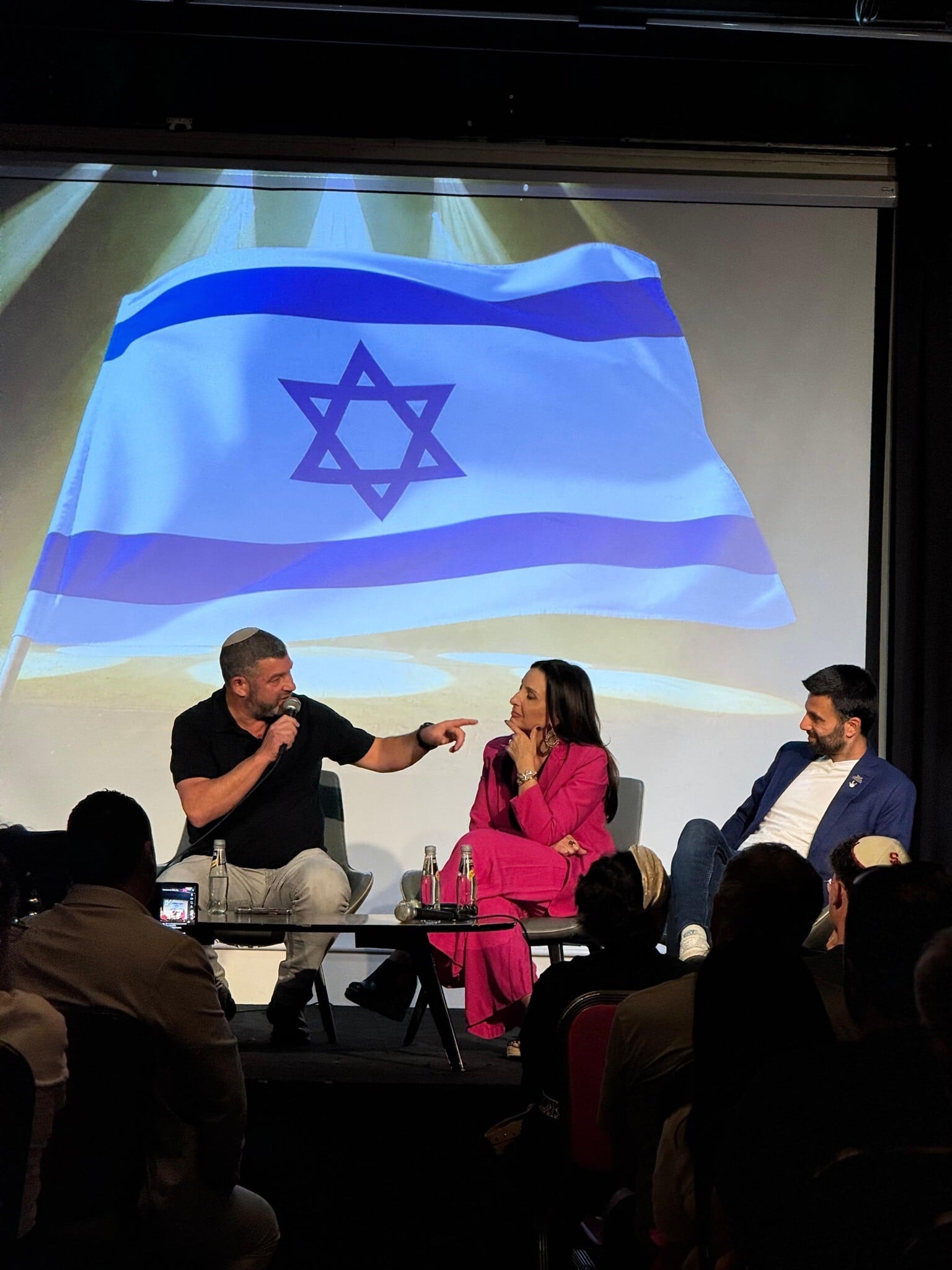
“All the 120 members of Knesset of the 7th of October should go home,” Haddad said. “And it doesn’t matter whether it’s Bibi, [Bezalel] Smotrich, [National Security Minister Itamar] Ben Gvir, [Gadi] Eisenkot, [Naftali] Bennett, or Yair Golan, or the rest of the leaders there. Every one of them was part of the conceptzia.”
It was an extraordinary flattening of political responsibility, and one that seems to have been adopted as the party line in order to reconcile its inherent contradictions.
On Tuesday, People of Israel announced plans to propose a special commission to investigate the failures surrounding October 7, calling the absence of an inquiry “a shared disgrace for the coalition and the opposition” and claiming both sides have an interest in preventing one because “they were part of the failure.”
The proposal, under which members of the new Knesset would vote on representatives to the commission, bears a striking resemblance to the controversial politically appointed inquiry that the current coalition sought to establish earlier this year.
Netanyahu has refused to approve a state commission of inquiry, Israel’s highest investigative authority, despite repeated demands from opposition parties, former hostages and bereaved families, as well as majority public support according to opinion polls.
Critics accuse the prime minister, who has never accepted explicit responsibility for the attacks and has instead deflected responsibility onto security forces, the judiciary, and political opponents, of seeking to evade accountability for the attacks.
A coalition that doesn’t add up
When the discussion turned to the individual opposition parties, Haddad had a different reason for rejecting virtually every alternative: Ra’am and the Joint List were “terror supporters”; the Democrats were too far left (he specifically cited candidate Gaby Lasky’s past legal representation of Palestinian activist Ahed Tamimi); and Eisenkot had been “racist” toward him (a reference to a July interview in which Eisenkot invoked Likud’s willingness to embrace Haddad while explaining why he would not rule out sitting with Ra’am chairman Mansour Abbas).
For a party whose central pitch is political change, that leaves remarkably few options. Not the Arab parties, not the Democrats, not an Eisenkot-led government, and not an opposition government that relies on Ra’am or the Joint List. Above all, not a prime minister other than Netanyahu.
“We are a right-wing party,” the politicians repeatedly stressed.
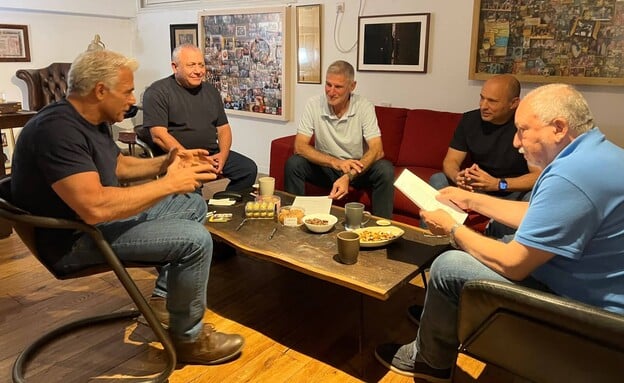
The party faces another contradiction over Haredi conscription. Winter has vowed to condition People of Israel’s entry into the next government on the passage of a universal service law that ends blanket military draft exemptions for the ultra-Orthodox. But he has offered no clear explanation, including at Monday’s event, of how he intends to secure such legislation under Netanyahu, whose governments have long depended on Haredi parties fiercely opposed to mass conscription.
Hassan-Nahoum instead turned the criticism toward the opposition, faulting Bennett and Lapid for failing to resolve the issue during their roughly year-long government, when they had the “luxury,” she argued, of governing without Haredi parties.
Haddad offered one theoretical escape hatch: bring right-wing opposition parties into Netanyahu’s coalition so that the prime minister no longer needs the Haredim. He called on Avigdor Liberman and Bennett to join what he described as a “wider right-wing government.”
The possibility of such a coalition has been raised by several figures on the right, including Ben Gvir, who has suggested — without evidence — that Netanyahu is seeking an alliance with Eisenkot and Liberman to exclude him from power. Netanyahu himself has spoken vaguely of forming a “broad national government.”
But while Likud, Yashar, B’Yachad, Yisrael Beytenu and People of Israel inhabit similar ideological spheres, getting them to sit together would require either Netanyahu taking a back seat, or the other parties reneging on defining commitments they are making to voters now. Neither seems especially likely.
New faces, familiar policies
Beyond coalition arithmetic, People of Israel faces another question: What does it offer right-wing voters that Ben Gvir and Religious Zionism’s Smotrich do not?
The established hard-right parties are already polling comfortably above the electoral threshold, while People of Israel is hovering around the cutoff.
On policy, there is very little daylight. Like Smotrich and Ben Gvir, Winter promises to destroy Hamas (though he has offered little detail on how), supports “facilitating” the removal of Palestinians from Gaza and disarming the Palestinian Authority, denies the existence of a Palestinian people, and rejects any cooperation with Arab political parties.

The party’s clearest distinctions are its demand for universal service, and the distance its candidates have from the leadership’s failures around the October 7 massacre.
But they cannot claim the same lack of involvement in the government’s missteps since that dark day.
Both Hassan-Nahoum, who served as a Foreign Ministry special envoy, and Haddad, a prominent hasbara influencer, spent much of the post-October 7 period defending Israel and its government’s policies internationally, an effort that largely failed judging by the country’s current diplomatic isolation.
Now they are running with a party whose central argument is that the establishment they were defending was actually the author of policies that were a catastrophic train wreck all along.
One of the party’s more unique — if disturbing — proposals came from Haddad, who wants to revive the Public Diplomacy Ministry, with himself at its head. He proposed weekly government briefings advocating for Israel, held in Arabic, English and, notably, Hebrew.
“In Israel, people also need to listen to hasbara,” he said, recalling young Israelis who told him they had learned more about their country and the Jewish people from his videos than at school.
The anecdote was revealing. Faced with what Haddad described as a failure of education, and amid longstanding criticism of Israel’s under-resourced diplomatic corps, People of Israel’s proposed solution is not better education or a stronger professional diplomatic corps, but better government propaganda and more of it directed not only at foreign audiences but at Israelis themselves.
The party says it wants change. The party says it wants to break from the failed policies of the last four years. But it has yet to prove that it’s willing to do more than put a new gloss on the same old government.







The Times of Israel Community.