

Poll: 31% of public says government should ignore court on Shin Bet head’s ouster
Small minority of voters for pro-Netanyahu parties find it necessary to obey potential High Court order against dismissal of Ronen Bar, survey shows
 Add ToI as a Preferred Source on Google
Thirty-one percent of Israelis, including 36% of Jews, believe the government should disregard the High Court of Justice if it reverses the dismissal of Shin Bet head Ronen Bar, according to a poll published by the Israel Democracy Institute on Tuesday, amid chaos at a court hearing on the spy chief’s ouster.
Among all respondents, 56.5% said the government should obey a High Court ruling against Bar’s ouster, including 71% of Arabs and 54% of Jews. Just 8% of Arab respondents said the government should not obey the court.
The government had voted last month for Bar to vacate his position by April 10, but the High Court issued a temporary injunction against the move. The injunction came after Attorney General Gali Baharav-Miara, whom the government also seeks to oust, said Prime Minister Benjamin Netanyahu had a conflict of interests due to the ongoing Shin Bet probe of his top aides’ alleged criminal ties to Qatar, which backs Hamas.
Netanyahu has characterized the Shin Bet probe as a “deep state” bid to oust a right-wing premier and has argued that the High Court cannot intervene in Bar’s ouster since it is a security issue, in which the court almost always declines to involve itself. Members of Netanyahu’s cabinet have refused to confirm that they would obey a ruling against the government.
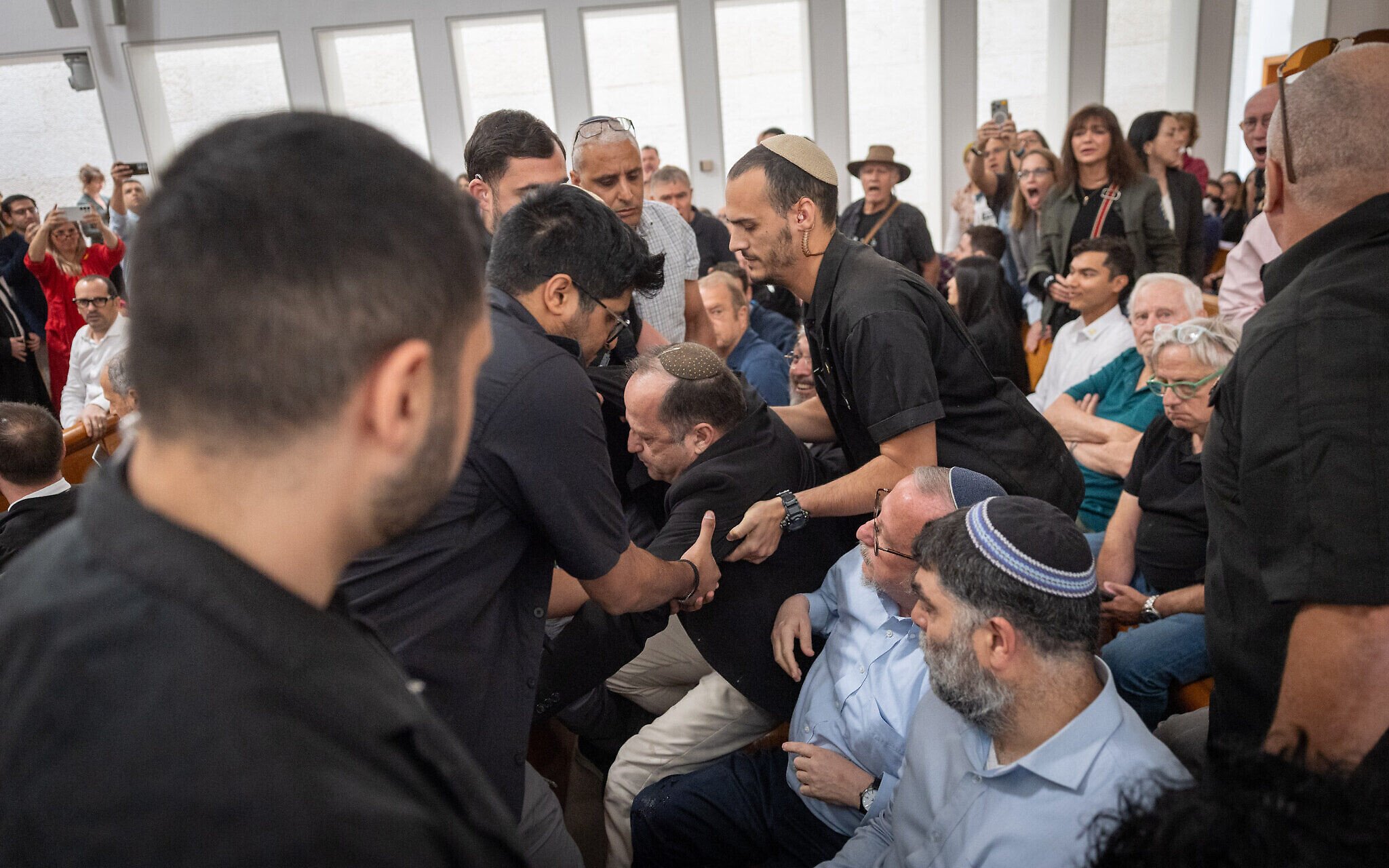
On Tuesday, hecklers, including a lawmaker from Netanyahu’s party and a bereaved father, repeatedly interrupted the High Court hearing on petitions against Bar’s ouster. Opposition leaders accused Netanyahu’s supporters of seeking to intimidate the court.
In the early poll results it published on Tuesday, the IDI said that among Jews, 96.5% of left-wing respondents, 32% of right-wing respondents and 73% of centrists said the government must obey the court if it rules against Bar’s ouster.
The IDI did not provide a similar breakdown of Arab respondents and did not specify whether the breakdown was based on each respondent’s self-identification or their vote in the last Knesset election in November 2022.
Based on respondents’ votes in the previous election, the IDI said that “no right-wing party has a majority in favor of obeying the High Court of Justice.”
A breakdown of respondents sorted by the party they last voted for showed that 30% of Likud voters thought the government should obey the High Court.
Among the Likud’s religious coalition partners, the proportion of respondents who thought the High Court must be respected was even lower: 16% of respondents who voted for Ashkenazi ultra-Orthodox slate United Torah Judaism; 8.5% of those who voted for the Sephardic ultra-Orthodox Shas; and 15.5% of those who voted for the joint far-right slate unifying the Religious Zionism and Otzma Yehudit parties.

Among respondents who last voted for Zionist opposition parties, an overwhelming majority said the government must obey the High Court. They included 100% of respondents who voted Labor, which has since merged with the further-left Meretz to form The Democrats; 90% of those who voted for the centrist Yesh Atid, led by Opposition Leader Yair Lapid; 81% of those who voted for the centrist National Unity, led by former defense minister and IDF chief Benny Gantz; and 70% of those who voted for Yisrael Beytenu, led by veteran lawmaker Avigdor Liberman.
Among respondents who voted for Arab parties, 100% of Ra’am voters and 68% of Hadash-Ta’al voters said the government must obey the High Court. Ra’am is a conservative Islamist faction that joined other anti-Netanyahu parties to form a government for 18 months in 2021-2022. Hadash-Ta’al is an alliance of the communist binational faction Hadash and secularist Arab faction Ta’al, neither of which has ever been in government.

The data forms part of IDI’s monthly “Israeli Voice” survey for March, which was conducted by internet and telephone, in Hebrew and Arabic, between March 31 and April 6. The full data has yet to be released. The nationally representative sample comprised 748 respondents, and the margin of error was 3.58%.
Netanyahu’s announcement last month that he would seek to oust Bar sparked mass demonstrations.
The premier has said he lost trust in Bar following the Hamas onslaught of October 7, 2023, when thousands of Hamas-led terrorists stormed southern Israel to kill some 1,200 people and take 251 hostages, sparking the war in Gaza. Opposition leaders, meanwhile, have accused the long-term premier of seeking to offload blame for the onslaught.
In a letter to the cabinet as it convened to oust him, Bar said the move was a bid to thwart active Shin Bet investigations. Contradicting the known sequence of events, Netanyahu claimed last month that the Shin Bet’s Qatar probe was opened to forestall Bar’s ouster.









The Times of Israel Community.