

 From the Liveblog of
Monday, September 8, 2025
From the Liveblog of
Monday, September 8, 2025
Sa’ar charges Europe pushing ceasefire with no plan to end Hamas rule, blasts Sanchez and Macron
 Add ToI as a Preferred Source on Google
Nava Freiberg is The Times of Israel's deputy diplomatic correspondent.
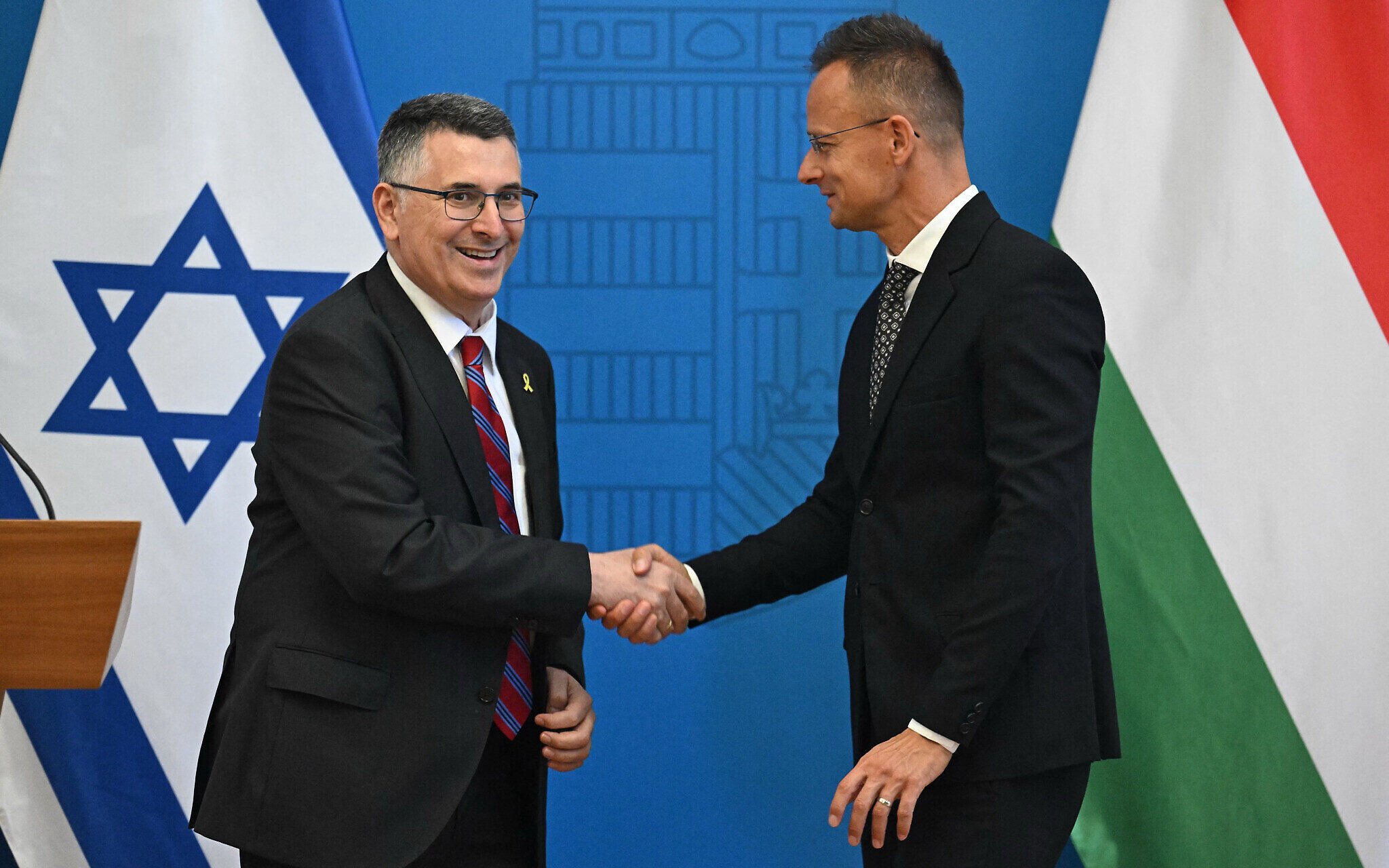
Foreign Minister Gideon Sa’ar says Israel is ready to accept a ceasefire and hostage-release deal with Hamas once its conditions for ending the war are met, while slamming European leaders for pushing a ceasefire “unconditionally” without offering any “practical suggestion” for how to disarm the terror group and end its rule in Gaza.
Speaking in Budapest alongside Hungarian Foreign Minister Peter Szijjarto, Sa’ar notes that United States President Donald Trump “said it clearly yesterday. Israel said yes to his proposal. We are ready to accept a full deal that would end the war based on the cabinet’s decision.”
The conditions, he reiterates, are “the return of our hostages” and that Hamas “must lay down its arms.”
“But there are European leaders that call on us to end the war now, practically unconditionally,” he says. “Yet, at the same time, they support our position regarding the conditions to end the war – that Hamas must disarm and not play a role in the future of Gaza. And so I ask, how do these European leaders propose to resolve this contradiction? By politely asking Hamas to leave?” he asks rhetorically.
“I have not heard one practical suggestion from them,” Sa’ar says.
For its part, Israel has ruled out the Palestinian Authority taking over postwar Gaza, and has refused for much of the war to advance a viable alternative to Hamas or the PA.
Sa’ar praises Szijjarto — whom he notes is the counterpart he has met with most frequently since becoming minister, seven times in the last ten months — for Hungary’s “independent judgment” in contrast to other European leaders. Hungary has withdrawn from the International Criminal Court in support of Israel and has resisted the harsh rhetoric and punitive measures taken against Jerusalem by countries such as France and the United Kingdom since the war in Gaza began.
Taking a jab at domestic politics in those countries, Sa’ar says Spain and France turn to harsh rhetoric on Israel in part as a distraction: “Sometimes I feel, when I hear about their internal problems, that it’s easier for them to focus on our problems instead,” he says. “If they are so enthusiastic about establishing a Palestinian state, well, Spain and France have vast territories. If they are so eager, they can do it on their own soil.”
Sa’ar also addresses Spanish Prime Minister Pedro Sanchez’s announcement of nine measures against Israel this morning, including an arms embargo, over what Sanchez described as a “genocide” in Gaza: “If they want to halt defense ties with Israel, who do you think will lose from that? We don’t need Spain to defend the land of Israel. On the contrary, they probably need Israeli capabilities far more than we need theirs.”
Sa’ar also says he believes that French President Emmanuel Macron — whose prime minister, François Bayrou, is expected to lose a confidence vote today — “has huge problems in France — but that’s his business.”








The Times of Israel Community.