

Symbolism, simple fare planned for first visit of Pope Francis
A three-day tour for the pontiff in Israel, Jordan and the West Bank prompts Jerusalem to spruce up some border crossings
 Add ToI as a Preferred Source on Google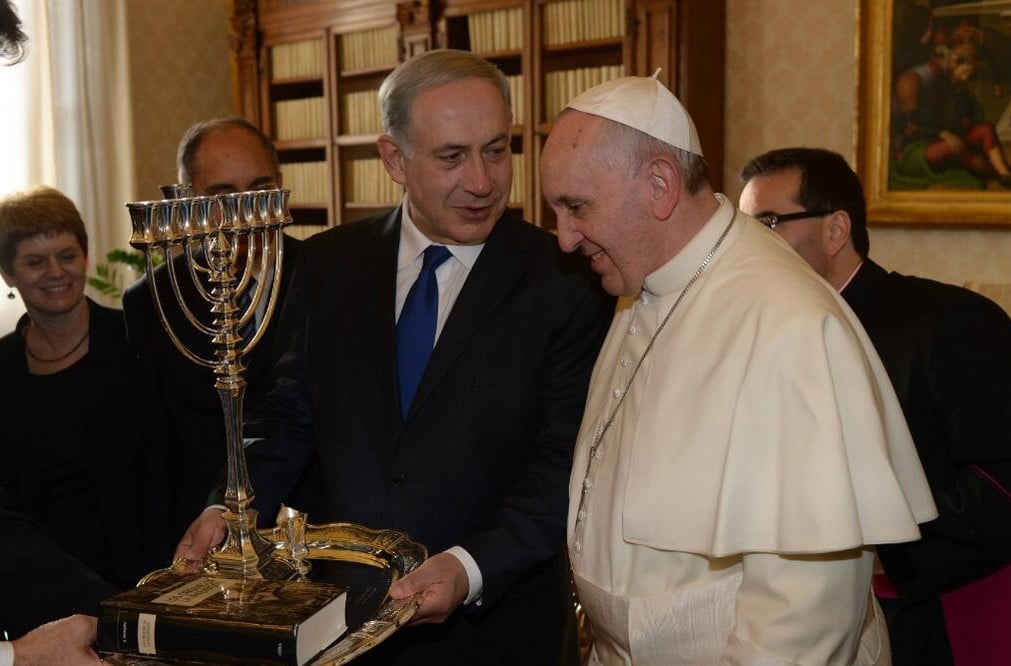
The itinerary for Pope Francis’ Middle East trip in May has been carefully planned, down to where he will spend nearly every moment during his three days here. But white smoke has yet to emerge on a decision of what the Holy Father will dine on while in Jerusalem.
Officials say the papal trip to Israel, the West Bank and Jordan will be heavy on symbolism, featuring meetings with officials, masses, visits to notable sites and even encounters with ordinary folks.
But the menu for lunch in Jerusalem, being held at the Grill & Pizzotto restaurant of the Pontifical Institute Notre Dame of Jerusalem Center, is still up in the air.
The Vatican kept the meal request general, said Father Juan María Solana, L.C., chargé of The Holy See at the Notre Dame center, recalling the Vatican’s instructions at a recent briefing about the visit. They outlined the pope’s preference for simple fare — soups, rice and water rather than wine or spirits.
“And, of course, he’s Argentinian, so look for good, good meat,” said Solana. “We would like to offer the Holy Father the best we can, because he is our leader and our superior, and we love him very much — because he is the pope, and because he is Francis.”
From May 24 to 26, Francis will visit Amman, Bethlehem and Jerusalem. He will hold several masses and will visit the baptismal site at Bethany beyond the Jordan, the Grotto of the Nativity, the Western Wall, Mount Herzl, Yad Vashem and the Mount of Olives.
During those three days, Francis will meet with Queen Rania and King Abdullah II of Jordan, Palestinian Authority President Mahmoud Abbas, President Shimon Peres, Prime Minister Benjamin Netanyahu, Jerusalem Grand Mufti Muhammad Ahmad Hussein, Sephardi Chief Rabbi Yitzhak Yosef, Ashkenazi Chief Rabbi David Lau and — the most symbolically significant part of the visit, Solana said — Ecumenical Patriarch of Constantinople Bartholomew I.
Francis’ first visit to Israel falls 50 years after Pope Paul VI and Patriarch Athenagoras I met at the Church of the Holy Sepulchre, an encounter that helped reverse a centuries-long schism between the Catholic and Orthodox denominations.

take place in May. (photo credit: Rebecca McKinsey/Times of Israel)
“This visit is very, very symbolic,” Solana said. “(The 1964 meeting) happened after almost 1,000 years of division and hatred and conflict. It’s very important that they met and shook hands. Fifty years later, this meeting is a big signal for all Christians that we need to continue to foster unity, understanding, charity, love and the need to come together.”
The everyday Israeli or visiting Christian shouldn’t expect to meet Pope Francis, Solana warned — but despite the expected hobnobbing, the pope won’t just be mixing with the upper crust; he’ll have several meetings of a more ordinary nature.
“He asked to have lunch with families in Bethlehem,” Solana said. “He wants to deal with the local people, the simple people, the poor people.”
And with the masses the pope will hold — some of which will be broadcast on large screens outdoors — organizers of his visit are expecting many tourists to materialize.
Tourism to Israel is on the rise with more than 3.5 million visitors in 2013, and 2 million of them were Christian tourists.
The pope’s visit will only draw more people, said Amir Halevi, director general of the Tourism Ministry. There was a spike in tourist visits after Pope Benedict XVI’s visit to Israel in 2009.

In a nod to the expected effect of the papal visit on tourism, the ministry has been allocated about 10 million shekels (about $2,900,000) to use for marketing and infrastructure projects pertaining to the visit. The marketing projects include a website dedicated to the visit and social media promotion in Israel and other countries. The ministry is also planning infrastructure improvements to Christian sites the pope will visit, including the Cenacle — considered the site of the Last Supper — and the baptism site on the Jordan River, as well as cosmetic enhancements to the Rachel’s crossing into the West Bank and the Allenby crossing into Jordan.
“For example, Rachel’s Crossing, between Jerusalem and Bethlehem, we will work on bringing plants there — more flowers, more pictures,” Halevi said. “We hope to soon see a garden there, so it’s not looking like an army base.”
The pope’s visit isn’t notable only for Christians in Israel, added Solana, pointing out Francis’ longtime friendship with Abraham Skorka, an Argentine rabbi. Before Jorge Bergoglio became Pope Francis, he and Skorka collaborated many times and co-wrote a book called “On Heaven and Earth.”
“I think there are big expectations for this trip, because (Francis) has always been a very good friend of the Jewish people,” Solana said. “So I think this could be an extraordinary occasion to foster friendship between the Christian world and the Jewish world, and I think the world can only benefit from that.”


The Times of Israel Community.