

Trump vows to keep US nuclear arsenal at ‘top of the pack’
President says he will not allow America to fall behind others; states preference for 2-state solution but will agree to what sides deem best
 Add ToI as a Preferred Source on Google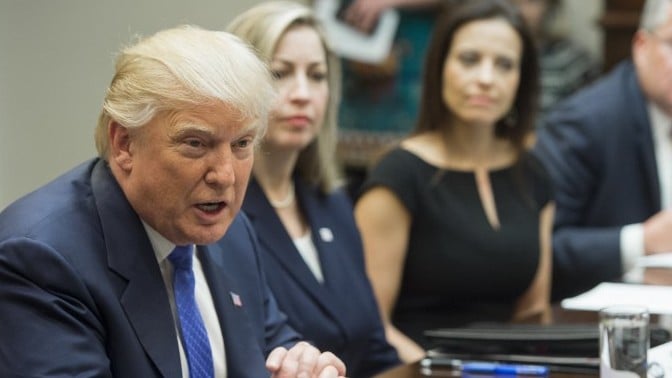
US President Donald Trump said Thursday he would not allow the US nuclear arsenal to fall behind that of other countries, vowing to keep America “at the top of the pack.”
“I am the first one that would like to see … nobody have nukes,” Trump told Reuters in an interview, “but we’re never going to fall behind any country even if it’s a friendly country, we’re never going to fall behind on nuclear power.”
Trump, asked about a December tweet in which he said the US should “greatly strengthen and expand its nuclear capability,” said that “It would be wonderful, a dream would be that no country would have nukes, but if countries are going to have nukes, we’re going to be at the top of the pack.”
Trump also spoke of recent North Korean missile tests, saying China must do more to pressure Pyongyang on its aggressive actions. He said Washington may accelerate work on a defense system for Japan and South Korea in light of North Korea’s actions.
The United States must greatly strengthen and expand its nuclear capability until such time as the world comes to its senses regarding nukes
— Donald J. Trump (@realDonaldTrump) December 22, 2016
“There’s talks of a lot more than that,” he added. “We’ll see what happens. But it’s a very dangerous situation, and China can end it very quickly in my opinion.”
On the Israeli-Palestinian conflict, the president said that while he does prefer a two-state solution, he would defer to whichever option satisfied the two sides. Trump, in the interview, “expressed a preference for a two-state solution to the Israeli-Palestinian conflict, but said he would be satisfied with whatever makes the two sides happy,” Reuters said.
During his meeting with Israeli Prime Minister Benjamin Netanyahu last week, Trump broke with longstanding US policy by saying two states were not necessarily the only acceptable solution to the conflict.
“I’m looking at two-state and one-state, and I like the one that both parties like,” he said at a joint press conference with the Israeli leader.
Last week the US warned Russia to respect its arms control treaty obligations amid reports that Moscow had deployed a new cruise missile that may breach them.
According to The New York Times, Moscow has secretly deployed an operational ground-launched cruise missile unit of a type that contravenes a 1987 US-Russia arms control treaty.
The US State Department would not directly confirm the report, but expressed concern that Russia was in any case already in breach of the Intermediate-Range Nuclear Forces Treaty.
“We do not comment on intelligence matters,” acting State Department spokesman Mark Toner said of the report.
But, citing a 2016 US treaty compliance report, Toner said Russia “remains in violation of its INF Treaty obligations.”
The treaty, signed by then US president Ronald Reagan and Soviet leader Mikhail Gorbachev, bans ballistic missiles with a range of between 500 and 5,500 kilometers.
“We have made very clear our concerns about Russia’s violation, the risks it poses to European and Asian security and our strong interest in returning Russia to compliance with the treaty,” Toner said.
“We value the INF Treaty and believe it benefits the security of the United States, our allies, our partners and the Russian Federation.”
The previous US administration under president Barack Obama had already complained that President Vladimir Putin’s Russia violated the INF Treaty by testing a banned cruise missile.
Now, according to the Times’ report, the missile has been deployed to active units, including one at a test site in Kapustin Yar in southwest Russia.
Putin has defended Russia’s test program, arguing the United States is also in breach of the INF Treaty and that new missiles are needed to maintain the balance of power.
The United States and its NATO allies are deploying an anti-missile shield in eastern and central Europe that Moscow sees as a threat to its nuclear deterrent.
Washington insists the interceptor shield is designed to protect Europe from so-called “rogue states” such as Iran.
AFP contributed to this report.






The Times of Israel Community.