

Francis era finds Republicans on religious defensive
Pope’s criticism of Trump’s immigration policies may not make voters switch candidates, but it has brought morality to the agenda
 Add ToI as a Preferred Source on Google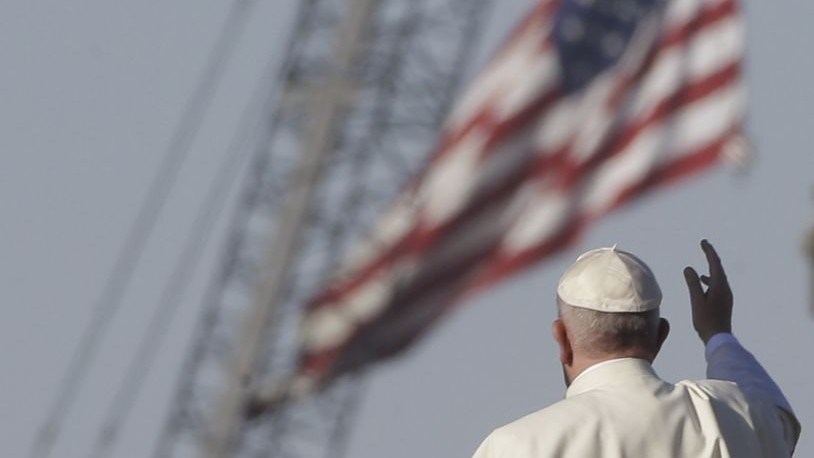
NEW YORK (AP) — When politicians were confronted in recent years about how their policies fit their faith, the issue at hand was usually abortion and the targets were mostly Democrats.
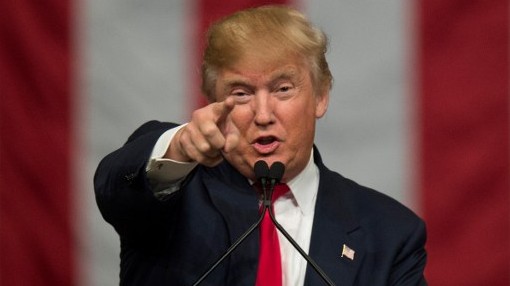
This week, Pope Francis managed to put the Republicans on the defensive by rebuking Donald Trump and doing so over a different issue: immigration.
The censure roared through the entire field of GOP presidential candidates, who were all pressed about the morality of their approach to immigrants in the country illegally, during a primary dominated by increasingly tough rhetoric that has emphasized border security.
Analysts say the pope’s remarks should serve as a wake-up call for Republicans about how public discussion of religion and policy is broadening under this popular pope who, through his gestures and speeches, has put a greater emphasis on helping the vulnerable than on divisive social issues.
“The Democrats aren’t off the hook. It’s just the Republicans are on it, too, and this might be a new experience for them,” said Cathleen Kaveny, a Boston College theologian and author of “Prophecy Without Contempt: Religious Discourse in the Public Square.”
Francis’ comments came hours after he ended a visit to Mexico, where he prayed at the border for people who died trying to reach the US While speaking to reporters on the papal plane Wednesday, he was asked about Trump’s campaign pledge to build a wall along the entire length of the border and expel millions of people in the US illegally.
“A person who thinks only about building walls, wherever they may be, and not building bridges, is not Christian. This is not in the Gospel,” he said. While Francis said he would “give the benefit of the doubt” because he had not heard Trump’s border plans independently, he added, “I say only that this man is not a Christian if he has said things like that.”
On Friday, the Rev. Federico Lombardi, a Vatican spokesman, said the pope’s remarks were “in no way a personal attack or an indication on how to vote.” And during the same news conference, in response to a different question, Francis also made some of his toughest public comments to date against abortion, comparing the procedure to a Mafia hit and repeatedly calling abortion evil. “It is a crime, an absolute evil,” Francis said.
But the pope had made clear since his first trip as pontiff outside the Vatican — praying at the Italian island of Lampedusa for migrants who died trying to cross the sea to reach Italy — that generosity toward immigrants was one of his top concerns.
“I think we’re looking at the impact of the Francis era, where there are different points of contact and different aspects of the Catholic tradition are emphasized,” said Mathew Schmalz, a religious studies professor at the College of the Holy Cross in Massachusetts. “Many prominent Catholic intellectuals have been swayed toward the Republicans in the last few decades. This is a jolt.”
Francis’ immediate predecessors, Popes John Paul II and Benedict XVI, also emphasized care for the poor and immigrants. But they prioritized greater adherence to doctrine, including on abortion, and appointed bishops who would do the same.
Recent presidential elections have seen intensifying confrontations between church leaders and candidates. In 2004, Cardinal Raymond Burke, then the St. Louis archbishop, caused an uproar when said he would deny Communion to Democratic presidential nominee John Kerry, a Catholic who supports abortion rights.
Some bishops followed suit by telling Catholic politicians who support abortion rights not to present themselves for the sacrament. In 2007, the US Conference of Catholic Bishops issued a new version of their presidential-year guidance for Catholic voters that highlighted a range of issues, but said opposition to abortion should be Catholics’ greatest concern. The bishops re-issued the guide for 2016 with only limited revisions, but several bishops individually have also been highlighting issues such as climate change, immigration and poverty.
No one expects the pope’s remarks on Trump to persuade voters to change candidates. But he can help shape public discussion of the issues, said Francis Rooney, who was US ambassador to the Vatican under President George W. Bush, and now backs former Florida Gov. Jeb Bush.
“The pope’s a soft-power player. His impact around the world comes from moral suasion and influence,” Rooney said. “I think the pope has got such a strong moral voice that when he weighs in on immigration, I think it makes more people think about it.”
Bush, one of the few GOP candidates proposing a path to legal status for people already in the US illegally, said Thursday he supports “walls and fencing where it’s appropriate.” He said he seeks guidance from the pope on being Catholic, but not on policy.
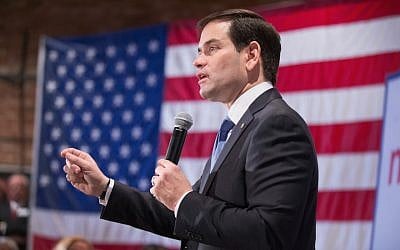
Marco Rubio, another Catholic candidate for the GOP nomination, said he has “tremendous respect and admiration” for the pope, but he added, “There’s no nation on Earth that’s more compassionate on immigration than we are.”
John Carr, who served for more than two decades as the social justice director for the US Conference of Catholic Bishops and for years helped write the bishops’ election-year guide, said the pope is having some impact on American political life. Carr met last fall with some Democratic lawmakers soon after Francis made his first visit to the US Carr asked them why they didn’t follow Francis’ lead and talk more about poverty.
“Pope Francis doesn’t fit our political prejudices,” Carr said. “He appeals to our consciences and that’s his most powerful contribution.”
Copyright 2016 The Associated Press.





The Times of Israel Community.