

Iran’s cabinet members join banned Facebook
15 ministers start accounts on social media site, signaling greater openness under Rouhani’s rule
 Add ToI as a Preferred Source on Google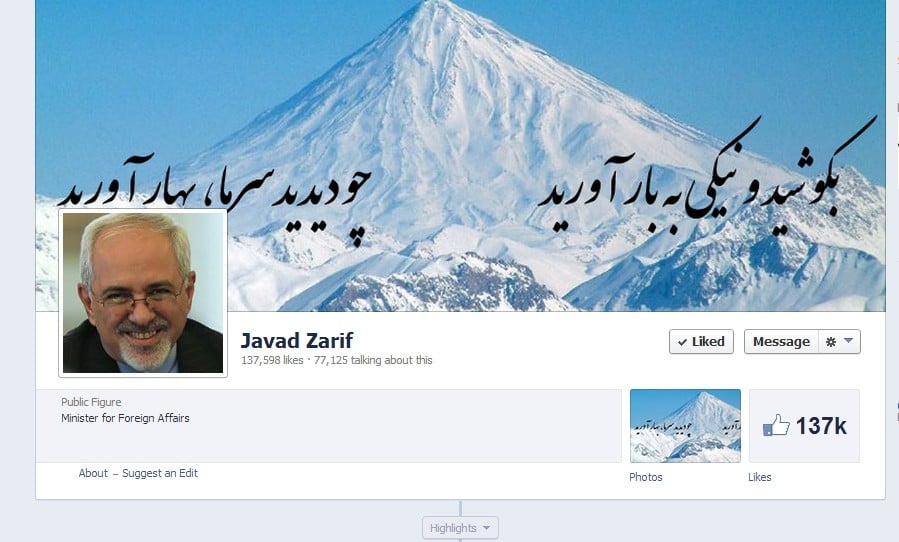
TEHRAN, Iran — Iran’s entire cabinet has opened Facebook pages in what is seen as a move toward greater government openness — even though the social media site is blocked in the Islamic Republic.
The Facebook pages of 15 ministers could be viewed in Tehran through a proxy server. Newspapers on Monday hinted the move might herald the lifting of some Internet barriers.
“It seems the ‘key'” — Rouhani’s electoral symbol in his presidential campaign — “may turn the lock of (Internet) filtering,” the pro-reform Shargh daily said.
With the exception of Foreign Minister Mohammad Javad Zarif, who joined Facebook in 2009, the cabinet members signed up this August after the inauguration of centrist- and reformist-backed President Hasan Rouhani.
Rouhani’s office has also opened a page on Facebook that was “liked” by all the ministers.
Saeed Leilaz, a Tehran-based political analyst, said it was likely the start of the lifting of Internet “filters,” which block specific sites. “Definitely filtering on Facebook will be lifted, and we will witness the elimination of filters (on the rest of) Internet,” said Leilaz.
Rouhani had promised greater openness and transparency during his presidential campaign in June. The move also suggests that his administration is looking toward social media to push its policies.
Last week, Zarif told a local news website that he sent a message on Twitter saying “Happy Rosh Hashana,” the Jewish new year, in what is likely a small diplomatic step toward easing the hostilities between his nation and Israel.
Iranian hard-liners see the Internet as a possible corrupting force, but many Iranians use proxies to access banned sites.
Iran imposed a ban on Facebook after disputed re-election of former President Mahmoud Ahmadinejad in 2009, when his opponents used social media to organize protests.
Earlier in 2012, Iran’s Supreme Leader Ayatollah Ali Khamenei, who has final say on all state matters, issued a religious decree in which Facebook was considered permissible if it was not used for corrupting or bad purposes. A page that claims to be Khamenei’s is generally believed to reflect his views. He has neither disowned nor claimed it, and many consider it his unofficial voice.
There are 18 ministers in the cabinet but three nominees of Rouhani failed to receive vote of confidence from parliament in August. The president should introduce their alternatives to the parliament in coming months.
Copyright 2013 The Associated Press.










The Times of Israel Community.