

Kahlon warned Netanyahu: If we go to elections, you will not be next PM
Quotes from negotiations over new broadcaster show finance minister calling PM’s bluff to dissolve coalition, even though he later signed on to deal largely seen as capitulation
 Add ToI as a Preferred Source on Google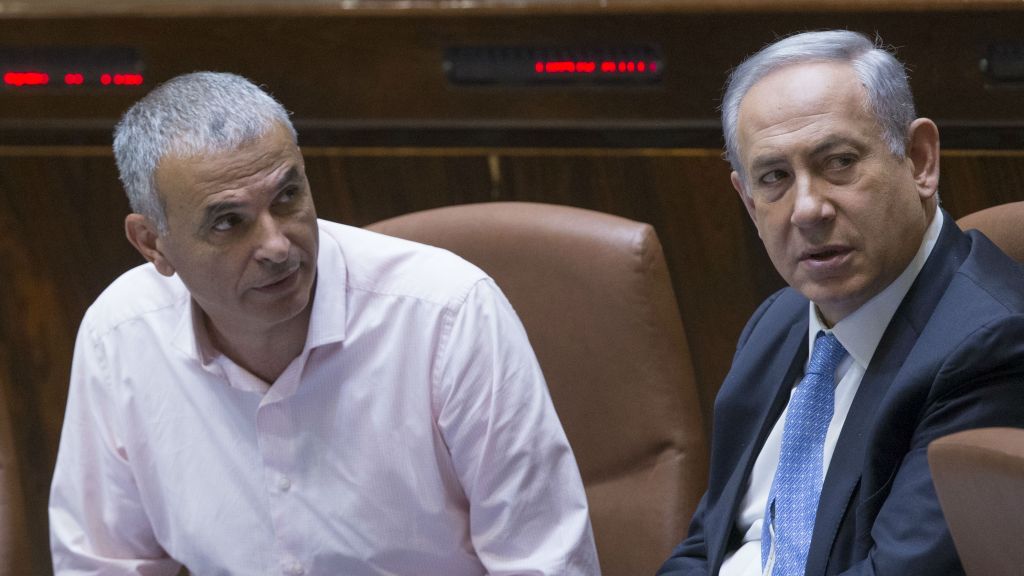
In a partial transcript of a newly released conversation between Prime Minister Benjamin Netanyahu and Finance Minister Moshe Kahlon in the lead-up to their controversial agreement Thursday over the future of Israel’s new public broadcasting cooperation, the prime minister warns Kahlon that he will not hesitate to call elections if his demands are not met, to which Kahlon appears to call his bluff.
The agreement Thursday headed off a coalition crisis that started two weeks ago when Netanyahu backtracked on an agreement with Kahlon to launch the new public broadcasting corporation — formally called “Kan” and widely known as HaTa’agid (the corporation) — set up through a law passed by his previous government in 2014 and slated to replace the old Israel Broadcasting Authority, or IBA. Instead, the prime minister called for rehabilitating the ailing IBA. Kahlon, meanwhile, fought for the establishment of the new state broadcaster, as legislated, and with reduced government meddling.
On Friday, Channel 2 and Channel 10 reported that in one conversation during their negotiations before the agreement, Netanyahu tells Kahlon: “I went to elections over the Yisrael Hayom bill. I am not afraid to do so again over the Ta’agid. You know the numbers, in the polls, over what could happen.”
Netanyahu was refering to his decision two years ago to dissolve the government and call elections over his coalition members’ dissent regarding the Yisrael Hayom bill, which would have curtailed the distribution of free newspapers. That legislation, which was never approved, is currently at the center of one of the investigations into the prime minister, who allegedly offered to help pass the bill in a quid pro quo deal with Yedioth Ahronoth publisher Arnon Mozes.
In the transcript released Friday, Kahlon shoots back at the prime minister that his threat to calls elections “doesn’t scare me. My party can lose or gain two or three mandates, but you will not return to this seat.”
Recent polls have shown potentially unfavorable outcomes for the Likud. A survey two weeks ago by Channel 10 showed the ruling party slipping from the 30 seats it currently holds to 26, with the centrist Yesh Atid party led by Yair Lapid rising to 25, from 11 currently. Other polls show the parties neck and neck.
Kahlon’s Kulanu party would drop to six seats, from 10, according to the polls.
Netanyahu’s threat to go to snap elections had hung over his coalition members for weeks as critics speculated on what he was up to.
Despite affirming that his primary concern was saving jobs at the IBA, Netanyahu is widely believed to have been opposed to the new body because he perceived it as being too left wing and difficult to control. Netanyahu has long complained of a media hostile to him.
Netanyahu, who had backed the 2014 legislation that established the new corporation, said in recent weeks that the new body was a “mistake.” His key complaint was the law’s guarantee of greater editorial independence for the new agency.
According to the deal, the new broadcaster will be allowed to go ahead, with a slight delay, but will lose its news division. In its stead, a separate broadcast entity will be established to deal with all state-funded current affairs offerings.
The deal was seen as a resounding victory for the prime minister while Kahlon was widely criticized. And despite the revelation Friday that he seemed to not be intimidated by the threat to call elections over the issue, he was portrayed in the press as having folded.
Sources familiar with the new deal told the Haaretz daily Thursday that “if it comes to fruition, it would represent a complete capitulation on the part of the finance minister and his commitment to setting up the corporation.”
After the announcement was made Thursday, Kahlon held a press conference defending the agreement but refused to answer questions.
“The battle in recent days has been a battle of principles, not ego,” said Kahlon on Thursday, expressing his satisfaction with the agreement. “It ensures freedom of the press, freedom of speech and it is keeping with the budget. According to the framework of the agreement, there will be no political influence [on the corporation].”
“This agreement prevented the passage of legislation that would have advocated for supervision of the press — a bill that [threatened] freedom of the press and terrorized many journalists and rightly so,” he went on.
There are currently 763 employees working for the new broadcaster, 421 of whom came from the IBA. Under the agreement, the Finance Ministry will provide a severance package to employees of both the IBA and Kan who will not be included in the new corporations.
In order to pass the new reforms through the Knesset, the transmission date will be delayed by two weeks, according to the PMO.








The Times of Israel Community.