

Palestinians won’t regain planning rights, court indicates
West Bank residents living under Israeli military rule decry discriminatory policies, as High Court calls for more inclusion
 Add ToI as a Preferred Source on Google
Elhanan Miller is the former Arab affairs reporter for The Times of Israel
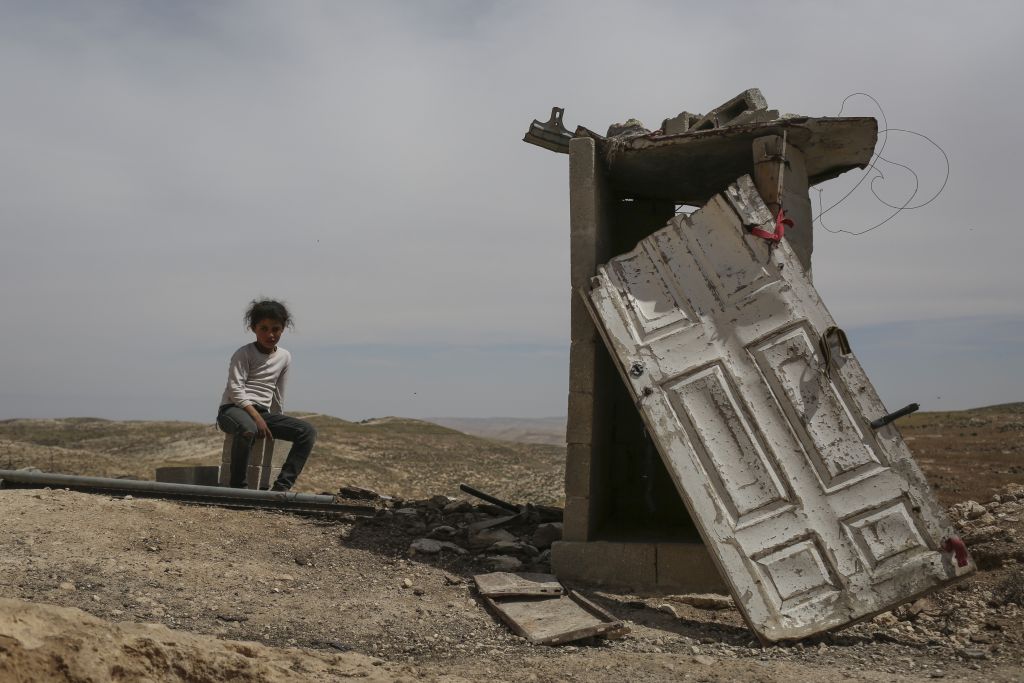
Palestinians will not regain planning rights for their communities in parts of the West Bank fully held by Israel, but may become more involved in the planning process, a panel of three Supreme Court judges said on Sunday.
Rabbis for Human Rights, an Israeli watchdog, had submitted a petition to the High Court in August 2011 on behalf of nine Palestinian villages in area C, demanding that residents be given the right to form regional planning councils, as was the situation across the West Bank prior to 1971, when a military decree transferred planning prerogatives to the Civil Administration in Judea and Samaria, an arm of the IDF responsible for civil and security coordination with the Palestinians.
“We are not going to turn the wheel back to the past, which is impractical,” said Justice Elyakim Rubinstein, who headed the panel, referring to the pre-1971 reality. “We are, however, seeking ways to improve ideas suggested by the respondent (the state), to make the process more meaningful [for the Palestinian residents].”
Rubinstein suggested testing the new procedure of including Palestinian residents in planning deliberations for a two-year period, while adding a “consultative body” of Palestinian representatives to the Israeli planning committees. During a previous hearing in April 2014, the court asked the state to put forward a mechanism that would include Palestinian community representatives in the planning process — representation that was not previously required.

Last week, the human rights group Amnesty International urged Israeli authorities to “seize the opportunity presented by this case to transfer planning powers to the local Palestinian communities.”
“Military Order 418, which abolished the local and district planning committees in the occupied West Bank … effectively precluded any meaningful Palestinian participation in Israeli-controlled planning processes,” wrote Amnesty. “This formal denial of participation in planning for an entire population, coupled with the establishment of a parallel planning system for Israeli settlements… is unique globally, to Amnesty International’s knowledge, and fails to conform to widely accepted and practiced planning standards.”
Appellants in the Israeli court case also include the Diraat-Rafiah Municipality, the Jerusalem Legal Aid and Human Rights Center, the Israeli Committee Against House Demolitions, and The Society of St. Yves, and Catholic Center for Human Rights.
According to Rabbis for Human Rights, less than one percent of Area C is designated for Palestinian development, as opposed to some 70% of the area, lying within Jewish municipal councils.
‘Life must go on. When a man gets married, he must leave his parents’ home. Where can he go?’ asked Najadeh
With few legal possibilities to build houses in their villages, Palestinians living in the communities in question have resorted to illegal construction of makeshift homes or have refrained from building altogether, residents said.
The state, represented in court by attorney Aner Hellman, argued that the issue of planning in area C — comprising some 60% of the West Bank and incorporating all Jewish settlements — is a diplomatic one, and should therefore be left for peace negotiations, not a judicial decision.
That argument was countered by attorney Netta Amar-Schiff of Rabbis for Human Rights. “We refuse to consider planning as a grace used by Israel as a bargaining chip in diplomatic negotiations,” she told the court.
Odeh Najadeh, head of the municipal council of Ka’abnah-Dqeiqeh, a hamlet of 350 residents situated 22 kilometers (14 miles) east of Hebron, told The Times of Israel that the Civil Administration issued 25 stop-work orders for ongoing construction in March. The total number of pending demolition orders for his community now stands at 126.
“Life must go on. When a man gets married, he must leave his parents’ home. Where can he go?” asked Najadeh, a school headmaster living in a community of shepherds. He denied that he had been invited by the Civil Administration to any planning meetings, claiming that lawyers from Rabbis for Human rights sometimes inform him of upcoming deliberations.
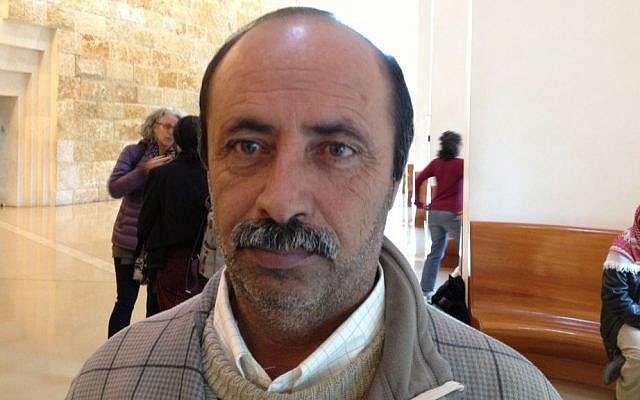
“We demand the most basic rights for an honorable life,” he continued. “The homes, mostly built from sheet metal, are very hot in the summer and cold in the winter. When they’re tearing down tents, why would anyone take a loan to build a brick home only to have it destroyed?”
Najadeh added that nearby Jewish settlements generally have no problems receiving building permits.
“Eight kilometers away lies the settlement of Carmel. We hear their dogs, who have a home for the summer and a home for the winter; and are cared for. No one cares about us. Give us 10 percent of the rights Israelis get, and we’ll be pleased.”
Jihad Nawajah, council head of Susya, a Palestinian village that lies some 15 kilometers (9 miles) south of Hebron, said the residents would ideally like to return to the ruins from which the Civil Administration evicted them in 1985; relocated to their agricultural land nearby.

“I was born in the ruin and spent my childhood there. I should be allowed to end my life there as well. No one should come and uproot my life.”
In response to the Palestinian residents’ claims, the Civil Administration submitted the following statement to The Times of Israel: “Over the past five years, seven outline plans have been approved for Palestinians in Area C, with 23 additional plans currently being prepared. The planning bureau of the Civil Administration authorizes outline plans after examining an array of criteria, including proximity to schools, connection to water and electric infrastructures, access to villages, and the cultural needs of the population. The planning committee cannot issue building permits where no approved outline plan exists.”









The Times of Israel Community.