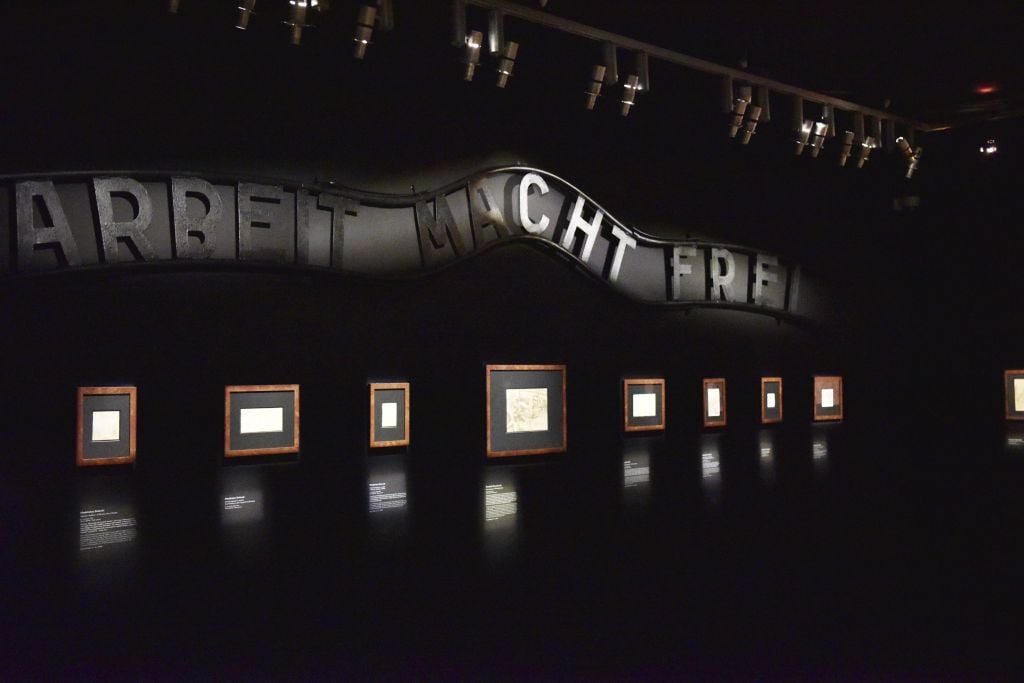
Illustrative: The 'Arbeit Macht Frei' (Works Sets You Free) gate of the Nazi German death camp of Auschwitz, made by the early inmates, is among some 200 drawings and other pieces of art now on display at the 'Face to Face: Art in Auschwitz' exhibition of art by inmates of the concentration camp, displayed at the Szolayski house in Krakow, Poland, July 12, 2017. (Bartosz Bartyzel/Auschwitz Museum via AP)
WARSAW, Poland — A new exhibition in southern Poland shows the brutality of the Nazi German death camp of Auschwitz through the artistic work of its inmates. Some of the artworks are being shown publicly for the first time.
The “Face to Face: Art in Auschwitz” exhibition opened last week at the Kamienica Szolayskich (Szolayski Tenement House) of the National Museum in Krakow to mark 70 years of the Auschwitz Museum. The museum’s task is to preserve the site in the southern town of Oswiecim and to educate visitors about it. More than 2 million people visited the museum last year.
The curator of the Krakow exhibit, Agnieszka Sieradzka, said Wednesday it includes clandestine as well as commissioned drawings and paintings by Jews, Poles and other citizens held at Auschwitz during World War II.
“These works help us see Auschwitz as the inmates saw it and experienced it,” Sieradzka told The Associated Press. “We stand face to face with the inmates.”
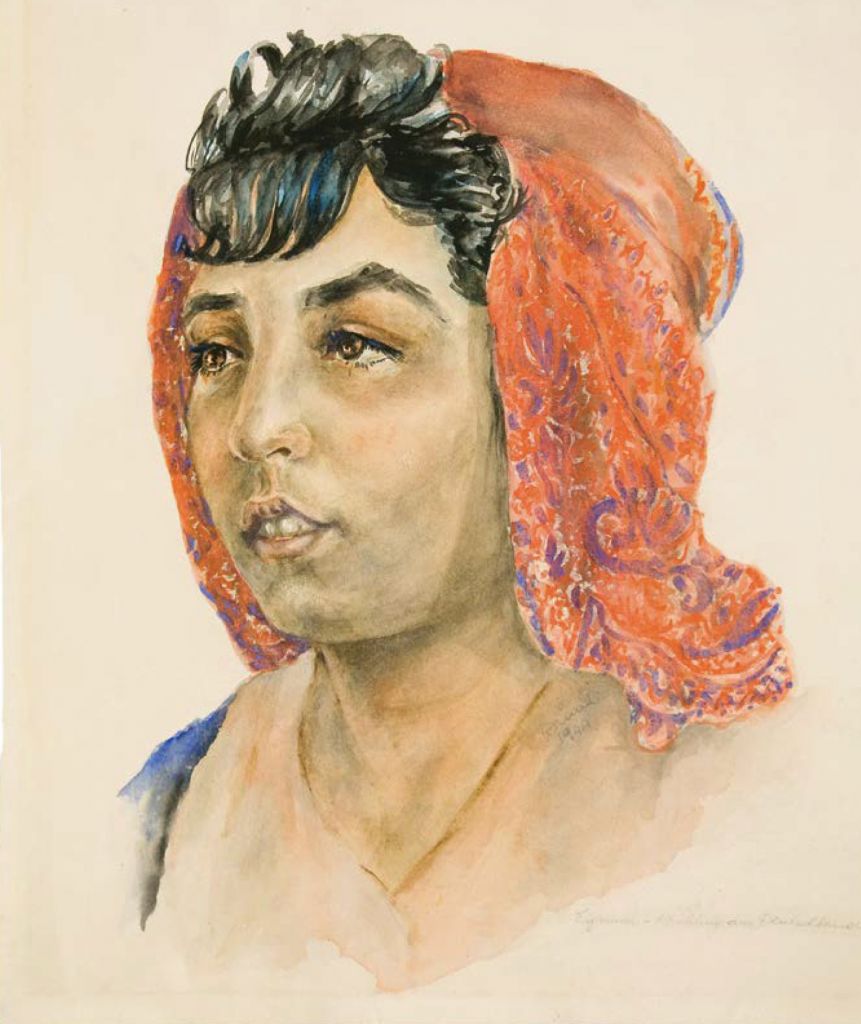
A portrait of a young Roma woman, an inmate of the Nazi German death camp of Auschwitz, drawn by another inmate, Dina Gottliebova, a Jew from Czechoslovakia, on display at the ‘Face to Face: Art in Auschwitz’ exhibition of art by inmates shown at the Szolayski house in Krakow, Poland, July 12, 2017. (Bartosz Bartyzel/Auschwitz Museum via AP)
The Nazis sometimes ordered talented inmates to make paintings for various purposes. One such painting is a portrait of a Roma woman that pseudo-scientist Josef Mengele experimented on. Mengele ordered portraits like this from inmate painter Dina Gottliebova, a Jewish woman from Czechoslovakia.
Get The Times of Israel's Daily Editionby email and never miss our top stories
The task helped Gottliebova survive. After the war she traveled to the US and started a family. She died in 2009 in California under the name Dina Babbitt.
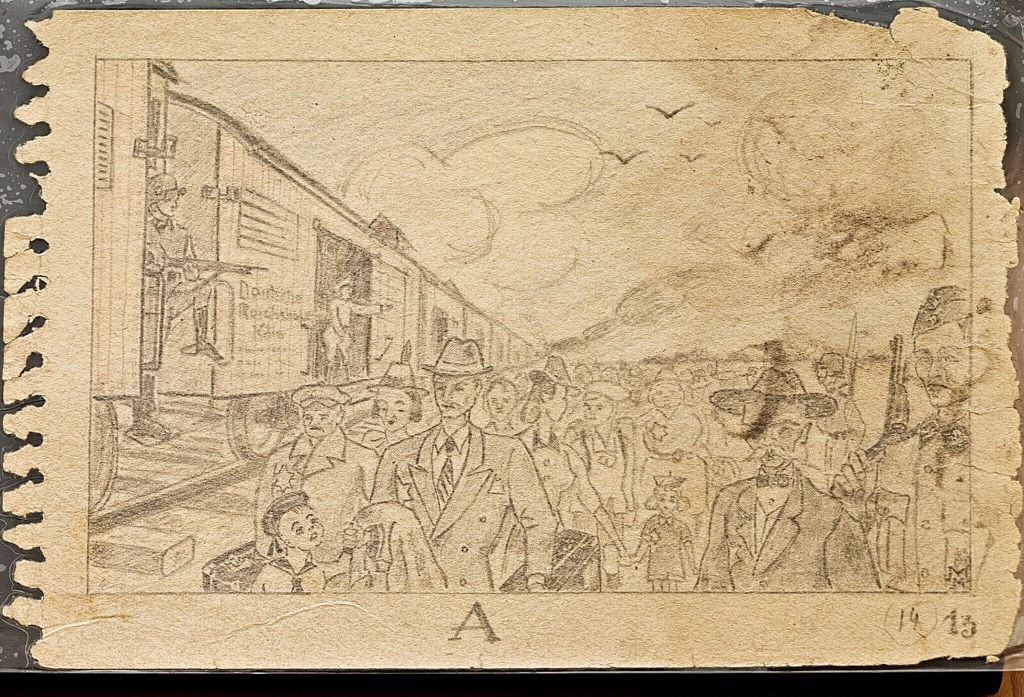
Among the clandestine art is the so-called Auschwitz Sketchbook by an unknown author. It has 22 drawings of scenes of beatings, starvation and death. It was found in 1947, hidden in a bottle in the foundation of a barrack at Birkenau, a part of the Auschwitz-Birkenau complex. It is the first time it is being shown to the general public. It is housed at the museum and only shown on request.
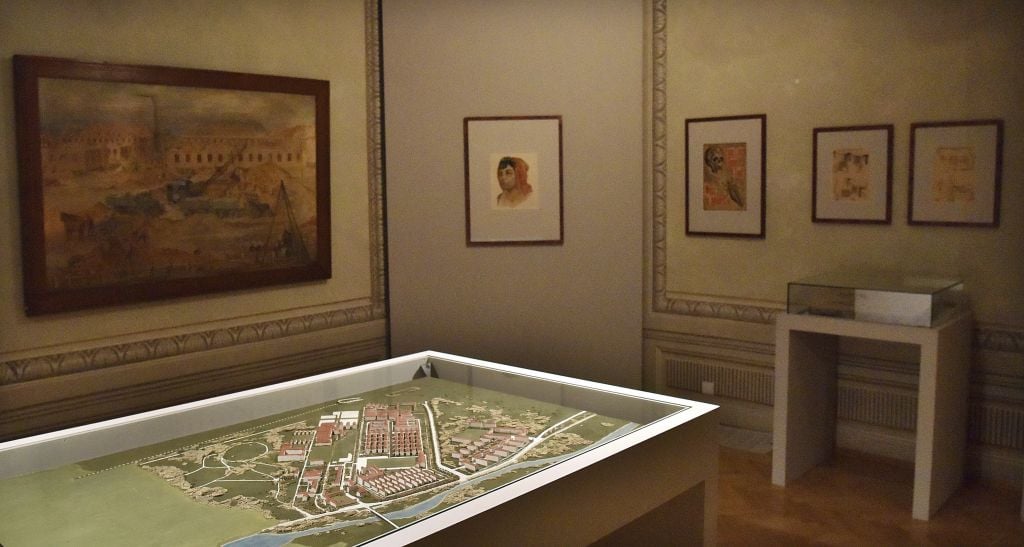
A model of a plan the German Nazis were making for the enlargement of the Auschwitz death camp on display at the ‘Face to Face: Art in Auschwitz’ exhibition of art by the inmates, shown at the Szolayski house in Krakow, Poland, July 12,2017. (Bartosz Bartyzel/Auschwitz Museum via AP)
Also being displayed is the original “Arbeit Macht Frei” (Work Sets You Free) gate top that was stolen and retrieved in 2009 and is now kept under guard at the museum.
Advertisement
From 1940-1945, some 1.1 million people, mostly European Jews but also Poles, Roma and Russians, were killed in the gas chambers or died from starvation, excessive forced labor and disease at Auschwitz, which Nazi Germany operated in occupied Poland.
Reproduction of a pencil sketch by unknown inmate of the Nazi German death camp of Auschwitz showing the arrival of a transport of Jews, guarded by armed German soldiers. It is a page from the so-called Auschwitz Sketchbook that was found after World War II and is now on display at the ‘Face to Face: Art in Auschwitz’ exhibition of art by inmates shown at the Szolayski house in Krakow, Poland, July 12,2017. (Bartosz Bartyzel/Ayschwitz Museum)
Help us report truthfully on social media
As a multimedia journalist, my job is to take the quality, fact-based journalism produced by The Times of Israel newsroom and make it accessible across every platform — from Instagram posts to podcasts to short-form videos.
This is how many, especially young people, consume news these days. But misinformation is rampant on social media. Our team at ToI produces accurate, responsible short-form reporting on Israel and the Jewish world.
If you believe in the importance of factual social media journalism, please consider joining our reader support group, The Times of Israel Community. Your financial support is essential to sustain responsible multimedia reporting.
We’re really pleased that you’ve read X Times of Israel articles in the past month.
That’s why we started the Times of Israel - to provide discerning readers like you with must-read coverage of Israel and the Jewish world.
So now we have a request. Unlike other news outlets, we haven’t put up a paywall. But as the journalism we do is costly, we invite readers for whom The Times of Israel has become important to help support our work by joining The Times of Israel Community.
For as little as $6 a month you can help support our quality journalism while enjoying The Times of Israel AD-FREE, as well as accessing exclusive content available only to Times of Israel Community members.
Thank you, David Horovitz, Founding Editor of The Times of Israel


 Add ToI as a Preferred Source on Google