

At Zionist Union HQ, deflation and forced levity as TV exit polls suggest a tie
‘Everything is open,’ Herzog tells an unconvinced crowd at party headquarters
 Add ToI as a Preferred Source on Google
Mitch Ginsburg is the former Times of Israel military correspondent.
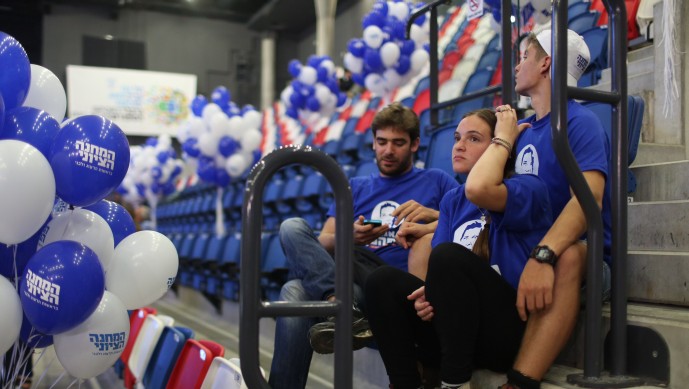
They chanted maha-pach, maha-pach (revolution) – the famous words with which news anchor Haim Yavin announced the inaugural rise of the Likud party in 1977 after 29 years of Labor dominance – but the conviction, for reasons depicted on the jumbo television screen, were not there: after weeks in the lead, the Zionist Union column in the exit polls came in at 27, deadlocked with Likud.
There were attempts at celebration from the blue-shirted Zionist Union supporters and party members, including flag-waving and traditional circle dancing, but the results seemed to have a deflating effect.
A computer engineer from Jerusalem, Guy, decked out in green beer glasses in honor of St. Patrick’s Day and a T-shirt so loud it required sunglasses to gaze it, said that “the tie is a bummer.”
A Labor Party member, he said a unity government “is still an option.”
Maya Bianco, a high school senior from Ramat Gan in a blue “I Love Tzipi” T-shirt, said she thought the rotation agreement between MK Tzipi Livni and Zionist Union leader Isaac Herzog, which is widely seen as having provided momentum for the joint party, was “problematic from the get-go.”
Others insisted that the arithmetic supported party leader MK Isaac Herzog. “Something happened here today,” said MK Hilik Bar, the Labor Party chairman. “And I believe that the president will call upon us to form the next government.”
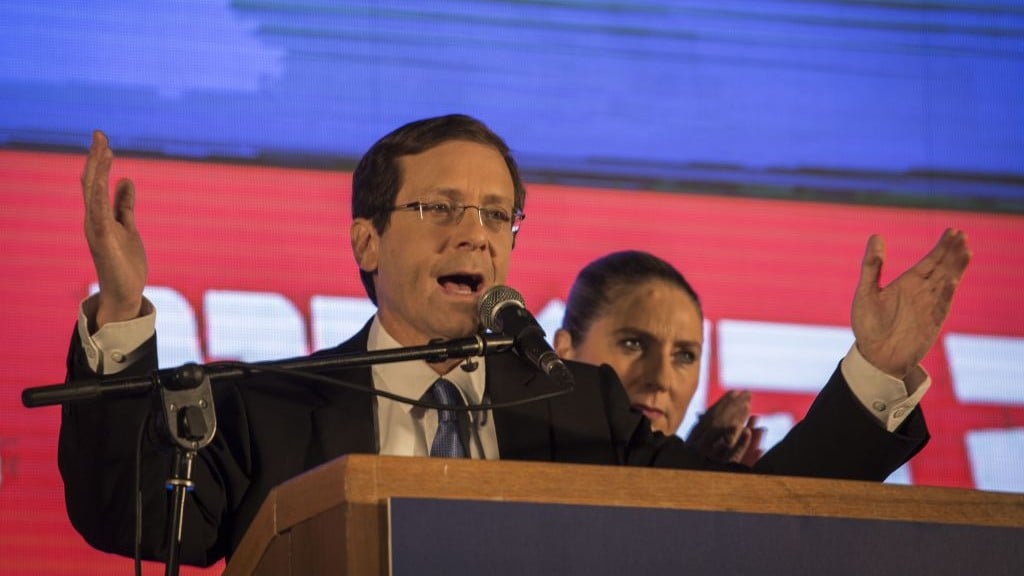
Herzog himself took to the podium before midnight and called the party’s projected 27 seats “an extraordinary achievement” that Israel had not seen since Yitzhak Rabin’s election in 1992.
The result, he added, “enables us to return to power. Everything is open.”
And yet Livni, in all black and sounding mournful, made concessionary statements, declaring that “we are not yet raising our hands” in defeat and “there’s still a state here that needs to be protected.”
Ksenia Svetlova, a fluent Arabic speaker, former journalist and scholar of the Middle East who was brought into the Zionist Union by Livni, said of the yet-to-be-finalized results, “We’ll wake up in the morning and be a lot smarter.”
The soon-to-be Knesset member, who immigrated to Israel from Moscow in 1991, remained hopeful that Herzog could still be asked to assemble a Zionist Union-led government.
Nearby, Rabbi Gilad Kariv said that “anyone who would have been told that we might achieve a tie a few months ago would have taken it.” Moreover, he argued, “a dynamic of change” had been established.
But the crowd, mostly young and quite few in number, seemed to have internalized the public’s verdict: the party that led the state for its first 29 years but last won an election in 1999 has little chance of returning to power this time around.




The Times of Israel Community.