

From Olympic gold to Jerusalem of gold
Garrett Weber-Gale is proud to be Jewish. Coming to Israel ‘would have happened before’ if he hadn’t been preoccupied beating the world in the pool
 Add ToI as a Preferred Source on Google
Aaron Kalman is a former writer and breaking news editor for the Times of Israel
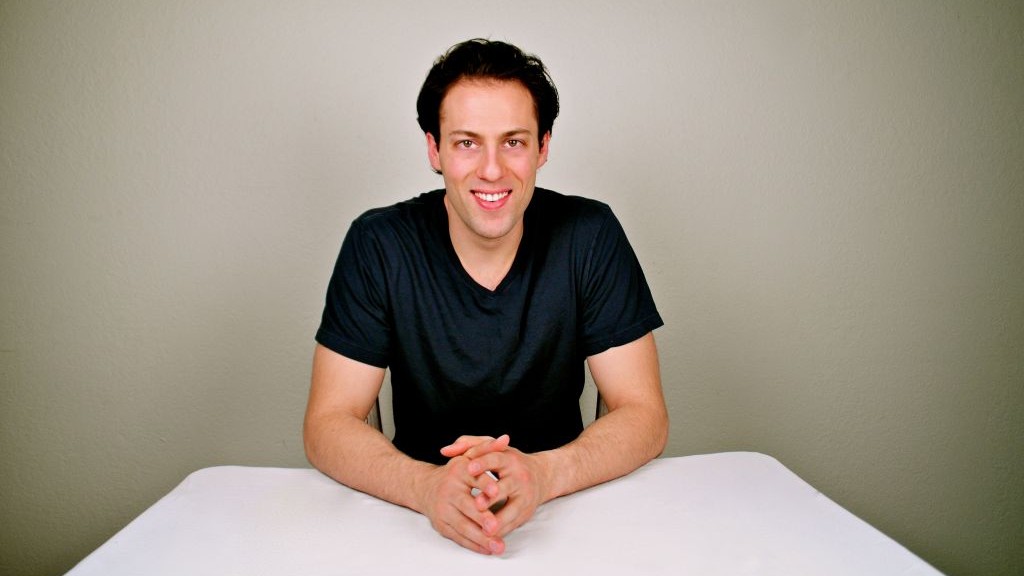
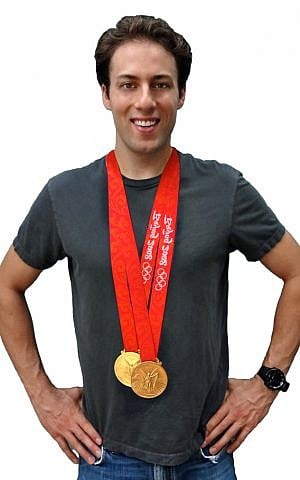
At the 2008 Beijing Olympics, four American swimmers awed the sporting world as they beat the French relay team to take gold in the 4×100-meter freestyle race, in a finish that seemed taken out of a movie. Two of those swimmers — Jason Lezak and Garrett Weber-Gale — are Jewish athletes who are here for the 2013 Maccabiah.
Standing on the podium with the gold medal, the national anthem playing in the background, “was the greatest honor I’ve ever experienced,” Weber-Gale recalls. Representing the USA and winning at the Olympics proved that “hard work and sacrifice really do pay off,” the swimmer told The Times of Israel in an interview held ahead of the 19th “Jewish Olympics.”
“I’m excited. I’ve wanted to compete in the Maccabiah for a long time,” the two-time Olympic gold medalist and world champion says. Coming to Israel “was an easy choice; I’ve always wanted to do it.”
Calling himself “a proud Jew,” the Milwaukee-born 27-year-old says he’s wanted to take part in the Games ever since swimming at the local JCC as a kid. “It would have happened before,” he states, if he hadn’t been focused on qualifying for the World Championships and the Olympics.
For Weber-Gale, putting time and effort into his training as a young swimmer paid off — first, when he started swimming for the University of Texas; later, when he won the NCAA 100-meter freestyle and clocked an American record at the 2008 Olympic trials for Team USA; and, finally, when he won two gold medals at Beijing and yet another at the 2009 World Championships.
In Beijing, Weber-Gale received gold for his efforts in the preliminary heats of the 4×100 medley race, which Team USA won. He also swam the second leg in the epic 4×100-meter freestyle relay race against France. The last leg of that heat, and the incredible final effort, was done by Jewish teammate Lezak — who has won eight Olympic medals and will be a guest of honor at the Maccabiah, after having participated in previous years.
Weber-Gale says that while other events “are purely about competing, about proving whose country is best,” the Maccabiah “conveys culture through sport.” The 2-week-long event is about “proving Jewish athletes can be at the top of the sporting world. There is a proud Jewish heritage, and we help pass it on.”
On the sporting side of things, the former world champion will compete in the 50- and 100-meter freestyle races. He also hopes to take part in both 4×100 relay races that earned him Olympic gold, but says that “it’s up to the coach. Whatever he decides.”
Downplaying the hype around him — he’s looked at by commentators as one of the best swimmers competing — Weber-Gale says he expects “to swim fast. I always try to swim fast.”
Born to a Jewish mother and non-Jewish father, Weber-Gale is open about his Jewish identity. His childhood and youth experiences at Sunday school and Hebrew school, as well as Jewish summer camp, he says, shaped who he is. Both his parents, as well as his fiancée, Kara, are here with the swimmer on what is his first real trip to Israel (after a 48-hour photo shoot in March).
It was “growing up in a wonderful community where everyone was very supportive” that helped him develop his Jewish identity. In fact, a Reform rabbi from Wisconsin, whom Weber-Gale has known for many years, will “fly down to officiate the wedding,” set to take place in his current hometown of Austin, Texas, this fall.
“I have a serious, proud and strong connection with Judaism, and I want my children to feel that way too,” Weber-Gale states. Also, he adds, “We want to expose them to other religions. There are a lot of different religions, and just because we believe certain things, and Christians believe other things, doesn’t make them wrong.
“It was important for me to marry someone who’s OK raising our kids in a Jewish way,” he says. Noting that Kara grew up in a Christian household, Weber-Gale describes their talks with Reform rabbis to make sure their children will be considered Jewish. He mentions the Reform movement’s ruling that one Jewish parent is enough if the child receives a proper Jewish education.
During 2005, when swimming for the University of Texas, Weber-Gale was diagnosed with high blood pressure. While some athletes could be dissuaded by such a find, the swimmer decided it was a challenge that needed to be faced.
Having high blood pressure “forced me to learn how to cook and what to eat” in a new way, he recalls. Later, Weber-Gale decided to transmit his love of cooking, as well as lessons to the public, and founded AthleticFoodie, a company which, he says, tries to “teach people they can help themselves by watching what they eat and how the prepare their food.
“Swimming is my full-time job,” Weber-Gale states, but cooking and finding “ways for people to help themselves through food” are important to him too. In fact, he hopes to use this trip to discover some good restaurants and culinary venues, which, he’s heard, “are on the rise in Israel.”
While looking forward to the see-the-country tours provided by Maccabi USA and the organizers of the Games, Weber-Gale makes it clear he’d also like to see Israel without a guide. In the past he’s traveled through France, Italy and Denmark, spending “three to five weeks in every country … immersed in the local community.” In Israel, he says, “I’d like to do the same.”
“I swim and cook out of love and passion,”he says when asked to give some advice to the thousands of young Jewish participants in, and millions of viewers of, the Maccabiah. Without enjoying your activity, it’s hard to overcome the difficulties you face, he points out. “Find what you really love to do the most. What you care for is what you do best.”







The Times of Israel Community.