

Personal chemistry was key to peace with Jordan, Israeli negotiator recalls
King Hussein and Yitzhak Rabin were ‘fond of each other,’ says Supreme Court justice and former peace broker Elyakim Rubinstein
 Add ToI as a Preferred Source on Google
Elhanan Miller is the former Arab affairs reporter for The Times of Israel
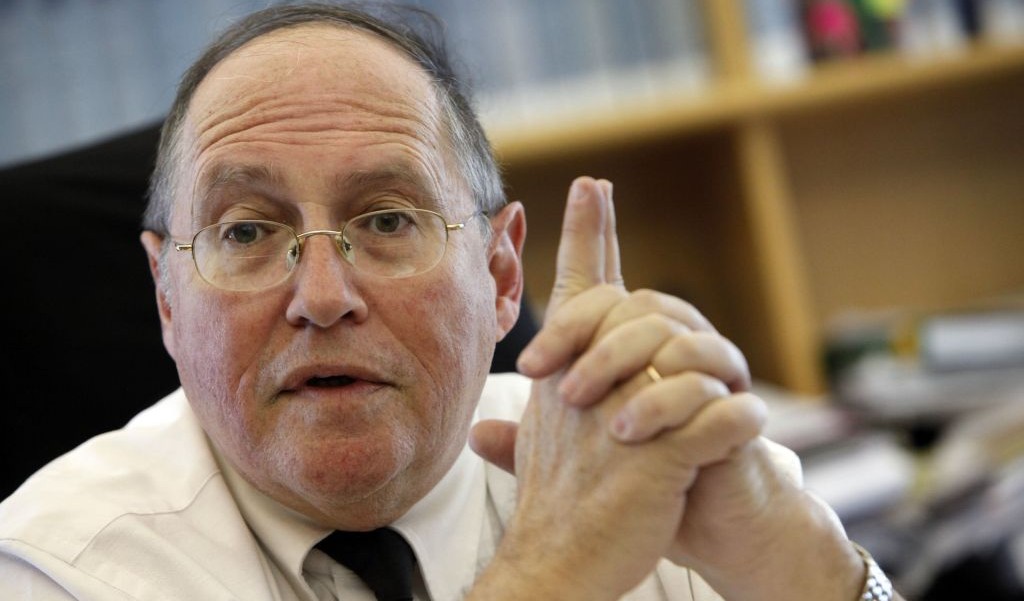
It was a Saturday afternoon in April 1994, and two Israeli officials, Elyakim Rubinstein and Efraim Halevy, were in a London hotel after working on the final touches of Israel’s peace treaty with Jordan. Prime minister Yitzhak Rabin had returned to Israel on Friday ahead of the Jewish Sabbath, and the two negotiators were waiting for the day of rest to end so they could catch their flight back home.
“Suddenly at 5 p.m. King Hussein arrives, driving the car with his son Prince Hamza. He said: ‘I knew you were lonely, so I came to keep you company.’ We had seuda shelishit with the king,” Rubinstein recalled in a conversation with The Times of Israel this week, referring to the traditional late Shabbat afternoon meal. “At the end of the meal he even gifted me a personally dedicated Koran in English and Arabic.”
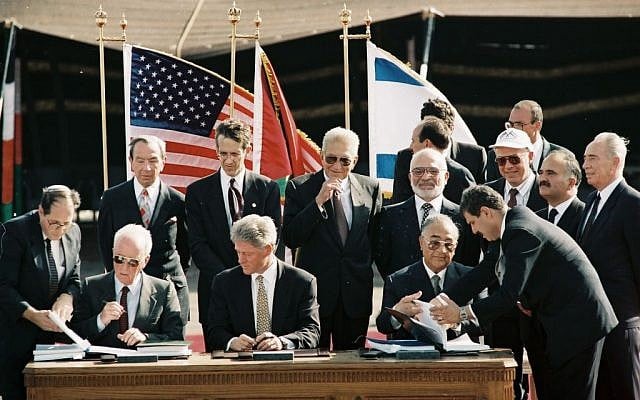
Twenty years after the leaders of Israel and Jordan signed a historic peace treaty at the Arava border crossing, Rubinstein, then Rabin’s cabinet secretary and chief negotiator with Jordan and today a veteran Supreme Court justice, said the warmth between Rabin and Hussein was crucial to bringing peace to Israel’s longest border.
An entire wall of his second-floor office in Jerusalem’s Supreme Court is covered with photos of those exciting years, the smiling Hashemite king and flushed Israeli prime minister schmoozing in black tuxedos. A poster issued for the occasion features both leaders signing the documents as two cartoon doves hover above a quote from Israel’s declaration of independence: “We extend our hand in an offer of peace and good neighborliness.”
“I deeply believe that all negotiations are built on personal relations,” he said. “There’s a debate as to whether ideals make history or whether personalities do. I believe that both make history, but I have no doubt about the great importance of personal chemistry between negotiators and decision makers.”
As cabinet secretary under Yitzhak Shamir since 1986, Rubinstein headed talks with the joint Jordanian-Palestinian delegation to the Madrid Conference in October 1991. When Rabin was elected prime minister in June 1992, it was only natural for him to ask Rubinstein — who had participated in the Camp David peace talks with Egypt as a junior jurist under Menachem Begin — to maintain the Jordanian portfolio.
Rabin, Rubinstein said, became acquainted with Hussein during his first term as prime minister in the mid-1970s, when Israeli leaders held secret meetings with their Hashemite counterparts across the river.
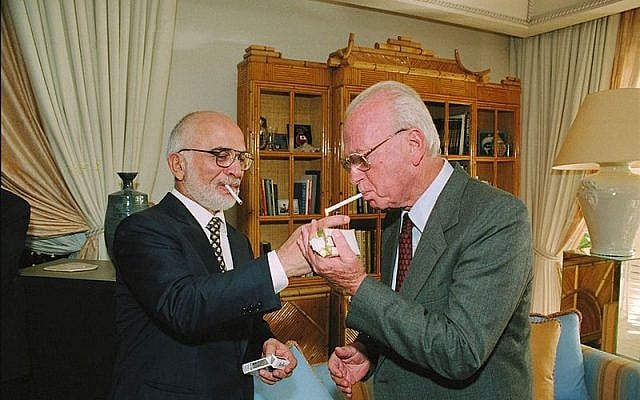
“They were fond of each other. Yitzhak Rabin liked the peace with Jordan and viewed it positively. The trust which gradually developed between the leaders was relevant; it created the positive atmosphere that prevailed.”
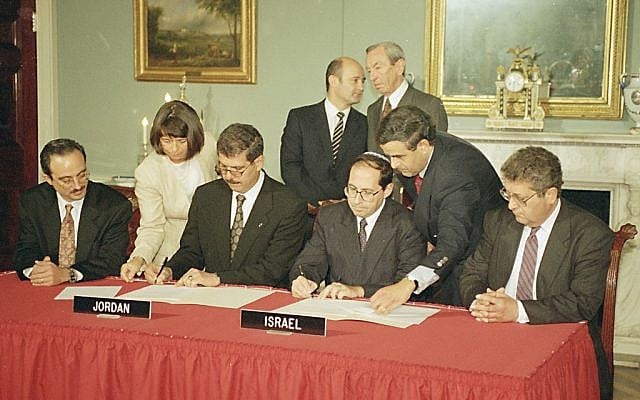
Rubinstein recalls the final frantic night of negotiations in Amman before the peace document was signed in October 1994, when 12 points remained unresolved.
“I read out the points raised by the Israeli side and [chief Jordanian negotiator Fayez] Tarawneh read the points from the Jordanian side. The king and Rabin decided each of them, and it went very positively. At 3 or 4 in the morning we ended the meeting and the leaders retired to rest as we finished working on the draft. Thus, at 7:30 a.m. I could come to Rabin and tell him it was ready.”
One of the most significant achievements of the peace treaty, in Rubinstein’s view, is the demarcation of the Israeli-Jordanian border, a frontier stretching some 500 kilometers (310 miles) from the gulf of Eilat to the southern slopes of the Golan Heights.The British Mandate document of 1922 never defined the border between Transjordan and Palestine in accurate geographic terms. This was particularly problematic south of the Dead Sea, where no natural border exists.
“[The British document] speaks of the middle of Wadi Arava. But what is Wadi Arava? There isn’t just one wadi between the Red Sea and the Dead Sea.”
The 1949 armistice line became the de facto border between the two countries, but was never physically demarcated. Beginning in the early 1970s, Israeli governments allowed the agricultural communities of the Arava in southern Israel to work the land east of the armistice line. The Jordanians came to the table in the 1990s demanding the armistice line become the official border.
“On the eve of the agreement, 50% of the Arava’s cultivated land lay east of the armistice line,” Rubinstein said. “How do we make an agreement which the other side can live with, but which also doesn’t destroy 50% of the Arava’s livelihood?”
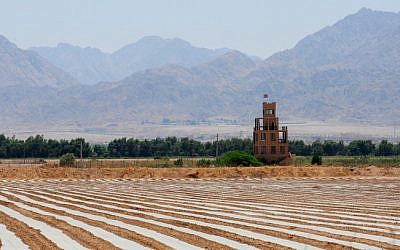
The solution Rubinstein and his team of geographers devised would be used by Israeli and Palestinian peace negotiators decades later to address the conundrum of Jewish settlements beyond the Green Line: land swaps in a ratio of 1:1.
Jordan agreed that Israel would apply its sovereignty over 40 square kilometers (9,885 acres) of cultivated land, and give Jordan the same proportion of uncultivated land along the Arava in return.
“Each side could then look into the eyes of its own public and say it achieved the outcome it wanted. The Jordanian interest was to say they got the armistice line, while our interest was to help the communities maintain their economy,” Rubinstein said.
For Jordan, one of the most arid countries in the world, water was an issue of prime importance at the negotiating table. Israel, which suffered from significant water shortages at the time, was wary of handing over too big a share of its scarce resource.
In the summer of 1994, days before Israeli and Jordanian delegations were set to meet at Bet Gabriel, a cultural center overlooking the Sea of Galilee, Rubinstein received a telephone call from Rabin. The prime minister had been warned by his army generals that the Jordanians’ appetite for water would increase if they spent the day gazing at the vast lake, and requested that Rubinstein change venues. Worried that a last-minute rescheduling would raise too many questions, the negotiator told Rabin to leave the matter to him.
“On the day of negotiations I took Dr. Tarawneh out to the balcony and told him I had a message from my government,” Rubinstein recalled. “Tarawneh took out his pocket book to start writing, and I said: ‘The message is that everything you see here is not water.’ When I told this to Rabin later he couldn’t stop laughing.”
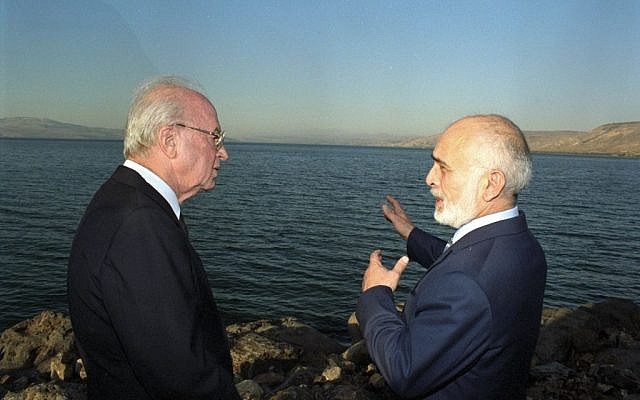
While the relationship between Israeli prime minister Menachem Begin and Egyptian president Anwar Sadat “knew its ups and downs,” the rapport between Rabin and Hussein was evident from the outset, Rubinstein said.
“With Egypt everything was new, it was a matter of breaking the existing psychology,” he said. “But with Jordan [the personal element] was more pronounced.”
Jordan’s attention to the personal needs of the Israelis manifested itself in the smallest details. Princess Sarvath, the wife of the king’s brother Prince Hassan who was deeply involved in the talks, made sure that kosher food was always available for the religiously observant Rubinstein during the secret meetings which took place over the years in Jordan and abroad.
“She would point to a small table on the side with food on it, and say, ‘That’s for you, it’s from Selfridges.”
Twenty years later, and two months ahead of his appointment as deputy chief justice, Rubinstein was reluctant this week to address the problematic state of peace between Jordan and Israel today.
“Peace is like a plant,” he said. “It’s not enough to plant once, it requires constant care. I say this to both sides; that’s the challenge of peace.”







The Times of Israel Community.