

Racial politics color New York City’s looming mayoral race
Seeking to court minorities, but not alienate police, incumbent Bill de Blasio denies he said statue of Nazi collaborator is first city will take down
 Add ToI as a Preferred Source on Google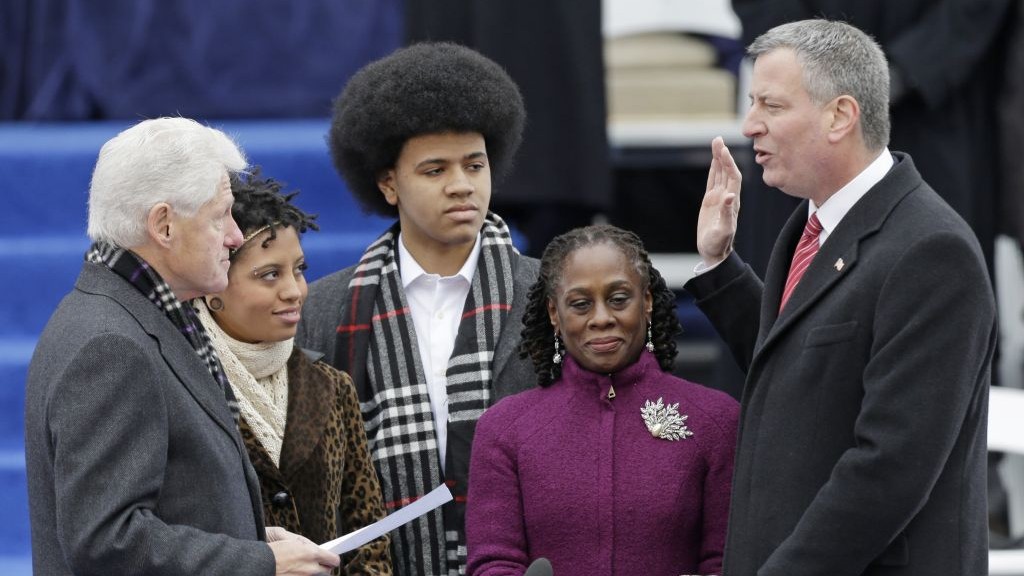
NEW YORK (AP) — Mayor Bill de Blasio isn’t much of a dancer.
But there he was on a recent Sunday morning, bobbing his head and bending his knees ever so slightly, as the Lenox Road Baptist Church choir belted out another hymn. He was the only white person celebrating with the congregation, gathered in a central Brooklyn house of worship he was visiting for the first time since becoming New York City’s mayor nearly four years ago.
“I need you,” de Blasio told congregants after the music stopped.
Indeed, the Democratic mayor knows the city’s massive minority population is one reason he holds a nearly unassailable position on the eve of Tuesday’s primary election despite a first term with plenty of political missteps.
De Blasio, whose wife is black, has won acclaim in many majority-minority neighborhoods after enacting changes in policing and education policies that benefited immigrants and minorities. He has expanded free preschool education dramatically and has kept crime at historic lows. He also alienated some police officers who question whether he is more committed to the Black Lives Matter movement than to the party’s traditional white working-class base.
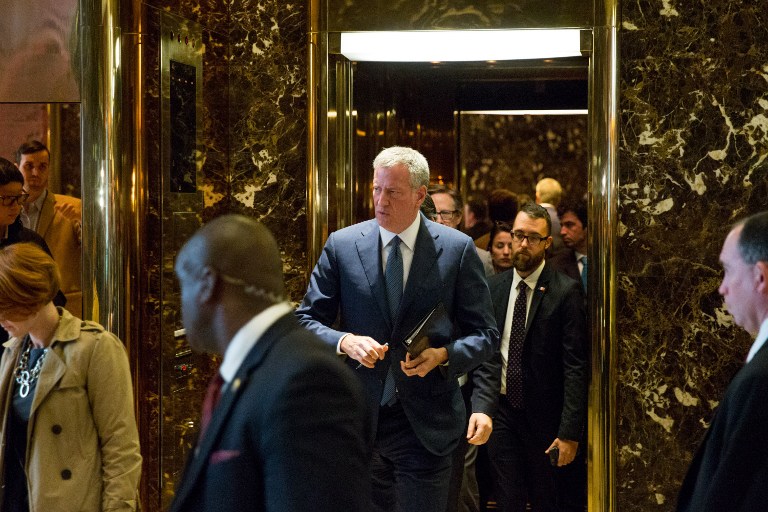
The story of de Blasio’s 2017 re-election in some ways mirrors that of the Democratic Party’s broader struggle with racial politics in the age of US President Donald Trump.
Of course, the president is not on the ballot in Tuesday’s mayoral primary or in the November general election.
Yet Trump has fueled racial divisions across America that have helped shape de Blasio’s push to become the city’s first Democrat re-elected mayor since Ed Koch in 1985. De Blasio, like Democrats across America, has been forced into an awkward dance at times with an electorate torn by the Republican president’s view on race and immigration.
“He is racist. Period,” de Blasio said of Trump in an Associated Press interview. “Unfortunately, this is a guy that does not see all people as equal.”
Yet de Blasio doesn’t agree with the growing movement by professional athletes who refuse to stand during the national anthem. And he quickly tempered a recent promise to remove racially insensitive monuments from public spaces — a promise sparked by national outrage that followed a deadly white supremacist rally to preserve a Confederate monument last month in Charlottesville, Virginia.
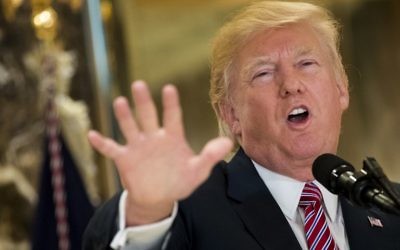
De Blasio charged into the monument debate after Trump said there were “very fine people” on both sides of the Charlottesville clash. The mayor said he would appoint a commission to examine potentially problematic statues and plaques.
“The commemoration for Nazi collaborator Philippe Pétain in the Canyon of Heroes will be one of the first we remove,” de Blasio tweeted at the time.
The commemoration for Nazi collaborator Philippe Pétain in the Canyon of Heroes will be one of the first we remove. https://t.co/hAnGmkCdtg
— Mayor Eric Adams (@NYCMayor) August 16, 2017
But in an interview with the AP, he offered a different take.
“I did not say, ‘One of the first removed.’ I said it would be one of the first looked at by the commission,” he said. “If you have a quote from me, that’s not from me. I want to see that because I said to my team that sent that out it would be one of the first we look at.”
Trump, who called de Blasio “the worst mayor in the US” back in 2015, has warned that Democratic efforts to remove offensive historical monuments could lead to the elimination of popular American heroes.
Within days, some Italian-American groups were angrily speculating that the mayor’s commission might wind up removing monuments to Christopher Columbus — despite de Blasio’s protestations that any such talk was premature.
“Bill de Blasio put Christopher Columbus in play. That’s crazy,” said New York GOP Chairman Ed Cox.
“It’s Bill de Blasio who’s playing the race card here. Donald Trump is not a racist.”
Few believe the issue is enough to stop de Blasio from rolling to re-election.
His main opponent in Tuesday’s Democratic primary is Sal Albanese, a city councilor who left office nearly 20 years ago and has struggled for political relevancy since. Should de Blasio win, he faces Republican Nicole Malliotakis, an underfunded challenger and a state assemblywoman, in the November 7 general election.
Albanese charges that de Blasio “has played politics with policing.”
The mayor irked the police department in particular after the 2014 death of Eric Garner, a black man who became a national symbol after a video showed him saying, “I can’t breathe,” as a white officer held him in a chokehold.
Afterward, de Blasio revealed that he told his biracial teenage son “to take special care with any encounter he may have with police.”
Amid street protests over the killing and a grand jury’s decision not to indict any of the officers involved, a gunman assassinated two New York City police officers.
Police officers have shown open contempt for the mayor ever since. Some began turning their backs on him at police funerals and other events.
“We can’t condemn every police officer in America as being racist. That’s what came across,” Albanese said of the mayor. He noted that several police unions have donated to his campaign.

But as the primary looms, de Blasio is focused largely on energizing his base in minority neighborhoods.
Inside a second church on Sunday, de Blasio vowed that all police officers would wear body cameras in the next two years. He reminded congregants that he helped enact universal pre-K for all 4-year-olds, along with ending the stop-and-frisk policy that allowed police to confront suspected criminals without probable cause.
“In Washington, we see voices of division…. We see, unfortunately, too much hatred, too much negativity,” de Blasio told nodding parishioners. “Here, we try to send a positive tone, an inclusive tone.”
“This is your city,” he said.



The Times of Israel Community.