

The story of Shockheaded Hitler
The unfortunately limited impact of a children’s poetry book adapted to ridicule the Nazis

 Add ToI as a Preferred Source on Google
David Horovitz is the founding editor of The Times of Israel. He is the author of "Still Life with Bombers" (2004) and "A Little Too Close to God" (2000), and co-author of "Shalom Friend: The Life and Legacy of Yitzhak Rabin" (1996). He previously edited The Jerusalem Post (2004-2011) and The Jerusalem Report (1998-2004).
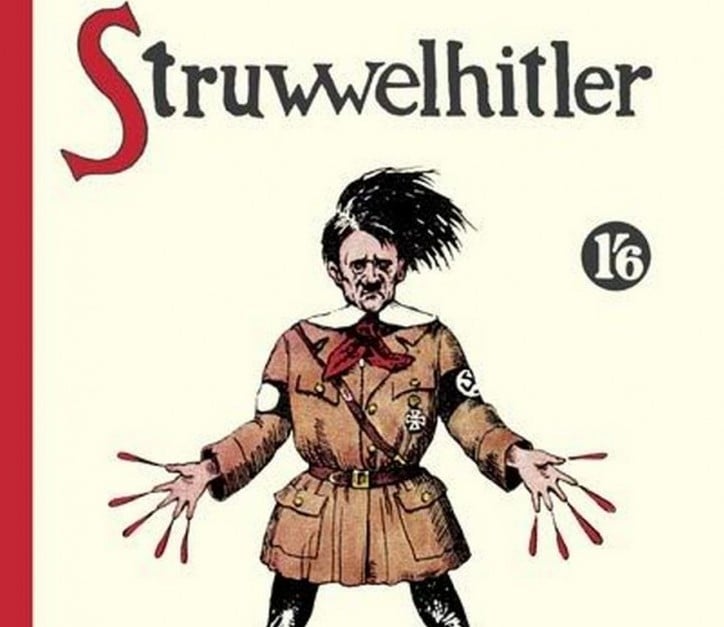
My grandmother was the most serene and kind-hearted of people. That she read her various grandkids the short, rhymed stories of Heinrich Hoffmann’s Struwwelpeter must have been because they delighted her — I imagine she had read them to her children in the original German decades before — and she knew we wouldn’t take them too seriously.
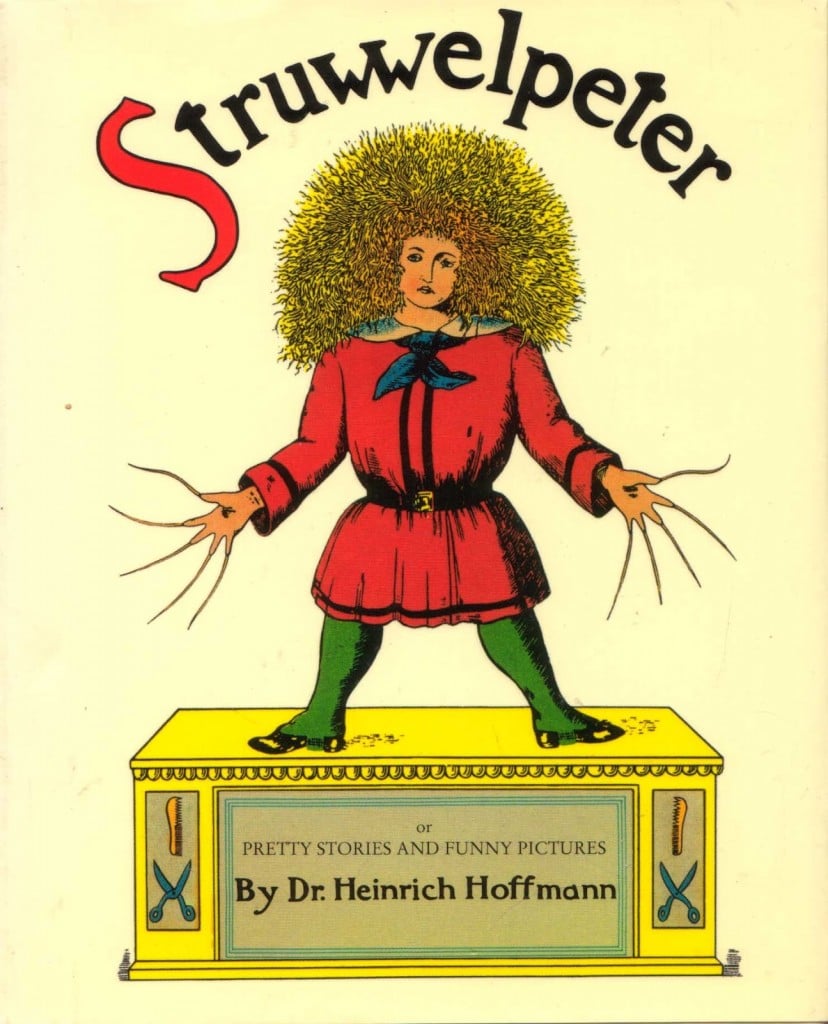
In the world of Struwwelpeter (“Shockheaded Peter,” known to Israeli children as “Yehoshua HaParua” — Wild Joshua), after all, misbehavior of even a fairly marginal kind — such as failing to eat one’s soup for a few days — tended to result in death. Not terribly credible.
Yet those stories, published by German psychiatrist Hoffmann in 1845, did stick with me down the years. The poems — written by Hoffmann for his three-year-old son when he couldn’t find a good children’s book for the boy — are so concise, businesslike and dramatic. The illustrations are so powerful. And, actually, the effect is pretty scary. I used to bite my nails as a kid, and I’m fairly sure that “The Story of Little Suck-a-Thumb” was central to my stopping:
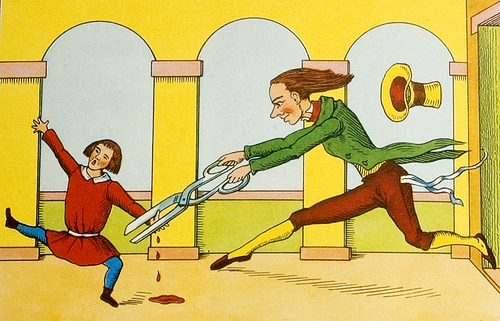
One day, Mamma said, “Conrad dear,
I must go out and leave you here.
But mind now, Conrad, what I say,
Don’t suck your thumb while I’m away.
The great tall tailor always comes
To little boys that suck their thumbs.
And ere they dream what he’s about
He takes his great sharp scissors
And cuts their thumbs clean off, – and then
You know, they never grow again.”
Of course, mother has scarcely turned her back, and Conrad is sucking away. At which point the frankly terrifying “great long-legged scissorman” bursts through the front door, with predictably dire consequences.
Snip! Snap! Snip! the scissors go;
And Conrad cries out – Oh! Oh! Oh!
Snip! Snap! Snip! They go so fast;
That both his thumbs are off at last.
Visiting Hoffmann’s and my own family’s former hometown Frankfurt last year with my children — each of whom endured me reading them Struwwelpeter in their younger years — we headed to the Struwwelpeter Museum, a multistory, colorful celebration of the book. We learned a lot that was admirable about the liberal, philosemitic Hoffmann, dressed up in Struwwelpeter characters’ costumes (I like to think I made an imposing “Great Aggripa”… but I didn’t), and marveled at the vast numbers of translations and adaptations of the work.
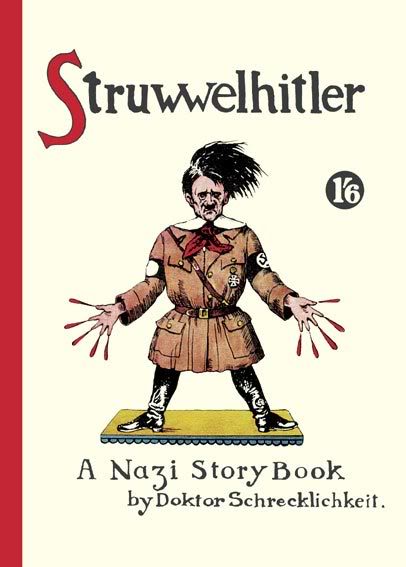
And among those, we came upon, read there and then, and purchased “Struwwelhitler,” a “Nazi story book” that reworks the poetic canon into 11 tales amended to ridicule the Nazi leader, his sidekicks and their toxic ideology. It was written in 1941 by Robert and Philip Spence, and “presented by them to the Daily Sketch War Relief Fund.” I pulled the slim volume off our bookshelf this morning, the eve of Holocaust Remembrance Day, read it through again, and wondered what use was made of it when it appeared 72 years ago.
Was it widely distributed in the UK, where it helped make the Nazi threat a little more ridiculous, and thus a little less scary?:
Just look at him! There he stands
With his nasty hair and hands.
See! The horrid blood drops drip
From each dirty finger tip;
And the sloven, I declare,
Never once has combed his hair;
Piecrust never could be brittler
Than the word of Adolf Hitler.
Was it brought into — dropped upon — Germany, in a bid to puncture German fear of, respect for, fealty to the Fuhrer? The version I have features German translations of all the poems.
Whatever the case, sadly and unsurprisingly, this attempt at ridicule and satire manifestly failed to slow the genocidal Nazi machine. The final page of the text features a small additional poem, an epilogue to the “Story of the Nazi Boys”:
“Now twenty months had passed away,” it opens — placing us presumably in 1943 — 70 years ago. “And still contentedly they play…”










The Times of Israel Community.