

North Korea leader says missile test ‘greatest success’
Celebrating submarine-launched rocket, Kim Jong-Un warns US, others that ‘rash acts will only precipitate their self-destruction’
 Add ToI as a Preferred Source on Google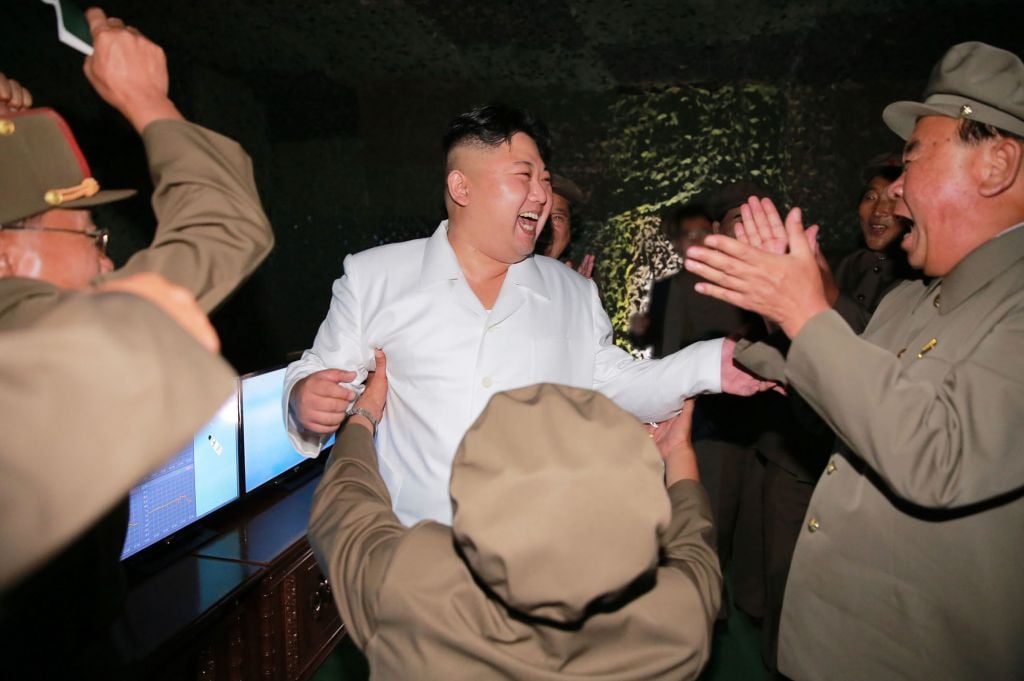
SEOUL, South Korea — North Korean leader Kim Jong Un declared a submarine-launched missile test the “greatest success,” state media said Thursday, as the UN weighed a condemnation of the launch which appears to advance Pyongyang’s nuclear strike capability.
The US mainland and the Pacific are now “within the striking range” of the North’s army, the official KCNA news agency reported Kim as saying after Wednesday’s launch.
The missile was fired from a submarine submerged off the northeastern port of Sinpo on Wednesday, according to South Korea’s military. It flew 500 kilometers (around 300 miles) towards Japan, far exceeding any previous sub-launched tests.
The UN Security Council met for two hours on Wednesday to discuss North Korea’s latest provocative move and agreed to consider a statement condemning the launch.
“There was a general sense of condemnation by most members of the council and therefore we will have to see how we would then be phrasing the press statement,” said Ramlan bin Ibrahim from Malaysia, which currently holds the council’s presidency.
However diplomats expected further haggling with China, Pyongyang’s main ally, over the wording.
Earlier this month, North Korea fired a land-launched ballistic missile directly into Japanese-controlled waters for the first time, drawing an outraged response from Tokyo.
But the Security Council failed to condemn the move after China sought to include language in a statement opposing the THAAD missile defence system that the United States plans to deploy in South Korea.
Kim said the latest launch proved the North had joined the “front rank of the military powers fully equipped with nuclear attack capability.”
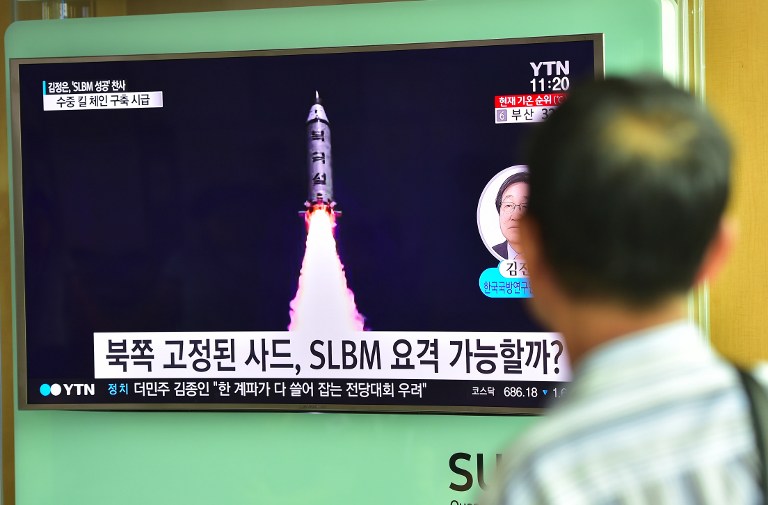
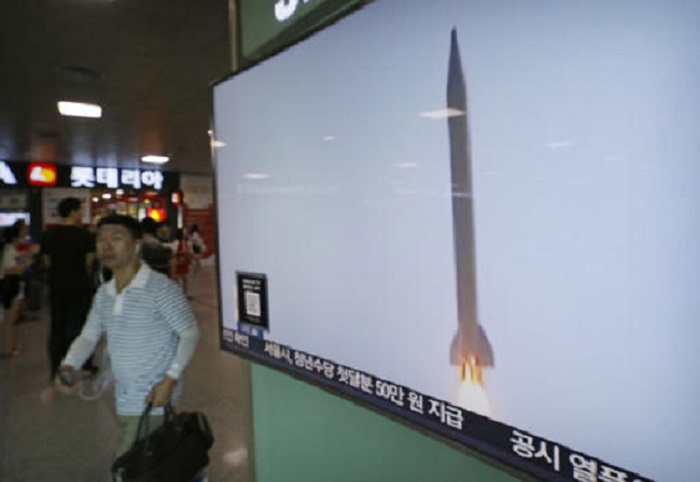
Pyongyang’s KCTV aired brief footage shot from different camera angles, showing the missile soaring from underwater, igniting and surging almost vertically into the air.
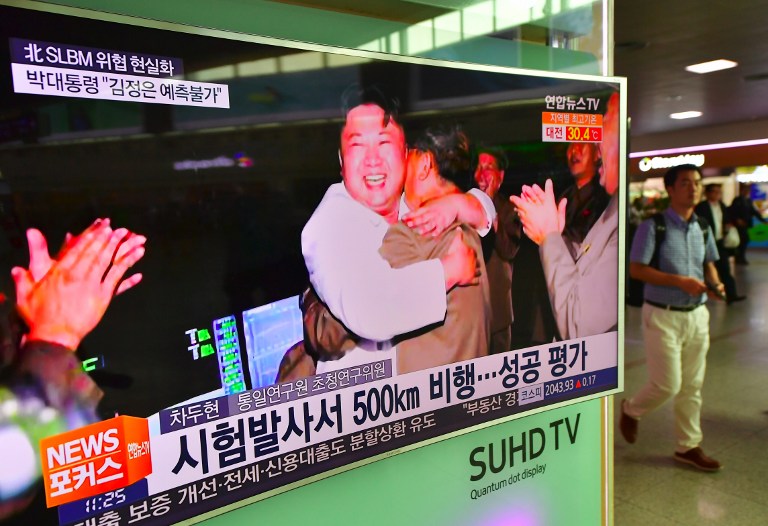
The North’s top newspaper Rodong Sinmun also carried 24 photos of him observing the launch, including one with his hands on his hips roaring with laughter at an observation post, and others watching through a pair of binoculars.
“He appreciated the test-fire as the greatest success and victory,” it said.
‘On track to hit Japan’
Kim called for his nation’s scientists to work towards mounting nuclear warheads on all types of ballistic missiles and to be able to deliver them in order “to cope with the unpredicted total war and nuclear war with the US imperialists.”
“I do not guess what ridiculous remarks the US and its followers will make about this test-fire, but I can say their rash acts will only precipitate their self-destruction,” he was quoted as saying.
A proven submarine-launched ballistic missile (SLBM) system would take its nuclear strike threat to a new level, allowing deployment far beyond the Korean peninsula and a “second-strike” capability in the event of an attack on its military bases.
South Korea’s Yonhap news agency cited a military source as saying Wednesday’s launch had been made at an acute angle to limit the missile’s range.
If fired at the optimum angle and fully fueled, it could travel over 2,500 kilometers (1,500 miles), the source said.
The agency had previously quoted a military source saying if fired at the optimum angle it could cover more than 1,000 kilometers (1,100 miles) — without mentioning if it was fully fueled.
The US-Korea Institute at Johns Hopkins University said on its website, 38 North, that Pyongyang still faces significant technological challenges including building a new class of submarine to carry the missile.
But the North is “on track to the capability to strike targets in the region — including Japan — by 2020,” it said.
The South’s Joint Chiefs of Staff said in a statement following the launch that the North was clearly bent on escalating tensions and that the latest test posed a “serious challenge” to security on the Korean peninsula.
The test came just days after North Korea threatened a pre-emptive nuclear strike against South Korean and US forces who kicked off their annual Ulchi Freedom military drills on Monday.
Current UN resolutions prohibit North Korea from any use of ballistic missile technology, but Pyongyang has continued to carry out numerous launches following its fourth nuclear test in January.
South Korea has responded to Pyongyang’s continued launches by agreeing to deploy a sophisticated US anti-missile system — known as THAAD — a move that has seriously strained relations with North Korea’s main diplomatic ally, China.






The Times of Israel Community.