

Seismic world news buries domestic coverage under the rubble
Thursday’s papers give prominence to the devastating Italy earthquake and the geopolitical tremors caused by Turkey’s incursion into Syria
 Add ToI as a Preferred Source on Google
Raoul Wootliff is a former Times of Israel political correspondent and Daily Briefing podcast producer.
With no earth-shattering developments in Israel compared to the seismic shifts taking place around the world, global news dominates Thursday’s Hebrew media while domestic stories get buried under the rubble.
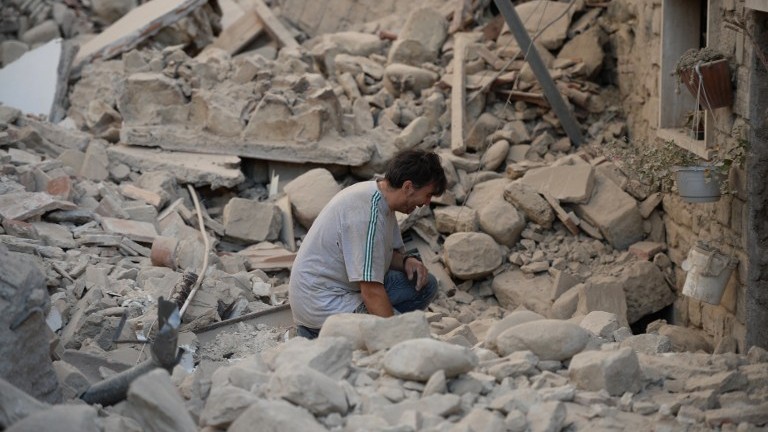
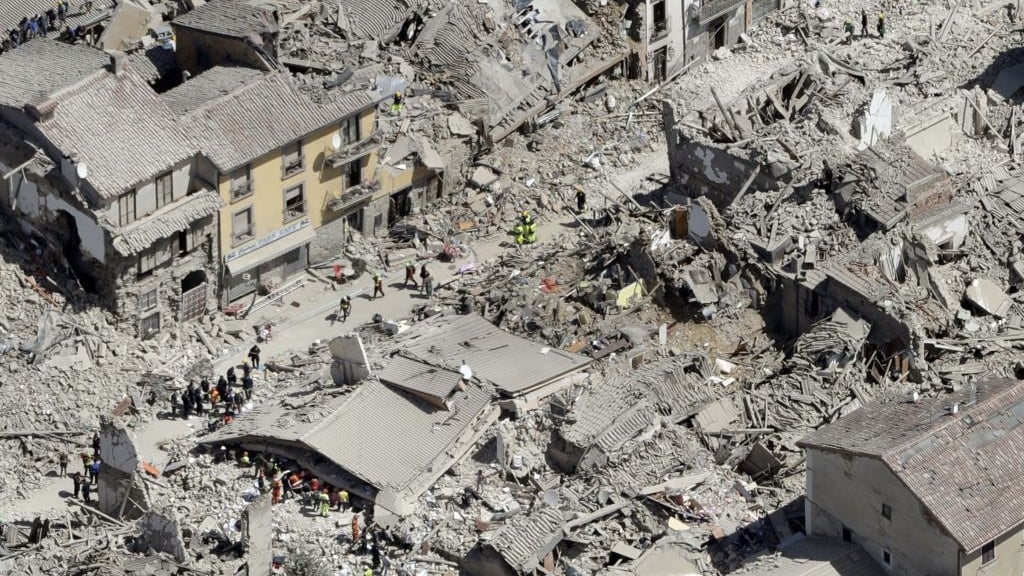
Wednesday morning’s devastating earthquake in Italy takes center stage of all major newspapers with Haaretz, Yedioth Ahronoth and Israel Hayom each running similar photos of people standing amid the destruction of Amatrice, one of the worst-hit towns.
Israel Hayom continues from its front page headline, “The towns that disappeared,” with four full pages of photos and coverage of the quake, which the Italian authorities now say killed 247 people in total.
Yedioth Ahronoth and Haaretz also run extensive coverage of Amatrice and the devastation across Italy, but Israel Hayom is the only of the three to focus on Israel’s earthquake readiness, or lack of it, as the case seems to be.
After its more general coverage of the damage and victims, the paper takes the opportunity to revive repeated warnings that Israel is worryingly ill-prepared for a similar quake, something that experts say is only a matter of time.
“There are currently about 80,000 buildings in Israel with three or more stories that were built before 1980, which will likely collapse in the event of an earthquake. These buildings comprise more than a million housing units,” the paper reports, drawing on an interview with a senior official at the National Emergency Management Authority.
“The assumption is not based only on statistics: Over the last several months, 30 tremors have been recorded inside and near Israel. Most of them occurred in the seas around us, in relatively remote areas in the Mediterranean or the Red Sea, but some of them were felt within Israel as well,” the article concludes.
The latest Turkish involvement in the Syria conflict is the other tumultuous world story to take prominence in the Hebrew papers.
Turkey’s military launched an operation before dawn Wednesday to clear a Syrian border town of its Islamic State militants, and the country’s state-run news agency said Turkish tanks had crossed into Syria as part of the offensive.
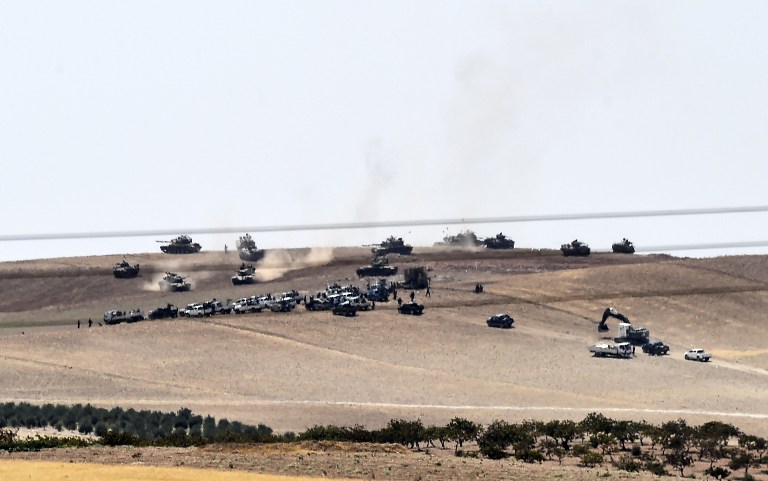
Haaretz’s coverage of the incursion is led by an analysis by correspondent Zvi Bar’el claiming, as the Kurds have, that the move is aimed at ridding the region of Kurdish forces and not targeting Islamic State, as Turkey claims.
“Ostensibly it is a reprisal operation for the mortar fire from Syrian territory early this week and the suicide attack that killed 54 people at a wedding in Gaziantep, only a few dozen kilometers from the battle site. But the Islamic State had committed large attacks before without drawing a Turkish invasion of Syria. The main reason for the incursion was to launch a military plan that had already been drawn up to prevent the Kurds from creating territorial contiguity for themselves,” Bar’el writes.
“Despite Assad’s sharp condemnation of the Turkish invasion, he too wants to prevent the establishment of an independent Kurdish district, and would prefer Turkey as a possible partner over the Kurdish or other rebel groups,” he concludes.
Israel Hayom takes the broad view, offering a look at the geopolitical thinking that could stand behind the Turkish move.
Columnist Reuven Berko says the decision is part of Ankara’s reconciliation with Russia, and even connected to the normalization of ties with Israel.
“It is becoming clear that Turkey has made peace with the fact the Assad is not going anywhere. Within the framework of pragmatic strategic considerations, Turkish Prime Minister Binali Yildirim announced that Assad would serve as a part of a ‘transitional period’ en route to an arrangement in Syria, rather than demanding he be removed.” he writes. “The need for Russian cooperation and gas explains the reconciliation between Erdogan and Russian President Vladimir Putin; and it also led, despite support for Hamas, to the renewal of relations with Israel — as a gas supplier, an economic actor and a broker to the Russians and the West.”
Haaretz’s scoop of the day is also second fiddle to international news in Italy and Turkey.
“Jerusalem’s planned cable car will include a stop in the Palestinian neighborhood of Silwan, so that riders will ‘understand who really owns this city,’ Jerusalem Mayor Nir Barkat told Likud party activists recently,” the paper’s Nir Hasson reports.
“The project is liable to be politically controversial, since the cable car would operate almost entirely in East Jerusalem, near the Temple Mount and various Christian holy sites. About 18 months ago, the French company Safege withdrew from the project, apparently following a request by the Palestinian Authority to the French government.”
Haaretz’s lead editorial takes a further step into domestic politics, using the daily column to shine a a light on what it calls “crony capitalism in the Israeli financial system.”
The editorial takes issue with the decision to foreclose on the NIS 1.8 billion debt of businessman Eliezer Fishman, who owns the business newspaper Globes, to Bank Hapoalim.
“The conduct of the bank arouses heavy suspicion of ‘crony capitalism,’ even more so when the person receiving preferential treatment owns the business newspaper Globes,” Haaretz writes. “If Bank Hapoalim wants to regain the public trust, it must honestly investigate how Fishman was allowed to accrue such a large debt, and not handle him with kid gloves — just as it would do in the case of a private person.”





The Times of Israel Community.