

US pilot describes challenges of bombing Islamic State
‘It really is a fight of good and evil,’ says Lt. Cmdr. William Vuillet, who flies off the USS George H.W. Bush in the Persian Gulf
 Add ToI as a Preferred Source on Google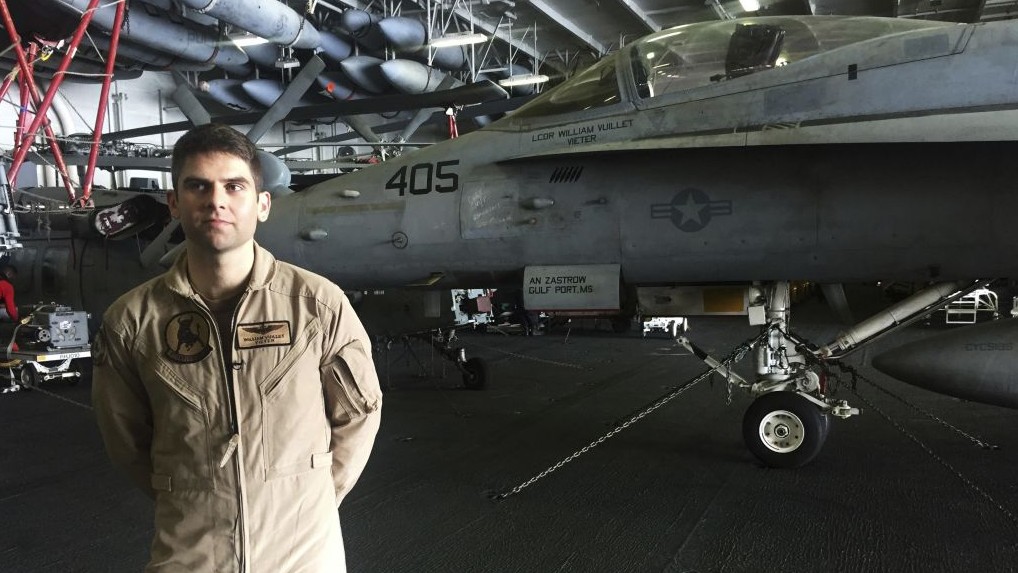
ABOARD THE USS GEORGE H.W. BUSH (AP) — The crowded skies over Islamic State-held territory have complicated US-led airstrikes targeting the extremists, though military planners are working to keep fliers safe, an American pilot involved in the bombing campaign has told The Associated Press.
Lt. Cmdr. William Vuillet also described the efforts American forces use to try to minimize civilian casualties from strikes on major cities like Mosul, where allied forces are trying to sweep the remaining militants out of the western half of Iraq’s second-largest city.
Vuillet said he believes coalition forces will “eradicate” the extremist group responsible for mass killings, beheadings and other atrocities targeting civilians across the Middle East and around the world.
It “is really above and beyond what we saw in the past from al-Qaeda,” he said. “It is really a fight of good and evil.”
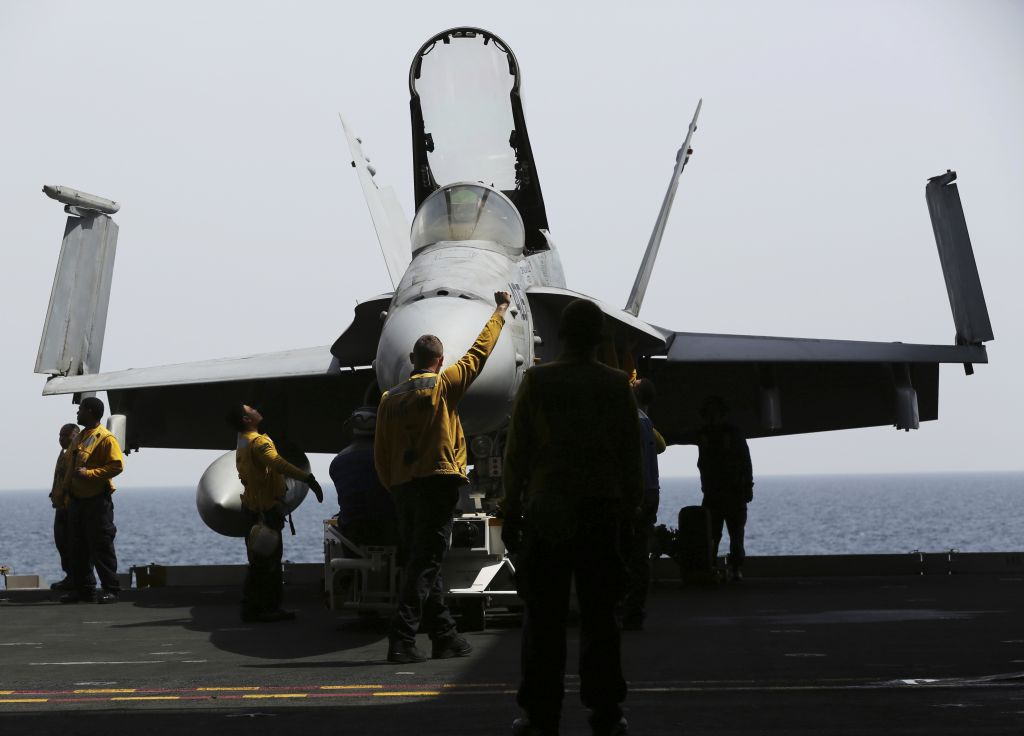
Vuillet, whose hometown is Athens, Georgia, though he grew up in Paris, spoke to the AP near his F-18 fighter jet in one of the hangars onboard the USS George H.W. Bush. The nuclear-powered, Nimitz-class aircraft carrier arrived in the Persian Gulf this week after leaving its homeport of Norfolk, Virginia.
The carrier launched airstrikes targeting the Islamic State group in February as it transited through the Mediterranean Sea. It will resume those strikes in the coming days during its tour of the Gulf, with many coming from Vuillet’s Strike Fighter Squadron 37, which is usually based at Naval Air Station Oceana in Virginia Beach, Virginia.
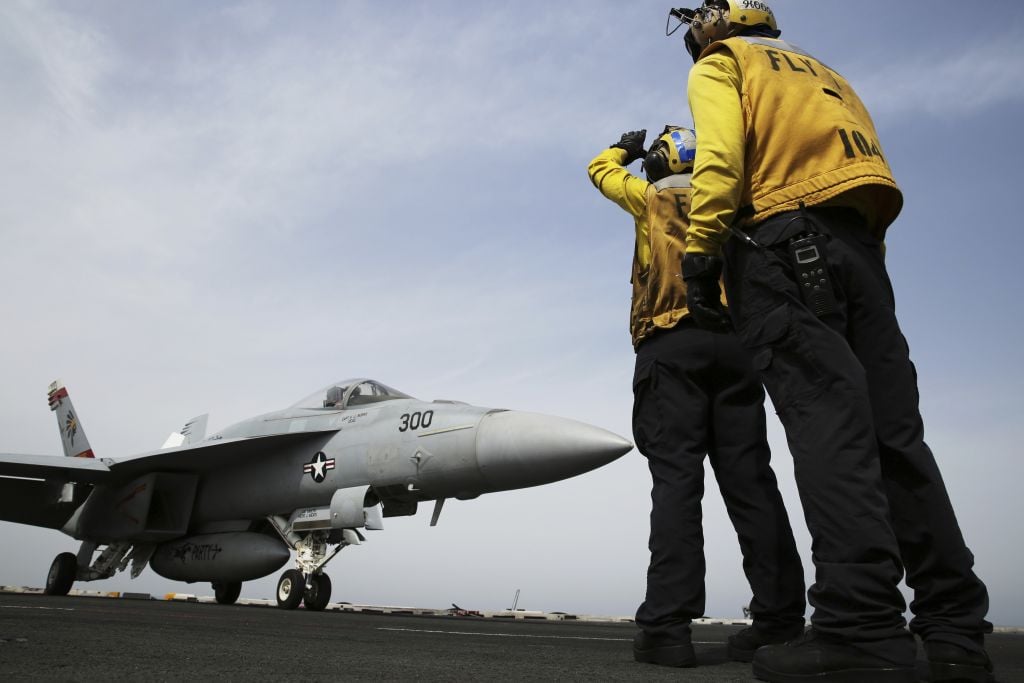
He and other coalition pilots enter an increasingly busy airspace when flying missions against the extremists, especially in Syria. Russian and Syrian aircraft regularly strike insurgents battling to overthrow President Bashar Assad, and Israel carries out occasional strikes aimed at preventing advanced weaponry from falling into the hands of the Lebanese Hezbollah group.
Vuillet, 33, who flies under the call sign “Vieter,” credited US air traffic controllers at the al-Udeid Air Base in Qatar with protecting American pilots. Military officials there also remain in touch with Russian forces and others to ensure nothing goes wrong.
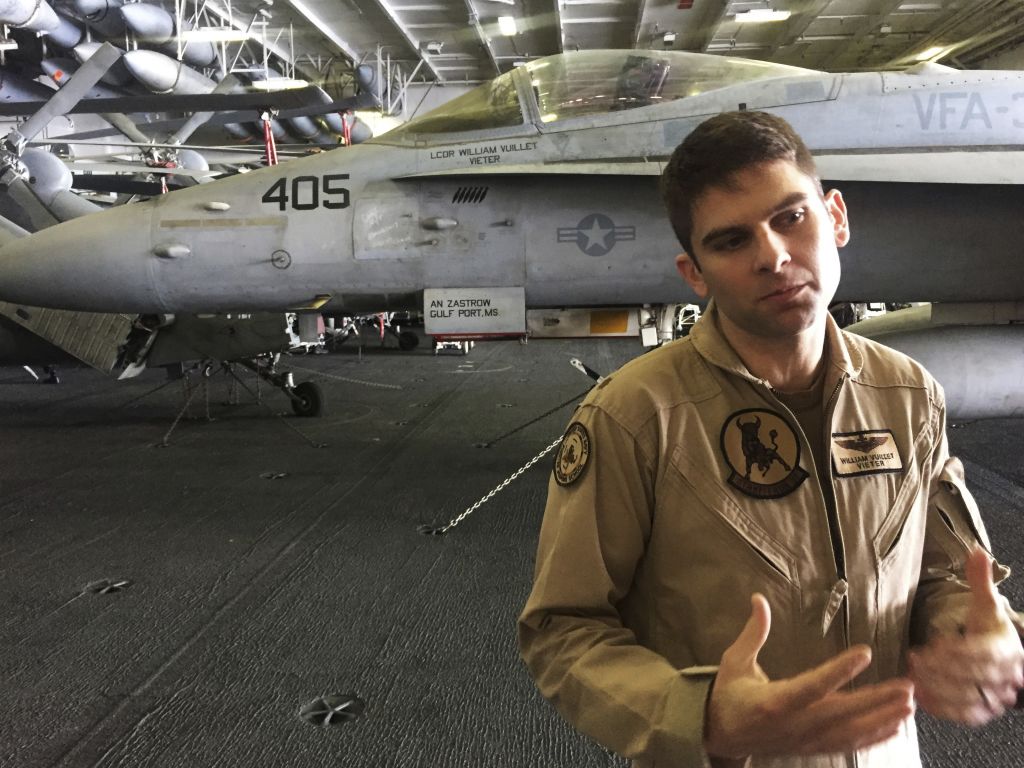
“There’s some de-confliction in terms of timing, de-confliction with altitude,” he said. “There’s also a command-and-control structure that’s in place at all times that we can remain in communication with that provides real-time warning in terms of other aircraft that may be in the air.”
The lieutenant commander previously flew combat missions over Afghanistan, but said the Islamic State fight represented a far different challenge. He said the use of drones has resulted in several close calls for American pilots.
“With the remotely piloted aircraft, obviously there’s no crew on board, so they don’t have the same visual lookout that we do,” Vuillet said. “So it happens every once in a while that we have passes with those.”
Meanwhile, American personnel remain concerned with limiting civilian casualties in their strikes. Airwars, a London-based group that tracks civilian deaths from airstrikes targeting IS in Iraq and Syria, estimates the over 19,000 strikes conducted by the coalition have killed more than 2,700 civilians. The U.S. military’s Central Command says at least 220 civilians have been killed, and that its forces “regret the unintentional loss of civilian lives.”
Vuillet said limiting civilian casualties is a priority, with planners spending “several weeks, up to a month at times,” to pick targets.
“There’s an extremely long vetting process that happens behind the scenes,” he said. “We try to minimize any kind of collateral damage effects we may have by employing … the smallest weapon possible, delaying the fusing sometimes, so basically having that bomb kind of bury itself prior to exploding.”
___
Associated Press writer Fay Abuelgasim contributed to this report.
Copyright 2017 The Associated Press.




The Times of Israel Community.