

Egypt: The body count dispute
Civil strife in Cairo is more dangerous than terrorism in Sinai, one columnist claims
- See more Times of Israel on Google - add us as a Preferred Source
Elhanan Miller is the former Arab affairs reporter for The Times of Israel
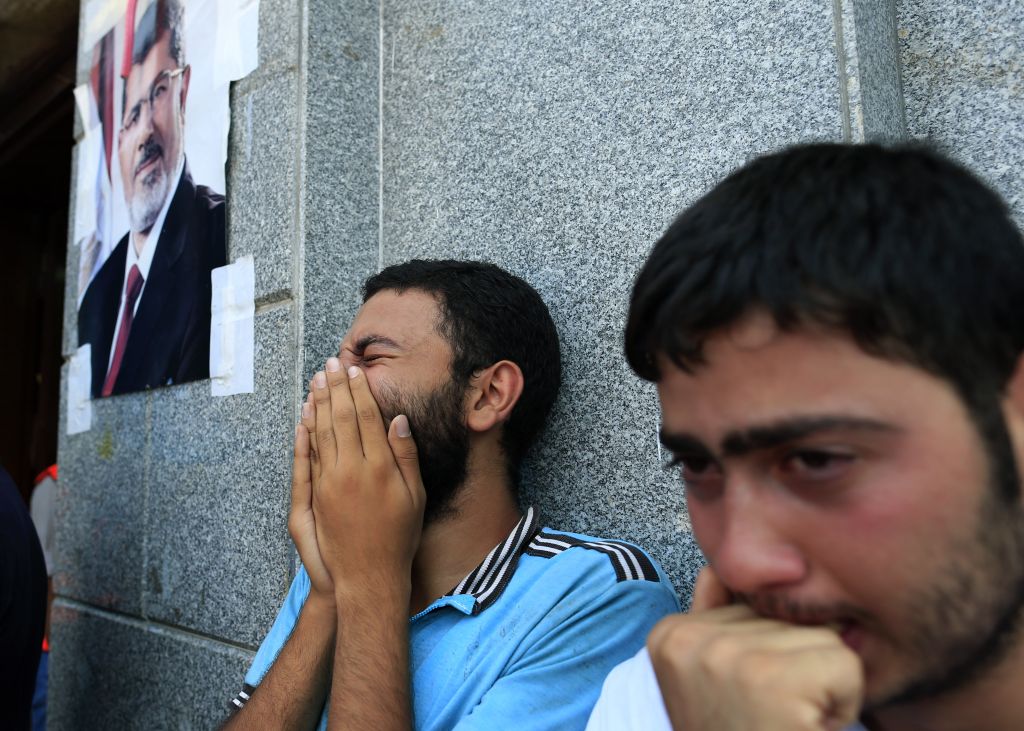
A sharp escalation in violence in Egypt leads the news in Arab media Sunday, as the government prepares to storm a central Cairo square where pro-Morsi demonstrators have been camped out.
“Egypt: The ‘Nasr road’ massacres broadens the gap between the government and the Brotherhood,” reads the headline of London-based daily Al-Hayat, with a featured image of emergency personnel standing amid white body bags, trying to identify the dead.
According to the daily, the police violence against the Islamists in Cairo has pushed undecided Islamist movements and figureheads in Egypt to support the Muslim Brotherhood, laying responsibility for the carnage on the government. Egyptian news websites are also describing the event as “a massacre.”
Saudi-owned daily A-Sharq Al-Awsat leads with the contradictory numbers of casualties and injured in the clashes early Saturday morning. While official Egyptian sources reported 65 dead following Friday’s pro-government demonstrations in Cairo and Alexandria, Muslim Brotherhood leaders spoke of 200 victims and thousands of injured.
Egyptian Interior Minister Major General Mohammed Ibrahim denied that live ammunition was used against the protesters, claiming that pro-Morsi demonstrators will be dispersed in a way that will avoid any casualties.
Qatar-based news station Al-Jazeera, sympathetic to the Muslim Brotherhood, dedicates a TV report to the funerals of the Egyptian demonstrators. Its reporter stands outside a field hospital set up at Rabiah Al-Adawiya square as bodies are taken out on stretchers. A bearded doctor tells the reporter that a large number of wounded were taken to the hospital, mostly shot in the head or the chest by live ammunition. The doctor claims that all medical equipment at their disposal has run out.
In an article titled “Blood on Nasr road,” Egyptian daily Al-Masry Al-Youm reports that some 35 million Egyptians heeded the call of Defense Minister Abdel-Fattah el-Sissi to take to the streets on Friday and empower the government to “fight terror.”
Meanwhile, establishment daily Al-Ahram toes a blatantly pro-government line when reporting that millions of anti-Morsi demonstrators remained on the streets from Friday afternoon into early Saturday morning “to express the Egyptian street’s rejection of all acts of violence or extortion which could jeopardize Egypt’s national security.”
Mohammed Morsi is referred to in the article simply as “the deposed one.”
Al-Hayat columnist Abdullah Iskandar identifies a dangerous transition from verbal and political violence to real violence on the streets of Egypt, which he defines as more dangerous than the jihadist threat emanating from Sinai.
“[In Sinai] there is a limited number of armed gangs. The security apparatus know their members and pursue them, confining the confrontations to the security realm,” writes Iskandar.
“But in these confrontations in the streets and squares, all sectors of Egyptian society are taking part, in addition to the army and the police. This means that it is violence directly connected to the country’s political fragmentation. It will continue as long as all sides do not reach some sort of settlement.”
A-Sharq Al-Awsat columnist Abdullah Al-Oteibi writes that while most Egyptians agree on the ouster of Morsi, they disagree on the way forward.
“It is clear as daylight that the Egyptian people, and the Egyptian state and its institutions … all reject the defunct fundamentalist regime of the Muslim Brotherhood and political Islam in general. But the consensus that must be created should revolve around the declared roadmap and how to follow it with resolve, for disagreement regarding the constructive [program] will be greater than the agreement surrounding the rejection.”
Structural problems within the Muslim Brotherhood have brought about the massive opposition to it among the Egyptian society, argues Al-Masry Al-Youm columnist Amr Shobaki.
“The Brotherhood failed to understand that it is colliding not only with the military, but with all organs of the state and all segments of the Egyptian population. This is taking place not because the latter is secular like Turkey, and has an ideological problem with the Muslim Brotherhood, but because the Muslim Brotherhood is the only one proposing to establish a parallel state which does not recognize the existing state, even tacitly,” writes Shobaki.



The Times of Israel Community.