

US says up to Moscow, Tehran to make ‘decisions’ needed to revive Iran nuclear deal
Washington predicts accord can still be worked out, but not much time left, after Russia derails negotiations with last-minute demands over sanctions imposed for Ukraine invasion
 Add ToI as a Preferred Source on Google
WASHINGTON — The United States on Friday urged Moscow and Tehran to take the “decisions” needed to revive the 2015 Iranian nuclear accord, putting the ball squarely in their camp as last-minute Russian demands threatened to derail the process.
“There will need to be decisions made in places like Tehran and Moscow,” US State Department spokesman Ned Price told reporters after the European Union announced a pause in negotiations on the deal limiting Iran’s nuclear program.
“We are confident that we can achieve mutual return to compliance with the JCPOA if… those decisions are made in places like Tehran and Moscow,” Price said, using the acronym for the deal formally known as the Joint Comprehensive Plan of Action.
The current round of talks between world powers and Iran, taking place in the Austrian capital Vienna, had appeared close to its goal until Russia made a sudden new set of demands last week.
Russia said it wanted guarantees that the Western economic sanctions imposed in retaliation for its invasion of Ukraine would not affect its trade with Iran.
Price told reporters that “the new Russia-related sanctions are wholly and entirely unrelated to the JCPOA” and “shouldn’t have any impact” on the talks.
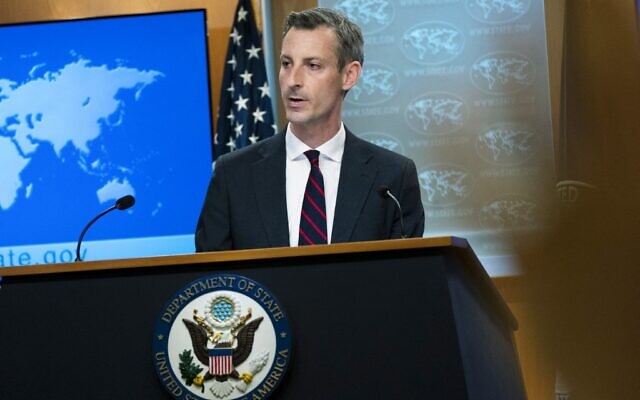
“We have no intention of offering Russia anything new or specific as it relates to these sanctions,” he added.
Price confirmed that the US negotiator, Rob Malley, had returned to Washington with his team for the time being.
Price warned that “there is very little time remaining” to save the accord, which began unraveling when former US president Donald Trump withdrew the US in 2018.
Israel has vowed not to let Tehran get nuclear weapons and has warned that funds from an Iranian economy freed from sanctions will enable Iran to step up support for its proxies across the Middle East, including Lebanon’s Hezbollah terror group.
Iran’s Supreme Leader Ayatollah Ali Khamenei said Thursday that Tehran will not bow to pressure to reduce its “defensive power,” regional proxies, or progress in nuclear technology.



The Times of Israel Community.