

Police recommend indicting head of outlawed Islamic group
Sheikh Raed Salah investigated for incitement to terror and violence on social media, supporting a banned organization
 Add ToI as a Preferred Source on Google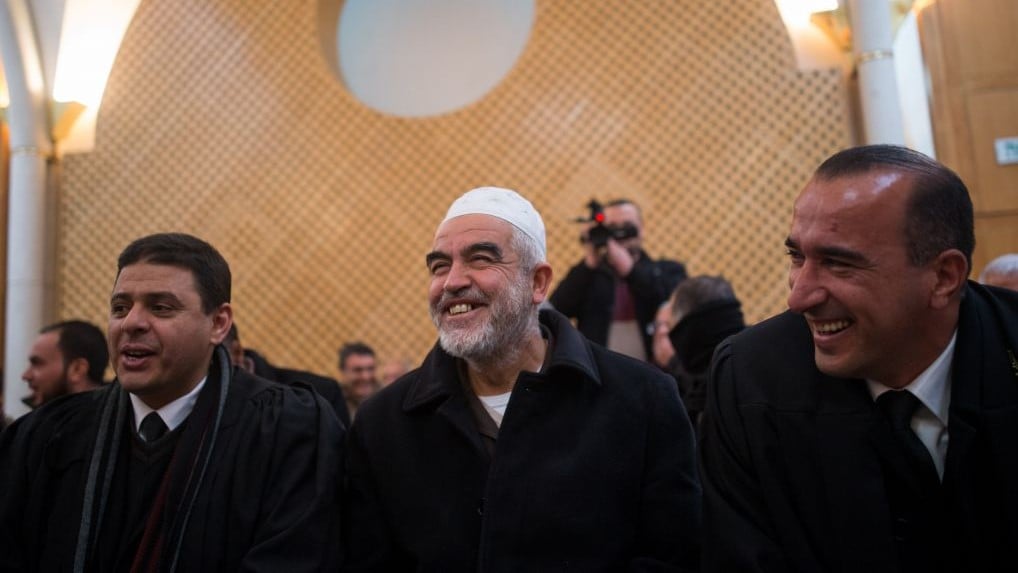
Police said Thursday they had recommended indicting Sheikh Raed Salah, the head of an outlawed Islamist group, on suspicion of incitement to terrorism and violence, as well as supporting an illegal organization.
In a statement, police said an investigation into Salah was completed last week and that the case had been passed to Haifa District prosecutors for review.
Salah is currently serving a nine-month sentence for a previous conviction of incitement and is due to be released from prison next month. Investigators began questioning the sheikh about the recent allegations in December. They apparently concern evidence from before he began serving out his prison sentence.
The investigation into Salah, head of the Northern Branch of the Islamic Movement, by police’s Lahav 433 major crimes unit was launched with the approval of the State Attorney’s Office, police spokeswoman Luba Samri said in a statement.
Salah had expressed support for the Northern Branch on multiple social media platforms since the organization was outlawed last year, the statement said. He also openly talked about his position within the organization.
Police said his online statements and own confirmation of his role in the Northern Branch amounted to incitement.
Last year, Israel banned the radical northern branch of the Islamic Movement, accusing it of links to terrorist groups and of stoking the recent wave of Palestinian terrorism and violence that has seen 40 Israelis, two Americans and an Eritrean national killed in a spate of stabbing, car-ramming and shooting attacks. Some 238 Palestinians, a Jordanian and a Sudanese migrant have also been killed, according to AFP figures, most of them in the course of carrying out attacks, Israel says.
After the security cabinet declared the movement illegal last September, then-defense minister Moshe Ya’alon signed an edict banning any activity connected to the group.
In May 2016, Salah entered prison following a conviction of incitement to violence and racism over an inflammatory sermon he delivered in 2007 in Jerusalem. He began a hunger strike in November to protest his prison conditions, which Palestinian media said included solitary confinement.
During the sermon that put him in jail, Salah expressed hope that “the streets of Jerusalem be purified with the blood of the innocent, who shed it in order to separate from their souls the soldiers of the Israel occupation, also in the blessed Al-Aqsa Mosque.” He further said that “our finest moment will be when we meet Allah as martyrs in Al-Aqsa.”
Founded in the 1970s, the Islamic Movement is not just a political organization but also a religious outreach group and social service provider rolled into one. The movement’s overarching goal is to make Israeli Muslims more religious and it owes much of its popularity to providing services often lacking in Israel’s Arab communities. Today the group runs kindergartens, colleges, health clinics, mosques and even a sports league – sometimes under the same roof.
The movement split two decades ago. The more moderate southern branch began fielding candidates for Israel’s Knesset in 1996 and is now part of the Joint (Arab) List, an alliance of several Arab-Israeli political parties. Three of the Joint List’s 13 current Knesset members are part of the movement. The more hard-line northern branch rejects any legitimization of Israel’s government and has called on its adherents to boycott elections.
It also rejects the Oslo peace accords between Israel and the Palestinians and boycotts national elections on the grounds that they give legitimacy to the existence of the Jewish state.



The Times of Israel Community.