

Several Americans among Kenya attackers, says official
Security expert says at least 10 hostages remain as government tries to end standoff with al-Qaeda-linked group
 Add ToI as a Preferred Source on Google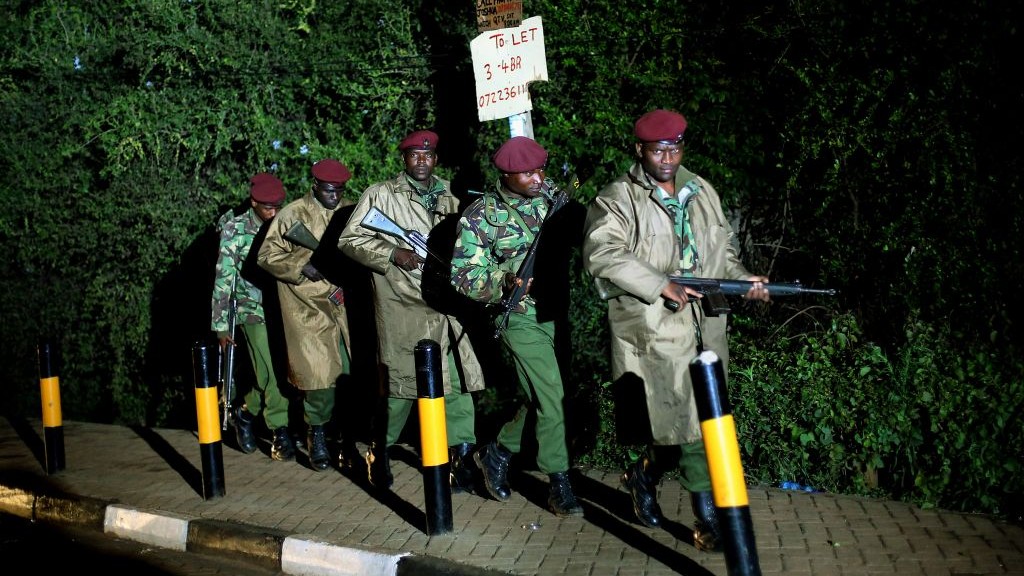
Kenya’s foreign minister says “two or three Americans” and “one Brit” were among those who attacked a Nairobi shopping mall. 62 people have been killed in the assault on the upscale mall, which has lasted for three days.
The foreign minister, Amina Mohamed, said in an interview with the Public Broadcasting Service’s “NewsHour” program that the Americans were 18 to 19 years old, of Somali or Arab origin and lived “in Minnesota and one other place” in the US.
US officials said they were looking into whether any Americans were involved. State Department spokeswoman Jen Psaki said Monday the department had “no definitive evidence of the nationalities or the identities” of the attackers.
Authorities in Kenya are trying to wrap up their standoff with al-Shabab, a group allied with al-Qaeda, and to rescue the remaining few hostages.
While the government announced Sunday that “most” hostages had been released, a security expert with contacts inside the mall said at least 10 were still being held by a band of attackers described as “a multinational collection from all over the world.”
The expert, who insisted on anonymity to talk freely about the situation, said many hostages had been freed or escaped in the previous 24-36 hours, including some who were in hiding.
However, there were at least 30 hostages when the assault by al-Shabab militants began Saturday, he said, and “it’s clear” that Kenyan security officials “haven’t cleared the building fully.”
Flames and dark plumes of smoke rose Monday above the Westgate shopping complex for more than an hour after four large explosions rocked the surrounding neighborhood. The smoke was pouring through a large skylight inside the mall’s main department and grocery store, where mattresses and other flammable goods appeared to have been set on fire, a person with knowledge of the rescue operation told The Associated Press.
The explosions were followed by volleys of gunfire as police helicopters and a military jet circled overhead, giving the neighborhood the feel of a war zone.
By evening, Kenyan security officials claimed the upper hand.
“Taken control of all the floors. We’re not here to feed the attackers with pastries but to finish and punish them,” Police Inspector General David Kimaiyo said on Twitter.
Kenya’s Interior Minister Joseph Ole Lenku said the evacuation of hostages had gone “very, very well” and that Kenyan officials were “very certain” that few if any hostages were left in the building.
But with the mall cordoned off and under heavy security it was not possible to independently verify the assertions. Similar claims of a quick resolution were made by Kenyan officials on Sunday and the siege continued. Authorities have also not provided any details on how many hostages were freed or how many still remain captive.
Three attackers were killed in the fighting Monday, Kenyan authorities said, and more than 10 suspects arrested. Eleven Kenyan soldiers were wounded in the running gun battles.
Somalia’s al-Qaida-linked rebel group, al-Shabab, which claimed responsibility for the attack, said the hostage-takers were well-armed and ready to take on the Kenyan forces.
An al-Shabab spokesman, Sheik Ali Mohamud Rage, said in an audio file posted on a militant website that the attackers had been ordered to “take punitive action against the hostages” if force was used to try to rescue them.
The attackers have lots of ammunition, the militant group said in a Twitter feed, adding that Kenya’s government would be responsible for any loss of hostages’ lives.
A Western security official in Nairobi who insisted on not being named to share information about the rescue operation said the only reason the siege hadn’t yet ended would be because hostages were still inside.
Westgate mall, a vast complex with multiple banks that have secure vaults and bulletproof glass partitions, as well as a casino, is difficult to take, the official said. “They are not made for storming,” he said of the labyrinth of shops, restaurants and offices. “They’re made to be unstormable.”
At least 62 people were killed in the assault Saturday by some 12 to 15 al-Shabab militants wielding grenades and firing on civilians inside the mall, which includes shops for such retail giants as Nike, Adidas and Bose and is popular with foreigners and wealthy Kenyans.
The militants specifically targeted non-Muslims, and at least 18 foreigners were among the dead, including six Britons, as well as citizens from France, Canada, the Netherlands, Australia, Peru, India, Ghana, South Africa and China. Nearly 200 people were wounded, including five Americans.
Fighters from an array of nations participated in the assault, according to Kenya Chief of Defense forces Gen. Julius Karangi. “We have an idea who these people are and they are clearly a multinational collection from all over the world,” he said.
In the United States, the FBI was looking into whether Americans were involved in the attack, said FBI spokesman Paul Bresson.
Al-Shabab, whose name means “The Youth” in Arabic, said the mall attack was in retribution for Kenyan forces’ 2011 push into neighboring Somalia. It was the deadliest terrorist attack in Kenya since the 1998 al-Qaida truck bombing of the US Embassy in Nairobi, which killed more than 200 people.
An extremist Islamic terrorist force that grew out of the anarchy that crippled Somalia after warlords ousted a longtime dictator in 1991, al-Shabab is estimated to have several thousand fighters, including a few hundred foreigners, among them militants from the Middle East with experience in the Iraq and Afghanistan conflicts. Others are young, raw recruits from Somali communities in the United States and Europe.
Somali President Hassan Sheikh Mohamud said the attack showed that al-Shabab was a threat not just to Somalia but to the international community.
Reports that some of the attackers may have been Somalis who lived in the United States illustrate the global nature of the militant group, the Somali leader said in a speech at Ohio State University. “Today, there are clear evidences that Shabab is not a threat to Somalia and Somali people only,” he said. “They are a threat to the continent of Africa, and the world at large.”
As the crisis passed the 48-hour mark, a video emerged that was taken by someone inside the mall’s main department store when the assault began. It video showed frightened and unsure shoppers crouching as long, loud volleys of gunfire could be heard.
Kenyans in many parts of the country stood in long lines Monday to donate blood to aid the nearly 200 people injured in the attack. Fundraisers raised hundreds of thousands of dollars, though government officials warned of scam artists taking advantage of the tragedy.







The Times of Israel Community.