

 From the Liveblog of
Wednesday, July 15, 2026
From the Liveblog of
Wednesday, July 15, 2026
Coalition passes law gutting powers of attorney general, removing key check on government power; Netanyahu skips the vote
 Add ToI as a Preferred Source on Google
Ariela Karmel is a political correspondent at The Times of Israel. She previously reported for Calcalist and Haaretz. She holds an MA in Middle Eastern and African History from Tel Aviv University and a BA in Political Science from the University of British Columbia.

The Knesset votes 65-51 to pass a law significantly weakening the power of the attorney general – one of Israel’s few checks on executive power – after over eleven hours of opposition and later coalition filibustering.
The legislation effectively strips the attorney general of authority over the government by allowing ministers to disregard the attorney general’s currently binding legal opinions and decide for themselves whether their actions are lawful. It also grants the coalition effective control over appointing and dismissing the person holding the office, replacing the current system under which the cabinet acts on the recommendation of an independent public committee headed by a retired Supreme Court justice.
Prime Minister Benjamin Netanyahu was absent from both the eleven-hour plenary discussion and the vote itself. He similarly was not present at a vote yesterday to freeze the arrest of ultra-Orthodox draft evaders and Monday’s vote to designate Torah study a foundational value of Israel.
Knesset Constitution, Law and Justice Committee chairman and Religious Zionism MK Simcha Rothman, who spearheaded today’s legislation, celebrates the law’s passage, calling it “a historic change” that “restores legal advice to its natural role” and “strengthens Israeli democracy.”
Rothman also vows to revive provisions dropped from the original bill to split the attorney general’s role and strip it of the authority to indict senior elected officials, which were shelved as the coalition raced to pass the current legislation before the Knesset dissolves on Friday.
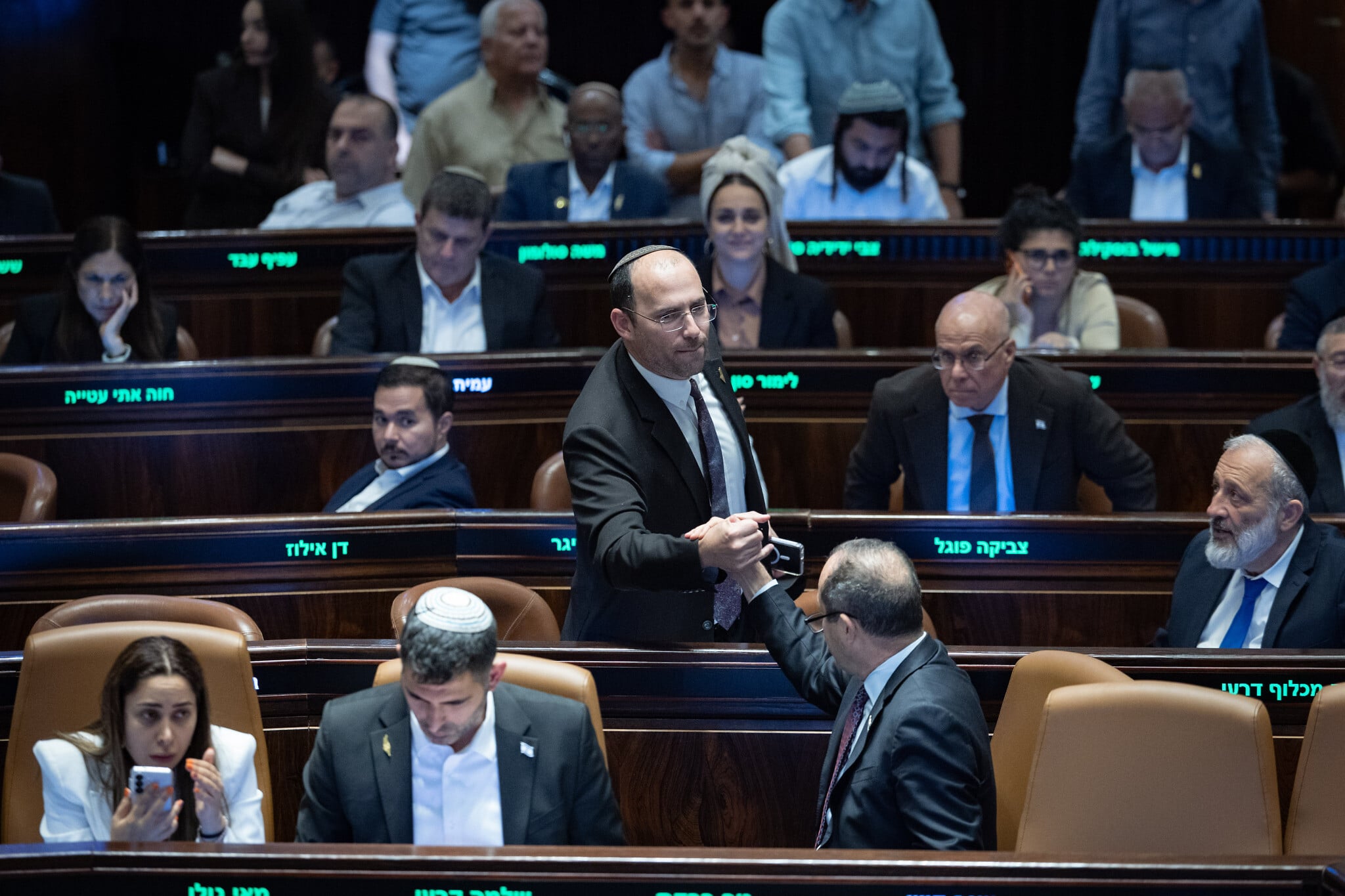
“We will pass the second part of the attorney general reform after the election, God willing, and, with the mandate the public gives us, continue reforming the judicial system,” Rothman says.
The vote followed a small coalition crisis in which United Torah Judaism MK and Degel HaTorah faction leader Moshe Gafni threatened to withhold support for the law unless the government first approved tens of millions of shekels in additional funding for daycare teachers in the Haredi school system. As a result, Rothman delayed proceedings by speaking for more than an hour and a half until coalition leaders resolved the crisis.
The attorney general law has been championed by the coalition, whose members argue that it restores power to elected officials from an overly powerful attorney general. But opposition lawmakers, good-governance watchdogs and Attorney General Gali Baharav-Miara herself argue that the bill is intended to eliminate one of the government’s sole checks on its power, allowing it to advance legislation and policies that would otherwise be blocked as unlawful, without establishing any alternative safeguards.
Unlike most other democracies, Israel has few checks on executive power, lacking a bicameral legislature, representative constituencies, a written constitution or fixed term limits, making the role of the attorney general particularly significant.








The Times of Israel Community.