

‘We will not accept a fait accompli’
Muslim Brotherhood supporters march on seven embassies in call for Morsi to be released, democracy to be upheld
- See more Times of Israel on Google - add us as a Preferred Source
Michael Bassin is a founding member of the Gulf-Israel Business Council, a co-founder at ScaleUpSales Ltd, and the author of "I Am Not a Spy: An American Jew Goes Deep In The Arab World & Israeli Army."
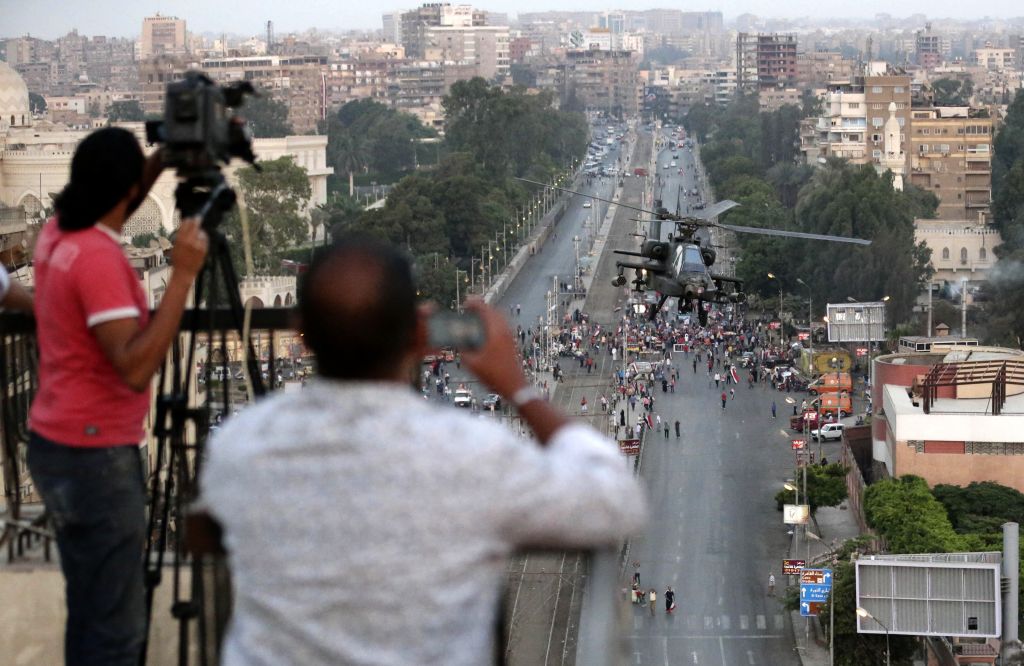
Supporters of the Muslim Brotherhood in Egypt marched on the embassies of seven democratic countries on Sunday afternoon to protest the international community’s compliance with the toppling of the democratically-elected former president Mohammed Morsi, Arab media reports.
“Muslim Brotherhood marches on seven embassies to protest Morsi’s isolation” reads the headline of the Saudi-owned daily A-Sharq Al-Awsat. Carrying pictures of loved ones killed in clashes and shouting “We will not accept a fait accompli,” hundreds of Muslim Brotherhood loyalists protested outside the embassies of Germany, France, Canada, Japan, South Korea, the United Kingdom, and the United States.
“The people are marching to demand a complete rejection of the military coup by these nations,” said Ahmed Aref, a spokesman for the Muslim Brotherhood. “If they do not, it shows that the countries that proclaim the principles of democracy are in fact the first to turn against those same principles. The Egyptian people are waiting and waiting for these countries to condemn the coup. This is not a position that will change.”
Historically, the Muslim Brotherhood has opposed Western influence in Egypt and denounced Western nations’ systems of governments as corrupt and un-Islamic. The irony that now the Muslim Brotherhood cries out for the West’s support has not been lost on critics who blame the group’s downfall on its refusal to include other political groups in the governmental process.
“The leaders of the Brotherhood have so quickly changed the language they communicate in to English,” writes Abdel-Halim Qandil in an op-ed called “Brotherhood suicide” in the London-based Al-Quds Al-Arabi. “That is the language best understood by the residents of the White House. They’ve changed the language on their banners at their protests and stopped calling for Sharia because they know deep down what they are doing. They have run over Egyptian law and Islamic law. They wanted to keep all power for themselves. They have no hope but to appeal to the Americans, Europeans, and Israelis to intervene in Egypt.”
Still, the Muslim Brotherhood’s refusal to stay silent since its government was deposed by the Egyptian Armed Forces continues to instigate violence by both its supporters and its detractors. Since Morsi’s overthrow on July 3, over 100 Egyptians have been killed in politically-motivated clashes.
The London-based pan-Arab daily Al-Hayat is the first Arab media outlet to report on clashes that erupted in Suez in the late hours of Sunday evening during an impromptu pro-Muslim Brotherhood protest. Witnesses stated that Morsi supporters began to attack locals who supported the former president’s ouster right after evening prayers.
Live ammunition, smoke bombs, stones, and knives were used as an all-out street brawl ensued. Forty-five people have been hospitalized so far with no word yet on fatalities.
Critics of the Muslim Brotherhood argue that the group’s leadership is very much aware that there is no scenario in which their group can return to power. The chaos and instability the group is instigating in Egypt is a tactic designed to improve its negotiating position with the new government. The Brotherhood is not concerned with developing a real political solution to deal with the current situation.
Dr. Mustafa Kamel El Sayed, a political science professor at the American University of Cairo, told the Dubai-based media channel Al-Arabiya that the violence being threatened and carried out by Muslim Brotherhood activists is designed to hide the major strategic failure of the movement as a whole.
“The return of the president is impossible,” El Sayed explains. “There has been no popular movement that has ever succeeded in demolishing a regular army in all of history. The Brotherhood has lost all popular sympathy and is capable now of only mobilizing the most loyal members of its group and not a real majority of Egyptians.”
Though there may be truth to this, Egypt’s new leadership cannot tolerate chaos indefinitely. If acting Egyptian President Adly Mansour and his cabinet cannot entice the Muslim Brotherhood with enough carrots to cooperate, attacks on government institutions and supporters may become bolder.
Ahmed Aref, the Muslim Brotherhood’s official spokesman, claims the movement is unfazed by the impasse with the current government.
“We did not create the impasse,” he says. “So why should we have to come up with a way to solve it.”





The Times of Israel Community.