

3 weeks into hunger strike, Palestinian inmates add vitamins
Physicians for Human Rights-Israel slams proposal to import doctors to force feed prisoners, set up field hospitals
 Add ToI as a Preferred Source on Google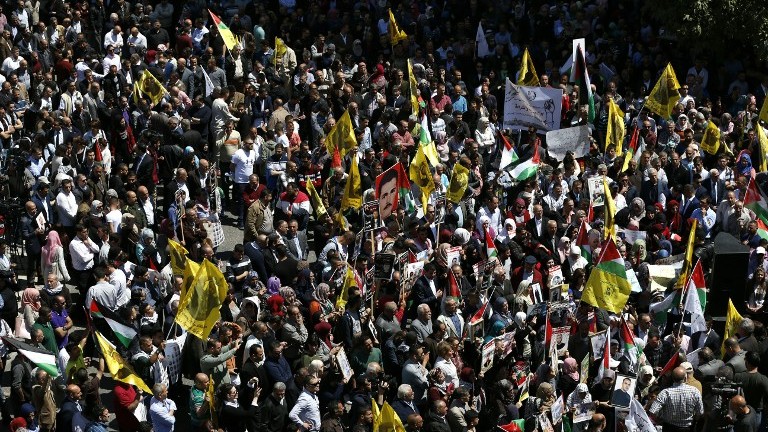
An activist said hundreds of Palestinians participating in a hunger strike in Israeli prisons have begun taking vitamin supplements.
The strike entered its 21st day Sunday. Israel said 890 prisoners are participating.
Qadoura Fares, head of an advocacy group for Palestinian prisoners, said the hunger strikers began taking supplements on day 15. He said guards stepped up punishment, seizing all personal items and leaving prisoners “with nothing except their beds.”
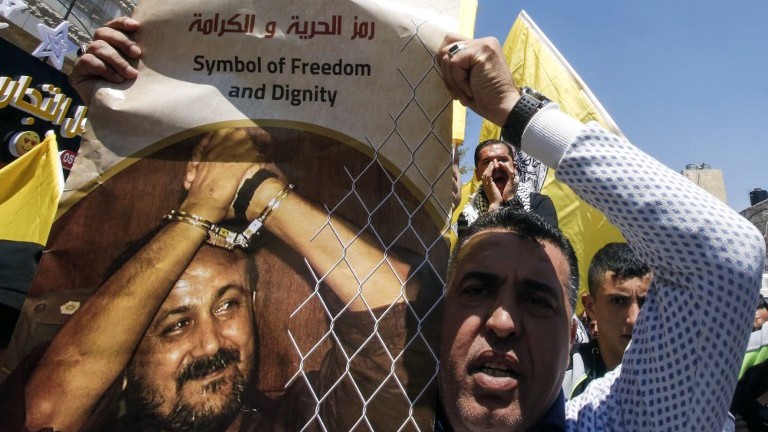
Fares said strike organizer and convicted murderer Marwan Barghouti remains in solidarity confinement. He said the information comes from lawyers who recently visited the strikers.
The spokesman for the Israel Prison Service could not be reached for comment, but the claim came hours before the agency released a video apparently showing Barghouti sneaking food on two occasions.
Also on Sunday Physicians for Human Rights-Israel (PHRI) wrote a letter to the World Medical Association condemning a proposed plan by the Israel Prison Service to bring doctors from abroad to force-feed Palestinian prisoners participating in the hunger strike.
The organization called on the WMA to instruct doctors around the world not to cooperate with the plans which it says is a violation of medical ethics.
“There is concern that the Ministry of Health in particular and the Israeli health system in general will become the instrument of the policies of the Ministry of Public Security and the Israeli Prison Service, contrary to their mission and medical ethics, while blurring the line between security considerations and the patient’s well-being and medical needs,” the organization wrote.
Although Israeli legislation allows for the forced feeding of prisoners, the Israeli Medical Association has barred its members from doing so.
Force-feeding prisoners by tube against a person’s will has been prohibited since 1975 by the World Medical Association’s Tokyo Declaration, provided that the prisoner is “capable of forming an unimpaired and rational judgment.” The procedure can result in extreme pain and in severe bleeding and spreading of various diseases.
In addition PHRI slammed plans to open a field hospital in Ketziot Prison in which to treat the striking prisoners.
“Treatment of the hunger strike within the incarceration system, in IPS facilities and in field hospitals operated by the army — which will operate in the form of a closed military camp without transparency and external supervision — heightens the risk of violation of medical ethics and the undermining of the trust of the hunger striker in those giving treatment,” the letter read. Furthermore, “this can lead to an incorrect assessment of the situation by medical personnel and may expose the strikers to unnecessary risks and even increase the chances of loss of life,” the organization wrote.
Some 6,500 Palestinians are currently detained by Israel for a range of terror offenses and crimes. Around 500 are being held under Israel’s system of administrative detention, which allows for imprisonment without charge.
Palestinian prisoners have mounted repeated hunger strikes, but rarely on such a scale.
Among the demands made by Barghouti — who is serving five life terms for murder in the second intifada — and fellow prisoners are the resumption of a second monthly visit by family members (a benefit that was canceled by the International Committee of the Red Cross last year due to budget cuts), the prevention of family meetings being canceled for security reasons, extending the length of each visit from 45 minutes to an hour and a half, and the restoration of academic studies and matriculation exams for prisoners. Other demands include more television channels being available in cells and the installation of public telephones in security wings.









The Times of Israel Community.