

At Peres funeral, PM and Abbas shake hands, but won’t shake up peace process
Despite his not-so-subtle digs at Netanyahu, Obama went home without any apparent effort to bring Jerusalem and Ramallah closer together
 Add ToI as a Preferred Source on Google
Raphael Ahren is a former diplomatic correspondent at The Times of Israel.
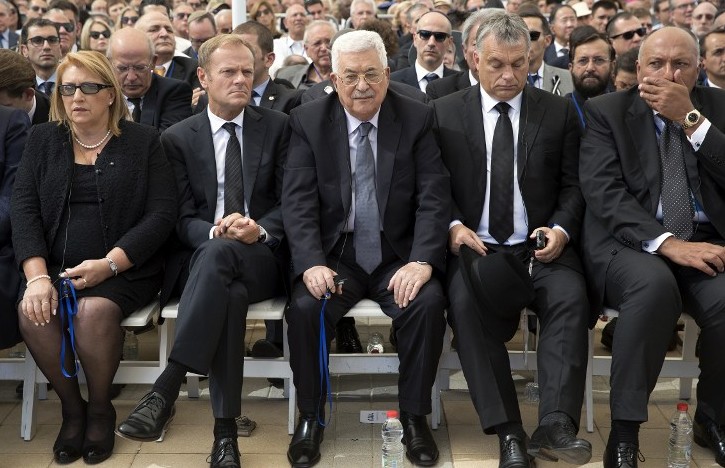
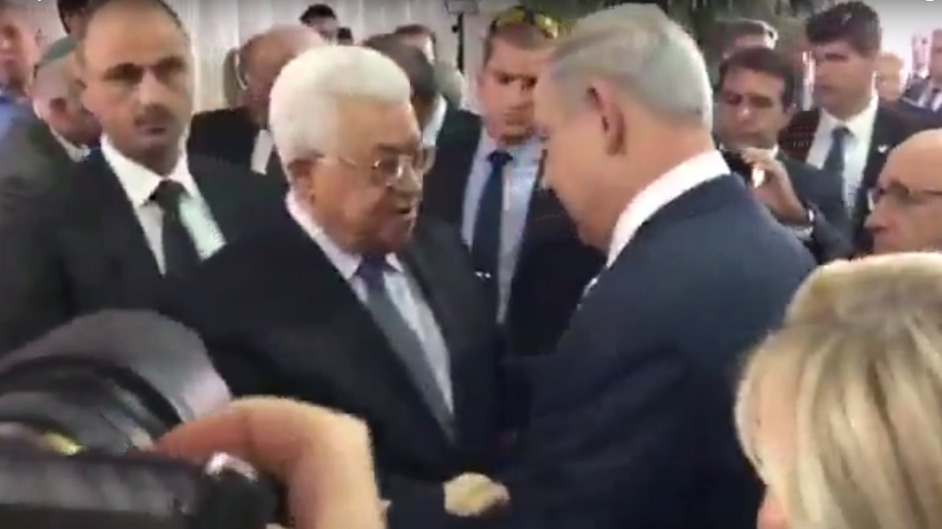
At their impromptu meeting at Shimon Peres’s funeral, Palestinian Authority President Mahmoud Abbas told Prime Minister Benjamin Netanyahu that it had been a “long time” since the two met. Indeed, the last proper meeting between the leaders that was more than a mere handshake (as during the famously photobombed meeting at the Paris climate conference) took place more than half a decade ago.
“I’m so happy. I am looking forward to having you in our house,” the prime minister’s wife, Sara, told her guest from Ramallah. “We’re waiting for you.”
Much was made of the Abbas-Netanyahu handshake. The European Union’s foreign policy czar, Federica Mogherini, for instance, posted a video of the 20-second encounter on her Twitter account, adding that “there is still hope for peace.”
But given the current climate, it could be a long time before Netanyahu and Abbas will meet again. Despite the friendly handshake between Netanyahu and Abbas, and notwithstanding the aggressive exhortation by Amos Oz, Israel’s most well-known novelist, and the not-so-subtle plea by US President Barack Obama, Friday’s funeral will most likely not result in tangible progress in the stalled peace process.
In 1995, Yasser Arafat refrained from attending Yitzhak Rabin’s funeral, and so Abbas and his chief negotiator Saeb Erekat took a significant step Friday by coming to Jerusalem’s Mount Herzl, which is named after the man who first articulated an idea that resulted in what Palestinians call the Nakba, their national catastrophe.
https://www.youtube.com/watch?v=5nhvMAxOev8&feature=youtu.be
But until Obama took the podium as the last speaker of the day, no one even acknowledged the presence of the Palestinian delegation.
Greeting dignitaries “from near and far,” Netanyahu mentioned by name Obama and his predecessor Bill Clinton, Spain’s King Felipe, Prince Charles and even the Grand Duke of Luxemburg. Israel does not recognize a Palestinian state, and diplomatic protocol thus does not consider Abbas a head of state. But on a day dedicated to honoring a man who fought tirelessly for peace and reconciliation, Netanyahu could have done more to acknowledge Abbas.
Shimon Peres was much more than the Oslo Accords, and many of the eulogies by Israeli officials and his family members chose not to focus their remarks on the peace process. Those who did made sure to stick to praising Peres for his vision and refrained from openly criticizing Israel’s current leadership.
The first speaker to become political was Oz.
“There are those who say peace is not possible. But peace is not only possible, it is necessary, it’s inevitable, simply because we are not going anywhere — we have nowhere to go from here — and also the Palestinians are not going anywhere from here,” he said. “Deep in their hearts, almost everyone, on all sides, know this truth. But where are the courageous leaders to rise and continue on [Peres’s] path? Where are Shimon Peres’s successors?”
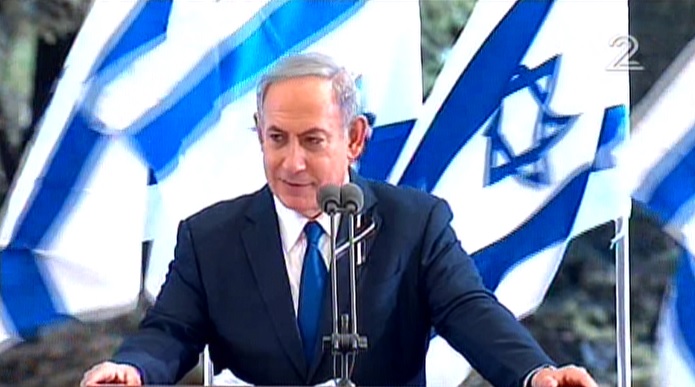
Netanyahu, in his eulogy, did not hide the “differences of opinion” he had with the late president, whom he had beaten in the 1996 elections for prime minister.
Netanyahu even recalled a passionate debate he recently had with Peres about the most essential question: From Israel’s perspective, what is paramount — security or peace?
“Bibi, peace is the true security. If there will be peace, there will be security,” Netanyahu recalled Peres as saying. “Shimon,” the prime minister replied, “in the Middle East, security is essential for achieving peace and for maintaining it.”
The “surprising conclusion” Netanyahu reached was that both philosophies are right, he continued. “In a turbulent Middle East in which only the strong survive, peace will not be achieved other than by permanently preserving our power. But power is not an end in itself.
It’s a means to an end. That goal is to ensure our existence and coexistence. To promote progress, prosperity and peace – for us, for the nations of the region, and for our Palestinian neighbors.”
Obama, who at the beginning of his remarks noted that Abbas’s presence “is a gesture and a reminder of the unfinished business of peace,” appeared to fundamentally agree with Netanyahu’s theory.
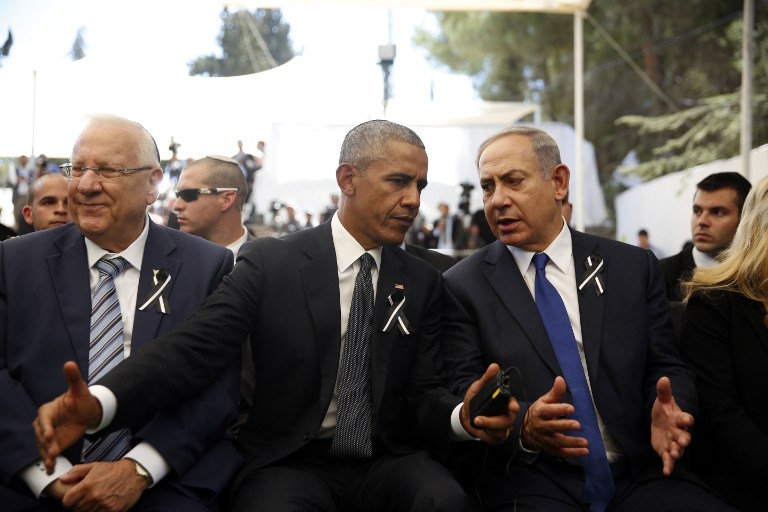
“I don’t think he was naive,” Obama said of Peres. “He understood from hard-earned experience that true security comes through making peace with its neighbors.”
Peres would say that “Jewish people weren’t born to rule another people,” and oppose the ideal of “slaves and masters,” the president continued. “Even in the face of terrorist attacks, even after repeated disappointments at the negotiating table, he insisted that as human beings, Palestinians must be seen as equal in dignity to Jews and must therefore be equal in self-determination.”
It is not only Peres’s sense of justice and his “understanding of Israel’s meaning” that led him to support the establishment of a Palestinian state, the president argued, but his “analysis of Israel’s security.” Peres believed that the “Zionist idea would be best protected when Palestinians too had a state of their own.”
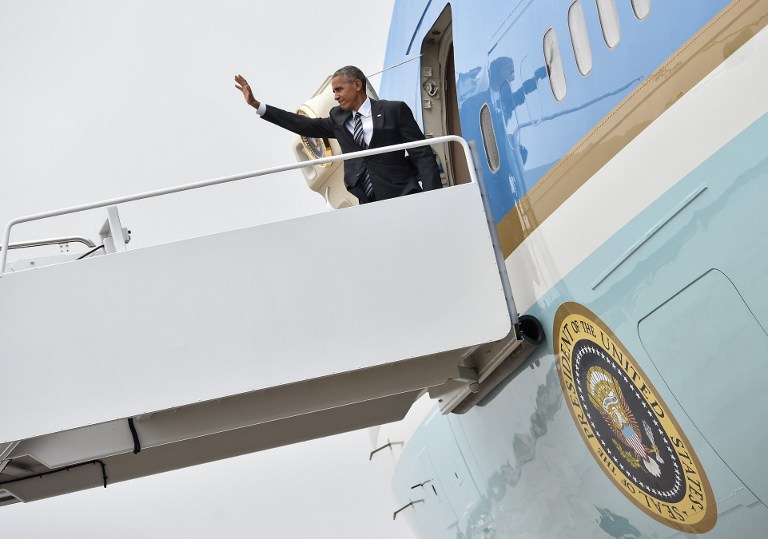
A short while after he spoke those words, Obama made his way to Ben Gurion Airport, boarded Air Force One and took off for Washington. He held no meetings and made no apparent effort to prod Netanyahu and Abbas into a room to talk about advancing Peres’s dream of an Israeli-Palestinian peace deal. (As opposed to his last presidential visit, in March 2013, when he successfully urged Netanyahu to call Turkish president Recep Tayyip Erdogan in what turned out an important milestone on the way to Jerusalem’s reconciliation with Ankara).
In his six-hour visit Friday, Obama did not resist the temptation to use Peres’s funeral to make plain once again his view that the Israeli government needs to do more to advance peace. It remains to be seen whether he will take Palestine-related action at the UN after the US presidential election in November. What’s clear already now is that Sara Netanyahu’s declared wish of hosting Mahmoud Abbas in her Jerusalem home, something that could only occur in the context of a new peace effort, is as elusive as ever.




The Times of Israel Community.