

Calling out politicians for calling out politicians
The Hebrew media devotes ample coverage to the debate over the shooting of a disarmed Palestinian assailant, except for Yedioth, which devotes its edition mostly to itself
 Add ToI as a Preferred Source on Google
Judah Ari Gross is The Times of Israel's religions and Diaspora affairs correspondent.
As the country is torn apart over the shooting of a disarmed Palestinian assailant by a soldier and a controversial bill that would allow legislators to oust one of their own, Yedioth Ahronoth realizes the most important issue of the day is: Yedioth Ahronoth.
While the rest of Israel’s newspapers tackle the news of the day, Yedioth opts instead to cover itself — more specifically, its conference on the Boycott, Divestment and Sanctions movement that was held on Monday.
“Yedioth Ahronoth and Ynet conference fighting the boycott,” the paper’s banner over the top story reads.
To give the conference a slight news peg, the paper leads with comments made by President Reuven Rivlin in defense of IDF Chief of Staff Gadi Eisenkot regarding the ongoing investigation and trial of the Kfir Brigade soldier who was filmed shooting a supine, disarmed Palestinian assailant nearly 15 minutes after a stabbing attack in Hebron.
The aftermath of the shooting became a political brouhaha, with the left attacking the right for creating a culture in which soldiers execute disarmed assailants lying the ground, and the right attacking the left for casting judgment before all the facts were known.
“I sleep better when Eisenkot is head of the IDF,” the paper quotes Rivlin on the front page as saying.
But just in case the headline made you forget who the star of the show is, the newspaper reminds you with its lede.
“The Yedioth Ahronoth and Ynet anti-BDS conference held yesterday dealt with the threats facing Israel from outside, but was also used to make remarks about the internal scandal burning these days as well — the storm over the soldier who shot an injured terrorist in Hebron last week,” the article says.
The article quotes Rivlin expressing support for Eisenkot in the ongoing saga, as some politicians and citizens come out against him, and also includes statements by Education Minister Naftali Bennett, who criticized the government for “deciding his fate on Thursday afternoon, before an investigation by commanders and the Military Police.”
(The newspaper fails to point out that Bennett himself decided the soldier’s destiny prior to a trial, declaring on Sunday: “The soldier is not a murderer.”)
Israel Hayom and Haaretz, meanwhile, lead their papers not with Rivlin but with Defense Minister Moshe Ya’alon, who calls out Bennett and others for “confusing IDF soldiers.”
The newspaper, often considered a mouthpiece for Prime Minister Benjamin Netanyahu’s Likud party, gives Likudnik Ya’alon a two-page spread to call out his political rivals in the Jewish Home and Yisrael Beytenu parties for using this issue for political gain.
“On Sunday, Bennett heard all the details of the case from the army’s top brass, but continued to lie and say we rushed to respond and reacted only from the video and that we made comments without having the facts,” Ya’alon tells the tabloid.
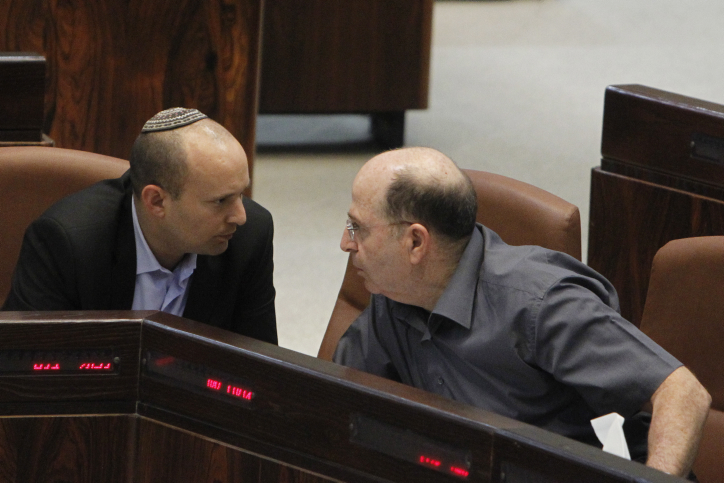
On its front page, Haaretz quotes Ya’alon attacking Bennett and Bennett attacking Ya’alon, alongside a photograph of the two of them looking in opposite directions because symbolism.
After a full seven pages of Yedioth congratulating itself for a successful conference in which we’re told everyone is “united against BDS,” the paper shifts to the first vote on a controversial bill that would allow a member of Knesset to be booted out of the parliament if 90 or more colleagues vote to do so.
The bill passed its first reading, but by a potentially insufficient margin for the High Court of Justice. Two members of the coalition abstained from the vote, granting the government a 59-53 victory, two votes shy of the 61-vote majority requested by the court for this legislation.
Due to the two-vote deficit, Yedioth describes the bill as pretty much dead in the water, while Israel Hayom makes the 61-vote requirement sound like the Knesset’s legal adviser thinks it is merely “preferable.”
Almost as exciting to the Hebrew media, however, is a verbal attack during the debate over the bill against Joint List MK Ayman Odeh by Likud MK Avi Dichter.
As the headline of a sidebar story on the spat, every major outlet quotes Dichter telling Odeh that terrorists would “be waiting for him at the gates of hell.”
All similarly quote Odeh as brushing off the attack, saying, “Dichter is apparently desperate for headlines.”
Looks like he got ’em.




The Times of Israel Community.