

Giuliani slams Obama’s ‘reckless’ stance on Iran
Anyone who thinks Tehran can be trusted with ‘any kind of nuclear capacity’ is ‘stupid,’ former New York mayor tells Iranian exiles at Berlin rally
 Add ToI as a Preferred Source on Google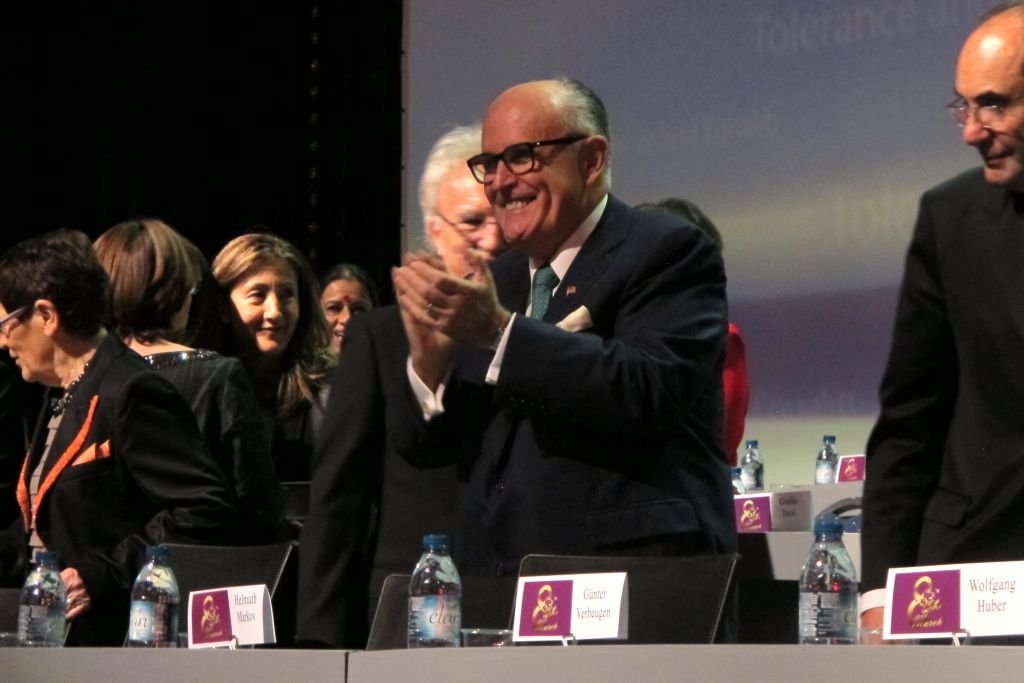
BERLIN (AP) — Former New York City Mayor Rudy Giuliani said Saturday that the US should take a stronger stance against Iran — or risk appeasing what he called an “insane” regime.
Giuliani spoke at a rally in Berlin organized by the exiled opposition National Council of Resistance of Iran. The organization is associated with the People’s Mujahedin of Iran, an armed resistance group that was taken off U.S. terror lists in 2012.
Giuliani claimed that the government in Tehran, which is seeking to reach a deal with world powers to lift crippling international sanctions, “has proven to us that it shouldn’t be trusted with any kind of nuclear capacity.”
Anyone who thought otherwise was “stupid” or risking the kind of appeasement that Britain tried with Nazi Germany in 1938, he said.
U.S. Secretary of State John Kerry has recently said Washington will endorse only an agreement with Iran that seriously and verifiably crimps Tehran’s ability to make atomic arms.
After his speech, Giuliani told The Associated Press that he believed President Barack Obama’s actions on Iran were reckless.
“What he (Obama) is doing with Iran right now is extremely reckless and it’s going to create an Iranian-controlled northern Middle East,” Giuliani said. He cited Tehran’s growing influence in Syria and Iraq, which he said could prompt a dangerous reaction from Iran’s Sunni rival Saudi Arabia.
To cheers from several hundred Iranian exiles at Berlin’s Velodrom cycling arena, Giuliani spoke strongly in favor of giving refuge to about 2,700 members of the People’s Mujahedin of Iran living at Camp Liberty, a former U.S. military base in Iraq.
The 10,000-seat Velodrom was filled mostly with students from neighboring Poland and the Czech Republic. Several whom the AP spoke to said they had been offered a return journey and hotel in the German capital if they attended the conference.
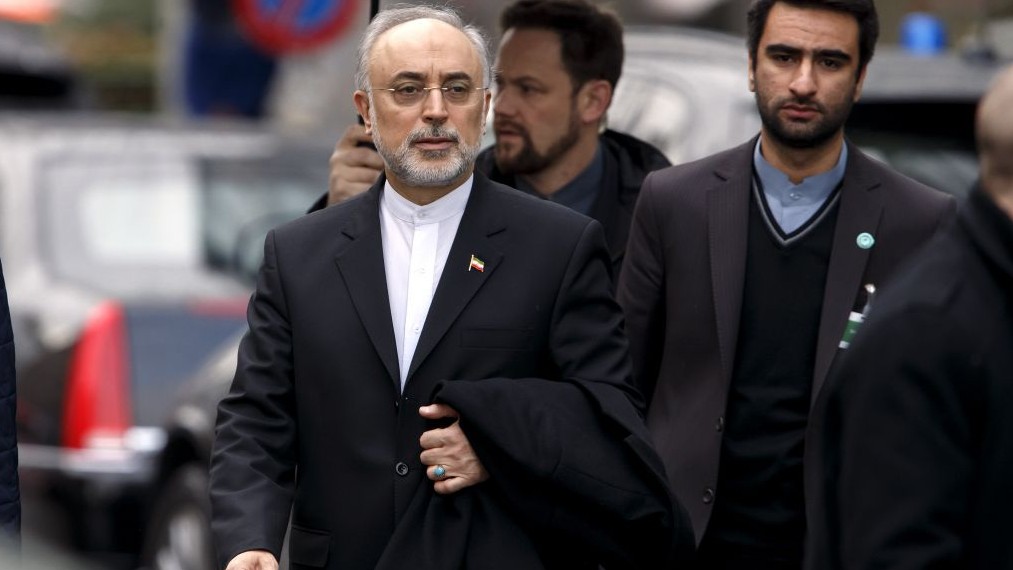
Earlier Saturday, Iran’s vice president said technical roadblocks hampering a final nuclear accord with world powers have been eliminated during ongoing discussions with American negotiators.
Ali Akbar Salehi, who is also in charge of Iran’s nuclear agency, told state television that Tehran offered proposals to remove “fake concerns” over the country’s nuclear program, paving the way for a final deal.
US and European diplomats said Saturday they are united in their strategy and goal in trying to achieve a nuclear deal.
“We are on the same page,” Kerry said after talks with French Foreign Minister Laurent Fabius. “We know what we are chasing after and we are chasing after the same thing.”
Kerry and Fabius, who met with the British and German foreign ministers after their session, cited progress in the talks, with the last round just wrapping up Wednesday in Switzerland. But they also acknowledged big gaps that must be bridged if the sides are to reach a deal by the end of March deadline set by negotiators.
“There is progress in certain areas but there are also divergences,” Fabius said. He said more work needed to be done on the length of the proposed agreement and on how to verify Iranian compliance.
“There is still work to do on the duration, we need a guarantee and transparency is necessary,” he said.
Kerry later seemed to contradict the Iranian vice president by stating there were still “gaps” that needed to be closed ahead of a conclusive deal.
Despite the headway, the hardline Iranian daily Kayhan was critical of negotiations, saying that an American proposal of a 10-year suspension of Iran’s uranium enrichment activities is a first step aimed at finally toppling Iran’s ruling Islamic government.
‘This is not a bilateral negotiation’
The next round of nuclear talks is set to begin March 15, involving mainly US and Iranian representatives. A small European delegation also will participate.
That configuration has led to some complaints that the talks involving the five permanent members of the UN Security Council, Germany and Iran have become more of an American-Iranian project. Objections, notably from France over certain provisions, held up agreement on an interim deal with Iran in November 2013.
Kerry denied such suggestions. He noted that he and Fabius would join German Foreign Minister Frank-Walter Steinmeier and British Foreign Secretary Philip Hammond as well as the European Union’s foreign policy chief, Federica Mogherini, for more detailed discussions.
“This is not a bilateral negotiation … and all of our partners are consistently sharing information, sharing ideas,” Kerry said.
Kerry stressed that Iran still needs to make decisions to prove to the world it is not trying to develop nuclear weapons. Tehran claims its nuclear program is peaceful and exists only to produce energy for civilian use.
“We have a critical couple of weeks ahead of us,” Kerry said. “But we are not feeling a sense of urgency that we have to get any deal. We have to get the right deal.”
Iran and the six-nation group — the US, Russia, China, Britain, France and Germany — hope to reach a rough deal on Iran’s disputed nuclear program by March and a final agreement by June 30.
Times of Israel staff contributed to this report.






The Times of Israel Community.