

Kerry: Iran deal will leave world safer, more secure
Secretary calls framework agreement a ‘solid foundation,’ though specific issues still need to be resolved
 Add ToI as a Preferred Source on Google
Tamar Pileggi is a breaking news editor at The Times of Israel.
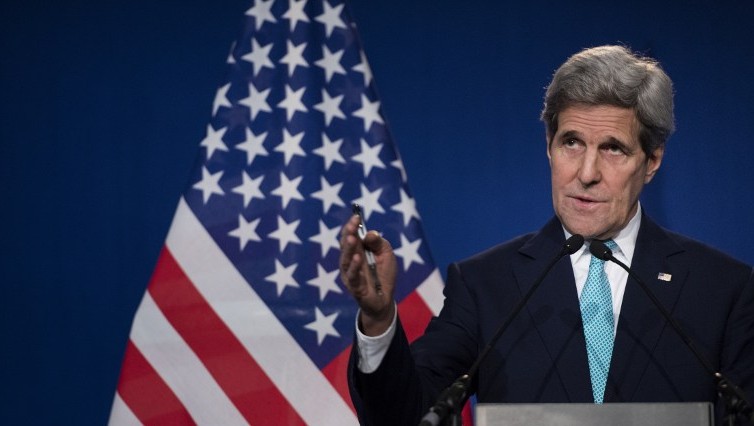
Following a marathon week of nuclear talks between world powers and Iran, US Secretary of State John Kerry said Thursday that the newly reached framework agreement would sharply curtail Iran’s nuclear program.
Echoing President Barack Obama, who called it a “historic agreement,” Kerry said the preliminary deal would “leave the world safer, more secure than it would be without it.”
Iran’s stocks of highly enriched uranium will be cut by 98% for 15 years, the Fordo plant will be converted for peaceful purposes, while its Arak reactor will stop producing weapons-grade plutonium, Kerry told reporters.
Iranian President Hassan Rouhani said the drafting of a full accord would begin immediately with the aim of completing it by the June 30 deadline.
The deal, which aims to put a nuclear bomb out of Tehran’s reach, will limit Iran’s nuclear program, and will provide the country with relief from economic sanctions that have crippled its economy for the past decade.

Kerry said that although specific issues — including the phasing out sanctions and the future of its nuclear facilities — were yet to be resolved, the deal was a “solid foundation for the deal we are seeking.”
“We have no illusions about the fact that we still have a ways to travel in reaching our goal with final deal,” he said.
.@JohnKerry: Once we’re able to finalize a comprehensive deal, the process of implementation remains before us.
— StateDept Curated (@StateDeptLive) April 2, 2015
“Throughout negotiation, we have made a diligent effort to consult with our allies and partners,” Kerry said, mentioning Israel and the Gulf states specifically.
The secretary of state said the preliminary deal opened the door to a long-term resolution that would ultimately satisfy international community’s concerns about Iran’s nuclear program.
“There can be no question that the comprehensive plan we are moving toward will more than pass that test,” he said.
“Simply demanding Iran capitulate makes a nice sound bite but is not a policy,” he said, in an apparent dig at Israel’s Prime Minister Benjamin Netanyahu.
He continued to outline some of the specific parameters of the agreement reached Thursday.
He said that Iran has agreed to reduce its centrifuges by two thirds — from approximately 19,000 to an allowed 6,104 installed under the deal. Of those, 5,060 will be allowed to enrich uranium for the next 10 years.
Tehran had also agreed to cap its uranium enrichment at 3.67 percent for at least 15 years, and will not build any additional facilities for the purpose of enriching uranium during that time.
Iran, whose breakout time for acquiring enough fissile material for one weapon is currently assessed to be 2-3 months, will be extended to at least one year for the next ten years.
Kerry said the deal, contrary to reports, had “no sunset clause.” Some of its components would in force for 10 years, others for 15, and still others for indefinite periods.
Kerry said that Iran had agreed not to enrich uranium at its Fordo facility or conduct nuclear research there, and will convert the complex into a science research center.
Iran will ship all of its spent fuel from the Arak reactor out of the country, and the facility will also be redesigned to support peaceful nuclear research and radioisotope production.
Kerry said that a final deal reached between the P5+1 powers and Iran would rely on proof — not on promises from Iran’s government, and that sanctions relief would only be implemented if Tehran abided by the outlined commitments.


The Times of Israel Community.