

New Hamas chief backs hunger-striking prisoners
In his first public appearance since being elected, Ismail Haniyeh visits protest tent in support of fasting Palestinians held in Israeli jails
 Add ToI as a Preferred Source on Google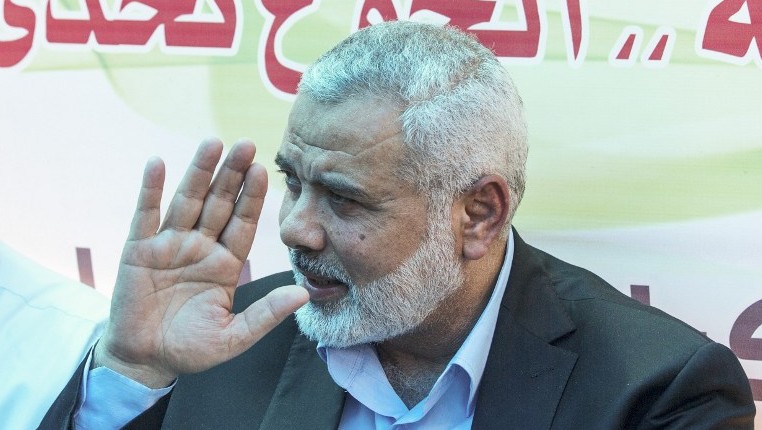
GAZA CITY — New Hamas leader Ismail Haniyeh pledged support for hunger-striking Palestinian prisoners on Monday in his first comments since being elected as head of the terrorist group that runs the Gaza Strip.
For his first appearance as leader of the Islamist terror group, Haniyeh chose a symbol of elusive Palestinian unity — a solidarity tent where several political factions are represented, including Hamas and the Fatah movement of Palestinian Authority President Mahmoud Abbas.
There are still close to 900 Palestinian prisoners, who demand better conditions from Israel, taking part in the strike that reached its 22nd day on Monday.
“This visit is a message to our heroic prisoners that your cause was and will remain a top priority,” he said during a visit to the solidarity tent.
“Your freedom is a national duty and your dignity is our dignity,” the 54-year-old added.
The strike is being led by Marwan Barghouti, a member of Fatah — a rival political faction to Hamas, which is considered a terrorist organization by Israel, the United States and the European Union.

Barghouti is a popular figure in Palestinian society and is seen as a possible successor to Abbas. Some analysts in Israel have pointed to the hunger strike as a bid by Barghouti to show Abbas he still wields political power.
Hundreds of Palestinians in Israeli jails have been refusing food since April 17.
Israeli authorities put the current figure at 860 hunger strikers, while Palestinian officials say 1,500 have been participating.
They have issued a list of demands including better medical services, family visits, and more dignified detention conditions.
On Sunday, Israeli authorities distributed video footage purporting to show Barghouti secretly eat in his cell. In the video, Barghouti, a convicted terrorist serving five life sentences for orchestrating murderous attacks during the Second Intifada, can be seen apparently unwrapping food in his prison cell and eating it in his toilet stall.
Barghouti’s wife and other Palestinian officials dismissed the video as fake and an attempt to break the hunger strikers.

On Monday, an unidentified Israel Prisons Service official told Channel 2 television that the food was planted in Barghouti’s cell and the video clips were obtained as part of an IPS scheme to induce the hunger strike’s leaders to eat by hiding food in their cells. Most of them, however, resisted the temptation, the official said.
Barghouti was also photographed furtively eating food in his cell during a previous prisoner hunger strike in 2004. Those still shots were taken with a hidden camera through a hole in the wall of his cell.
Hamas rules the Gaza Strip, while the Palestinian Authority, dominated by Abbas’s Fatah party, controls the West Bank. The two groups had a violent falling out in 2007, when Hamas fighters ousted Fatah from the Gaza Strip. Several attempts at reconciliation since have failed.
Haniyeh, seen as a pragmatist within Hamas, was elected by its Shura Council on Saturday. His rise was the latest sign of a power shift in Hamas from the diaspora to Gaza, which has been under Hamas rule since the takeover a decade ago.
This shift comes at a time of growing financial pressure on the territory by Western-backed Abbas, who in recent weeks has been trying to force the group to cede ground in Gaza.
Unlike his predecessor, Khaled Meshaal, he is expected to be based in Gaza.
[mappress mapid=”6164″]
Haniyeh takes charge of Hamas as it seeks to ease its international isolation, while not marginalizing hardliners within the movement.
Last week, Hamas unveiled a new policy document that presents softened language on Israel, while still calling for its destruction.
The document accepts the idea of a Palestinian state in territories captured by Israel in the Six Day War of 1967, but dismisses the establishment of the State of Israel as “illegal,” asserting a Palestinian claim to the entire land of Israel, and a so-called right of return for all descendants of refugees.
Israel dismissed the new document as an attempt to “fool the world.”
Haniyeh, a former Hamas prime minister in Gaza, could be hampered in his new leadership role by movement restrictions. Israel and Egypt imposed a border blockade on Gaza after the Hamas takeover a decade ago, keeping the territory’s borders sealed most of the time in order to prevent the terror group from importing weapons. Hamas leaders have been able to travel abroad from time to time, but only with Egyptian coordination.
Times of Israel staff contributed to this report.









The Times of Israel Community.