

Taking stock of the war next door
Eruption of hostilities in the Sinai catches the attention of the Hebrew press, which warns of possible spillover into Israel
 Add ToI as a Preferred Source on Google
Ilan Ben Zion is an AFP reporter and a former news editor at The Times of Israel.
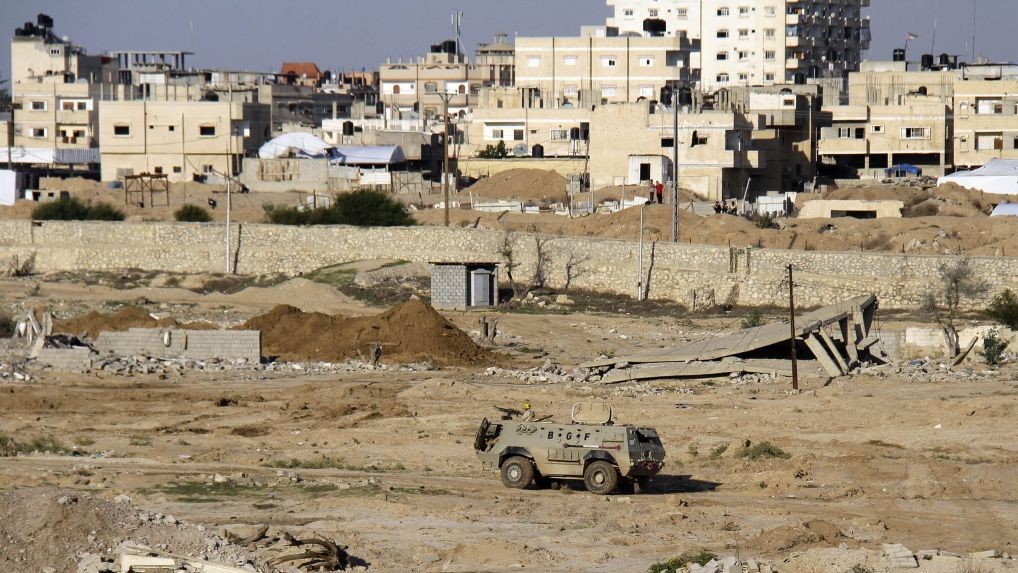
A massive assault by Islamic State affiliates against Egyptian soldiers and police officers in the Sinai Peninsula grabs the attention of the Israeli press on Thursday. The mood is one of astonishment that such horrors are taking place just over the border from Israel, as though Syria isn’t a stone’s throw from the Golan Heights.
Coverage in Yedioth Ahronoth leads off by referring to the string of attacks which killed at least 70 Egyptians as “a nightmare” and with a quote from the Egyptian prime minister saying the country “was in real war.” During the pitched battle, after gunmen struck with mortars, suicide bombers, and car bombs, the Egyptians asked Israel for permission to dispatch tanks and armored infantry to the Sinai, as per the peace agreement, and Israel approved, Israel Hayom reports. Haaretz reports that the Egyptian army says it killed one hundred fighters in the military’s counterattack, and that only 17 of its men were killed.
In response to the offensive, Israel shut its border crossings and ramped up readiness along the border, Haaretz reports.
Turning to home after describing the coordinated assault on Egyptian positions in Sheikh Zuweid, Yedioth Ahronoth quotes Israeli sources saying that that tactical sophistication demonstrated by the Islamic State fighters raises their level to one of a professional military. “The concern in Israel is that the Islamic State will now try to carry out attacks against our border, too, and the IDF is prepared for another escalation in fighting which will involve rocket fire at the south with the aim of dragging Israel into the conflict.”
Boaz Bismuth writes in Israel Hayom that the time has come to put the hammer down on the Islamic State. Cataloging recent attacks marking its one-year anniversary of establishing the caliphate, he writes that the “necessary thing today is that the world understand that IS is real, tangible and dangerous, and that the time has come to fight it seriously and not just strike a pose.”
“It won’t hurt if those fighting IS understand that they need to give the group a death blow in the Islamic State capital city of Raqqa in Syria,” he says. “That wouldn’t be a bad gift to celebrate its one-year anniversary.”
For Yedioth Ahronoth’s Alex Fishman, the attacks in the Sinai recall the August 2012 attack by the same group which ended with an armored car manned by jihadists plowing into Israeli territory before a fortunate strike by the air force. Both attacks, he notes, took place around the 17th of Ramadan, the day marking the battle of Badr, a key victory for the forces of Muhammad in the early days of Islam.
But the crux of his argument lies in the ties between Islamic State in the Sinai and Hamas. He says the use of anti-tank missiles by the attackers on Wednesday exposes their connection with Hamas. “The man responsible for training the terrorists in Sinai is none other than the Hamas expert on anti-tank missiles in Gaza, Abdullah Kishta,” Fishman says. Moreover, Hamas gives them funds in order to protect their weapons stockpiles in the Sinai and keep the flow of arms into the Gaza Strip, he says. In exchange, Hamas treats Islamic State fighters from the Sinai in Gaza hospitals and gives them logistical aid.
“In general, Hamas sees the Islamic State in the Sinai as a friendly entity, through which and with whose help it can act against Israel from the Sinai,” he says.
Zvi Barel writes in Haaretz that the campaign against terrorist groups in the Sinai Peninsula has turned into a full blown war “which threatens to develop into a facsimile of the war seen now in Iraq against the Islamic State.”
“This is a war on multiple fronts, partly in large cities such as Cairo, Fayyum, al-Arish and Rafiah, and partly in open areas. This is a war similar to the war against a foreign foe, even though it’s mostly made up of Egyptian citizens,” he says.
He says that the challenge for the Egyptian military right now is not just to eliminate the IS forces, but to prevent them from making a base of operations in Sheikh Zuweid and al-Arish in a way which will let them wage a long war of attrition which would ignite public pressure in Egypt and bring down the legitimacy of the regime and the president.






The Times of Israel Community.