

The Brexit finally reaches Israel
A weekend later, news of the UK’s historic vote runs in the front pages of the Hebrew press
 Add ToI as a Preferred Source on Google
Ilan Ben Zion is an AFP reporter and a former news editor at The Times of Israel.
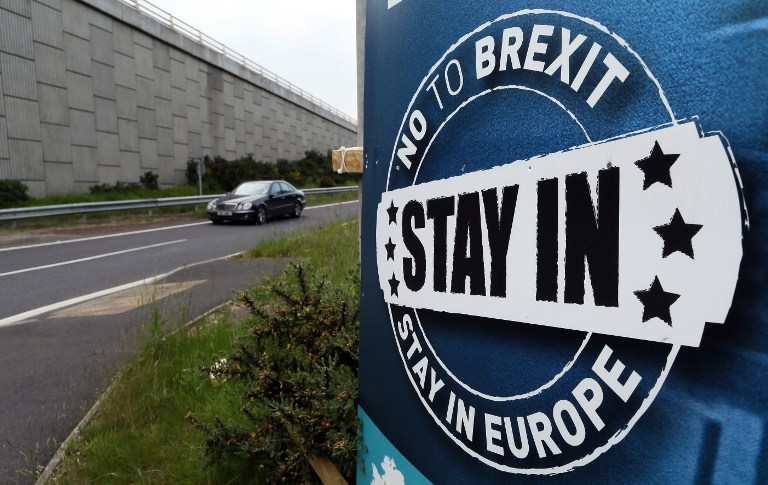
Two days behind the rest of the world, the Hebrew print media finally gets around to reporting on the Brexit. It’s silly that the papers have to play catch-up despite the fact that their readers undoubtedly already know the outcome of the referendum and the aftermath that’s unfolded over the past few days. The coverage of the referendum and its political and economic backlash goes deep into the back pages of the Sunday editions, with Israel Hayom reporting on nothing else in the first 25 pages, and Yedioth Ahronoth devoting a similar amount of space. Haaretz, as expected, lines up almost as many columnists to weigh in on what to make of the historic vote as there are signatories to a petition to hold a second referendum.
Among the aspects of the Brexit breakdown highlighted in the press is the EU’s response to the Brexit vote. Israel Hayom runs the headline “The British will pay,” as if Brussels will declare war on London. Haaretz offers a more moderate headline, reporting that the foreign ministers from the big six in the EU said that the Union “is a success, we won’t give up on it.”
Being so far behind the Brexit eight-ball, Palestinian Authority President Mahmoud Abbas’s anti-Semitic remarks in Brussels, which he later retracted, barely get any notice, and are stuck far back in the papers when they otherwise would have been the talk of the town.
In its editorial, Haaretz says that the Brexit vote was just the “beginning of the long and tortuous journey of separation, whose outcome is still impossible to predict.” The paper blames the referendum’s success on “nationalist, ultra-nationalist, isolationist groups, racism and a desire to distance [England] from a Europe awash in Syrian refugees, and dissatisfaction with continuing to take part in international military campaigns.”
With one deft stroke of the pen, Haaretz compares those groups and right-wing politics in Israel. “Israel, it seems, doesn’t need a referendum or official decision in order to declare its disengagement from Europe or the West,” the paper says. “Its policy and identity as the last occupation state in the West is a de facto declaration. But unlike Britain, Israel needs the support of international coalitions for its survival.”
It says the barriers keeping the ultra-nationalists in check in Europe are crumbling in Israel. “Britain’s decision must not be seen in Israel as a model for emulation by those who believe the state can exist as an island. The ultranationalist right must not be allowed to turn Israel into a state imprisoned in a solitary confinement of nations,” it says.
Having sent Boaz Bismuth all the way to London to report on the Brexit, Israel Hayom runs a three-page anecdotal reporting-cum-analysis piece explaining the issue. “If the British always had one leg out of Europe, it’s almost logical to assume that the time would come that they’d simply say they’d had enough of losing control over their lives,” he writes. The vote “rejects the direction of history,” but the European Union isn’t without fault, he argues: starting with its “failed treatment of addressing the migrants” and the “lack of democracy in the European body which dictates to European citizens.”
Bismuth says the British have started a new trend in Europe: leaving the EU.
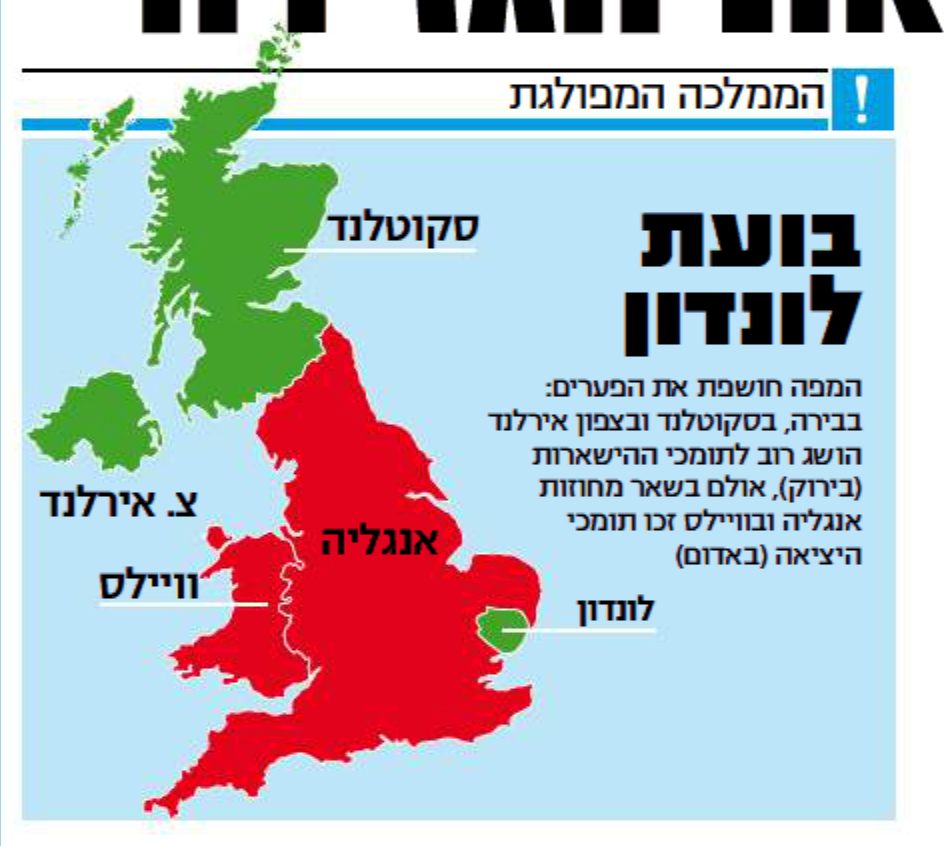
By far the most amusing part of his walkabout in the London area, talking to the locals, is a remark by a man named Nigel. (As an aside, it’s not clear Israel Hayom knows where London is. A map included in its coverage places it in Essex.)
“In England we’ve got serious newspapers, but we’ve also got newspapers that are terrible tabloids,” he tells Bismuth, likely oblivious to the outlet his interviewer writes for. “They didn’t stop telling us that everything here is bad and to be afraid. Telling us that foreigners are taking over Britain, saying that we aren’t running our country, writing that we’re paying too much taxes to Brussels. And they have power.”
Only the British could serve up a hot dish of irony like that.
Yedioth Ahronoth leads off with two titanic op-eds on the Brexit before wading into its news coverage. In fact, Nahum Barnea compares the calm before the storm to that in the film “Titanic” as he listened to the film’s soundtrack play on the intercom at Heathrow Airport.
“Britain isn’t sinking, but it’s torn in twain,” he says, trying to keep up his Titanic allusion. “On the losing side there are serious people who compare the result of the referendum to Hitler’s victory in the Germany elections in 1933. They’re exaggerating. But it’s reasonable to say that since Friday morning, Britain isn’t the same Britain and Europe isn’t the same Europe.”
He has one poignant anecdote from his London stroll in which he encountered young Britons demonstrating outside Parliament who are met by an elderly Londoner. “What are you protesting?” the man asked. “We can get along fine without Europe. The good old days will come back.”
“Those good old days were borne by many elderly when they voted to leave. It’s doubtful whether those good old days once were, but that’s how they remember them,” Barnea writes.







The Times of Israel Community.