

US, Iran negotiators ‘talk late into the night’ on nuke deal
Kerry, Zarif, Ashton aim for breakthrough in Oman summit ahead of November 24 target date
 Add ToI as a Preferred Source on Google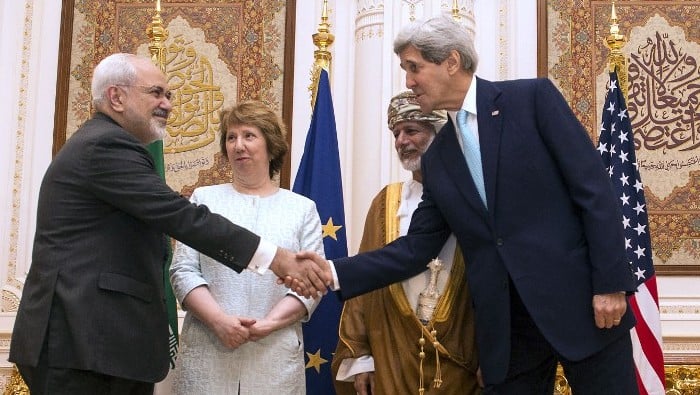
American and Iranian negotiators in Oman “talked late into the night” to try to reach a breakthrough in talks for a deal on Iran’s controversial nuclear program by the November 24 deadline set by the P5+1 worlds powers.
US Secretary of State John Kerry, Iranian Foreign Minister Mohammad Javad Zarif and the EU’s Catherine Ashton met for several hours Sunday evening, including after nightfall, to advance the latest diplomatic efforts, the Washington Post reported.
No statements were issued after the meeting but talks are set to resume later Monday.
On Sunday, US President Barack Obama said a “big gap” remains in international nuclear negotiations with Iran and he questioned whether talks would succeed.
“Are we going to be able to close this final gap so that (Iran) can reenter the international community, sanctions can be slowly reduced and we have verifiable, lock tight assurances that they can’t develop a nuclear weapon,” Obama told CBS News in an interview broadcast Sunday.
“There’s still a big gap. We may not be able to get there.”
After Sunday’s meeting, political directors from the P5+1 powers will hold talks in Muscat,on Tuesday.
The negotiations will move back to Vienna on November 18 for a final push towards the deadline six days later.
Iran and the P5+1 powers — Britain, China, France, Russia, the United States plus Germany — are seeking an agreement to rein in Iran’s nuclear program, in exchange for sanctions relief.
The diplomats’ meeting follows the revelation that Obama wrote to Iran’s supreme leader Ayatollah Ali Khamenei to push for a nuclear deal, arguing the Islamic republic and the West have shared regional interests.
The apparent reference to the fight against the Islamic State group in Syria and Iraq, however, was played down by Kerry in Beijing on Saturday, with the US diplomat saying “there is no linkage whatsoever” with the nuclear talks.
A comprehensive agreement would represent a hard-earned foreign policy win for Obama in a region where the threat of a nuclear-armed Iran has hung for more than a decade.
With a November 24 nuclear deadline looming, Iran and the P5+1 group are far apart on what capabilities Iran’s nuclear program should have.
On Saturday, a US think tank revealed that Iran has stepped up efforts to develop a process that could enrich uranium at a much quicker pace, thereby violating the interim nuclear agreement reached with the world powers last year
The issue of advanced enrichment is sensitive because Iran could potentially produce a nuclear weapon if it processes the material further, a main concern for the West. Iran wants “industrial grade enrichment” beyond its current capabilities while the world powers want a reduction.
Tehran’s envoy to the IAEA responded to the report saying it showed Iran was transparent that concerns about its nuclear program are “baseless,” the semi-official Iranian Fars News Agency reported.
The West has as yet been unconvinced by Iran’s denials that it has never sought a nuclear weapon — Tehran insists its atomic activities are for peaceful, civilian energy purposes only.
A deal, for the West, aims to put a bomb forever beyond Iran’s reach.
At issue is the number of uranium-enriching centrifuges Iran should be allowed to keep spinning in exchange for sanctions relief and rigorous inspections at its nuclear sites.
However, domestic politics now hang heavily over the talks, given the loss of the Senate by Obama’s Democrats in midterm elections to the Republican party, members of whom have consistently bridled at the White House’s negotiations with Iran.
If talks go sour in the coming weeks it is thought the US Congress may respond with fresh sanctions on Iran. Even though Obama has the power to veto them, the prospect of new penalties could disrupt an already protracted process.
Zarif’s foreign ministry is also under pressure, with members of Iran’s parliament criticizing the talks and threatening to scupper a deal if lawmakers themselves do not have a say in ratifying it.
Although officially supportive, hardliners in Tehran have often been ambivalent about the negotiations with the West which officially resumed last autumn after earlier secret talks with the US in Oman had set the wheels in motion.
On the plane to Muscat on Saturday, Zarif told reporters that Iran and the P5+1 have concentrated on “solutions rather than differences” since talks on the sidelines of the UN General Assembly in New York in September.
“There is still a gap between the two parties on the size of the enrichment program and the mechanism for lifting sanctions,” the official IRNA news agency quoted him as saying.
“If the other party acts with good political will, we can reach an agreement.”
The surprise election last June of President Hassan Rouhani, who had pledged to revive Iran’s sanctions-smashed economy, was a turning point on the nuclear issue but progress has been elusive since an interim deal came into effect in January.







The Times of Israel Community.