

Zarif and Kerry to meet ahead of Syria summit
Iranian FM will also hold talks with Russian counterpart as he joins high-level conference on ending years of civil war
 Add ToI as a Preferred Source on Google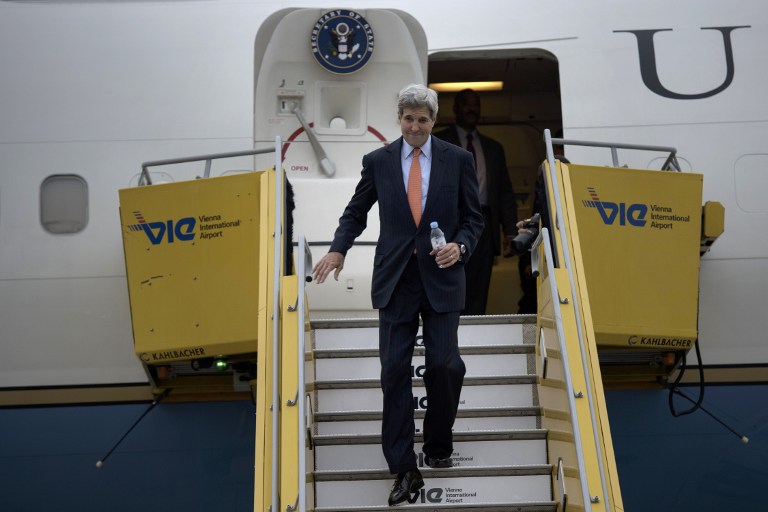
US Secretary of State John Kerry will meet his Iranian counterpart in Vienna on Thursday afternoon, ahead of multilateral talks over the Syrian conflict later in the day, a senior State Department official said.
Tehran will take part for the first time in international negotiations aimed at resolving the war, as key nations backing Syria’s warring sides seek to thrash out differences over the future of Syrian President Bashar Assad.
Iranian Foreign Minister Mohammad Javad Zarif was also due to hold talks on Thursday afternoon with Russia’s Sergey Lavrov, according to the Russian news wire Interfax.
The meetings mark the start of a two-day diplomatic flurry which will gather all the major players in the Syrian war in the same room for the first time.
On Thursday evening, Russia — a supporter of Assad — will hold talks with the United States, Saudi Arabia and Turkey, which all back rebel groups.
This will be followed by a wider meeting of regional players on Friday, when Javad will join representatives from Britain, Egypt, France, Germany, Italy, Lebanon and the European Union.
It is the second round of talks in less than a week between envoys from Moscow, Washington, Ryad and Istanbul.
It will be the first time all the major players in the conflict are in the same room, though there has been no mention of either the Syrian government or the opposition attending.
The inclusion of Iran — a key backer of Syrian President Bashar Assad — in this week’s meetings marks a crucial shift after Tehran was excluded from earlier talks, mainly because of opposition from Washington and Riyadh.
US Secretary of State John Kerry cautioned that this week’s talks would not secure an immediate political solution, but nevertheless represented the best hope available.
“While finding a way forward on Syria will not be easy — it’s not going to be automatic — it is the most promising opportunity for a political opening we have seen,” Kerry said just before he set off for Vienna.
“The challenge that we face in Syria today is nothing less than to chart a course out of hell,” he added.
Britain’s Foreign Office said the United Arab Emirates, Qatar, and Jordan will also attend Friday.
Washington is at loggerheads with Moscow over Syria, accusing Russian forces of concentrating their air campaign there on moderate opposition groups opposed to Assad’s rule.
Moscow says its bombing campaign is targeting Islamic State jihadists and also other “terrorist” groups.
But Kerry stressed that the US and Russia also shared “common ground,” arguing that both want “a united, secular Syria” in which citizens can choose their own leader through elections.
Divisions over Assad’s future
After months of failure, efforts to find a breakthrough have gained pace as hundreds of thousands of Syrians have fled their shattered country.
Serious divisions remain over when or whether Assad should step down — and four-way Russia-US-Saudi-Turkey talks in Vienna last Friday failed to make a breakthrough.
On one side, Russia and Iran are backing Assad’s forces on the ground and say Damascus must be helped to defeat “terrorism” before a political process can take shape.
On the other, the United States and its key regional allies Turkey and Saudi Arabia are supporting groups fighting Assad and insist he must go.
French Foreign Minister Laurent Fabius said Wednesday that Paris and its allies had agreed on the need for a “precise timetable” for Assad’s departure.
Meanwhile, the Pentagon announced plans to step up attacks on Islamic State jihadists in Syria and Iraq, with Defense Secretary Ashton Carter saying he expected more airstrikes and even possible “direct action on the ground”.
The dynamic in the Syrian conflict shifted after Russia launched its air campaign on September 30, claiming it was targeting IS fighters.
Russian warplanes struck 118 “terrorist” targets in Syria over the past 24 hours, the highest daily total yet, Moscow’s defense ministry said Wednesday, attributing the rise to fresh intelligence.
Iran is believed to have sent thousands of troops and Hezbollah militia fighters to support Assad’s forces.
But the US believes they will struggle to defend Assad for long, which is why they have been forced to engage diplomatically.
More than 250,000 people have been killed in Syria’s war since it began in March 2011 following a bloody crackdown on protests against Assad’s rule.






The Times of Israel Community.