

Palestinian deported back to Gaza after decades in Israel, leaving family behind
Gaza-born Basel al-Qur’an fears for his life after being sent to Strip following multiple criminal convictions; Israeli family begs IDF, Red Cross for his return
 Add ToI as a Preferred Source on Google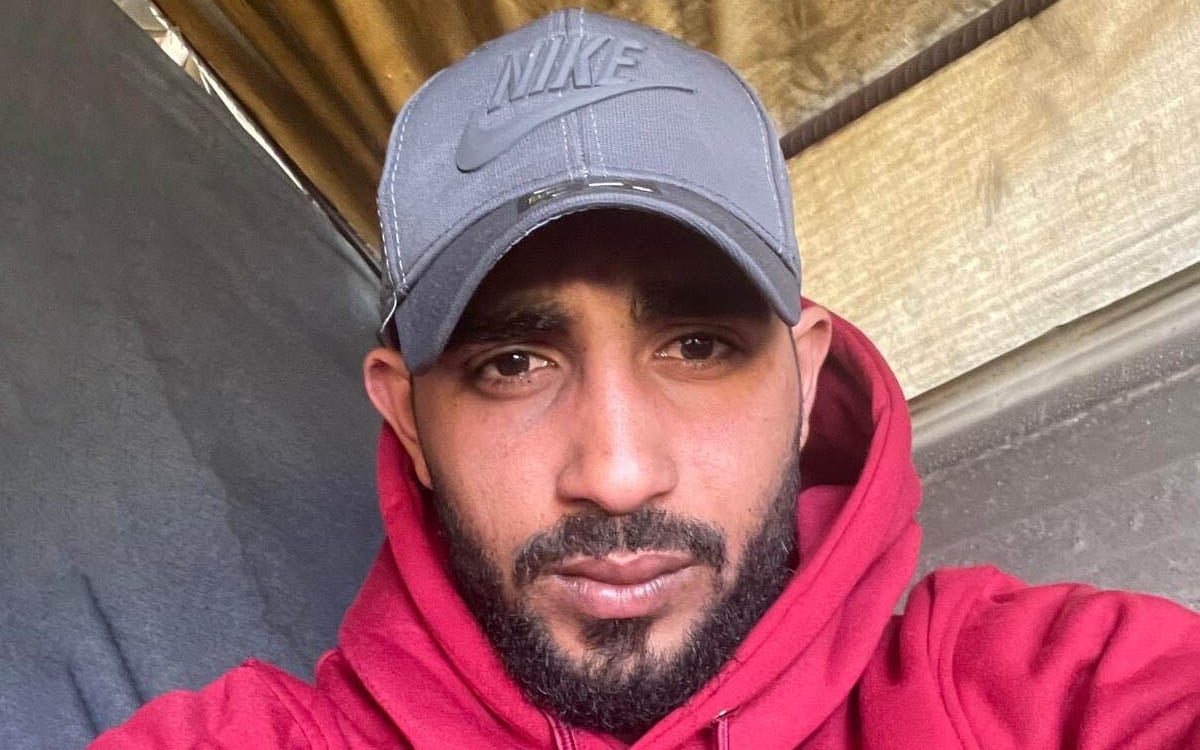
An Arab man, husband to an Israeli woman and father to their three young Israeli children, was recently deported to the Gaza Strip and has been barred by the Israeli authorities from returning to live with his family.
Basel al-Qur’an, 28, had been living in Israel for almost two decades without permanent status. He was recently caught driving without a license and subsequently jailed for illegal entry into Israel and domestic abuse. Al Qur’an was later deported to Gaza in February.
For at least part of his time in Israel, al-Qur’an possessed a temporary permit issued by the army, but he was never able to attain permanent status based on his familial ties under a sweeping law that bars Palestinians from the naturalization process.
Al-Qur’an is now holed up in war-torn Rafah after being sent across the Israel-Gaza border in February on a humanitarian aid truck, unable to return to his home in Kiryat Gat.
Hailing from a Bedouin background, al-Qur’an was born in Gaza to an Arab Israeli mother and Egyptian father. After his parents divorced, his mother moved to Israel
Al-Qur’an visited his mother twice in Israel – once for three months when he was 11, then for one month when he was 13. He entered Israel again at the age of 18, using a six-day stay permit to attend a wedding, after which he remained in the country permanently, illegally. Al-Qur’an found work in the country, learned fluent Hebrew and married an Arab Israeli woman with whom he had three kids.

Over several phone calls with The Times of Israel, the deportee claimed that upon his release from Shikma Prison on February 1 — the same day that 150 Gazan security detainees were freed as part of the hostage release-ceasefire deal with Hamas — Shin Bet agents took him to the Kerem Shalom border crossing, where two IDF soldiers loaded him onto an aid truck headed to Rafah.
Al-Qur’an said he was transferred to Shikma, near the coastal city of Ashkelon, only four days prior to his deportation. Until then, he was held for 20 months in Haifa’s Damon Prison. (The offense of driving without a license is punishable by up to two years.)
The Shin Bet and IDF declined to respond to requests for comment regarding al-Qur’an’s allegations. The Israel Prison Service also refused to confirm where he was incarcerated, stating it does not provide details about prisoners.
Al-Qur’an’s lawyer, Uzi Avraham, appealed to the Coordinator of Government Activities in the Territories, the Defense Ministry body that oversees coordination in the West Bank and Gaza, requesting he be allowed to return to Israel.
According to Avraham, the agency responded that it was reviewing the situation and would decide how to address it by the end of March.
Meanwhile, al-Qur’an is desperate to escape the enclave after over a month of hiding in what he called a “secure place,” the temporary shelter of a Bedouin stranger, whom he stumbled upon during his first day in Rafah, and the man’s seven children.
On Monday morning, al-Qur’an said that the family he was staying with had since fled their shelter in Rafah as the IDF resumed airstrikes on the Gaza Strip, leaving him alone near the southern border.
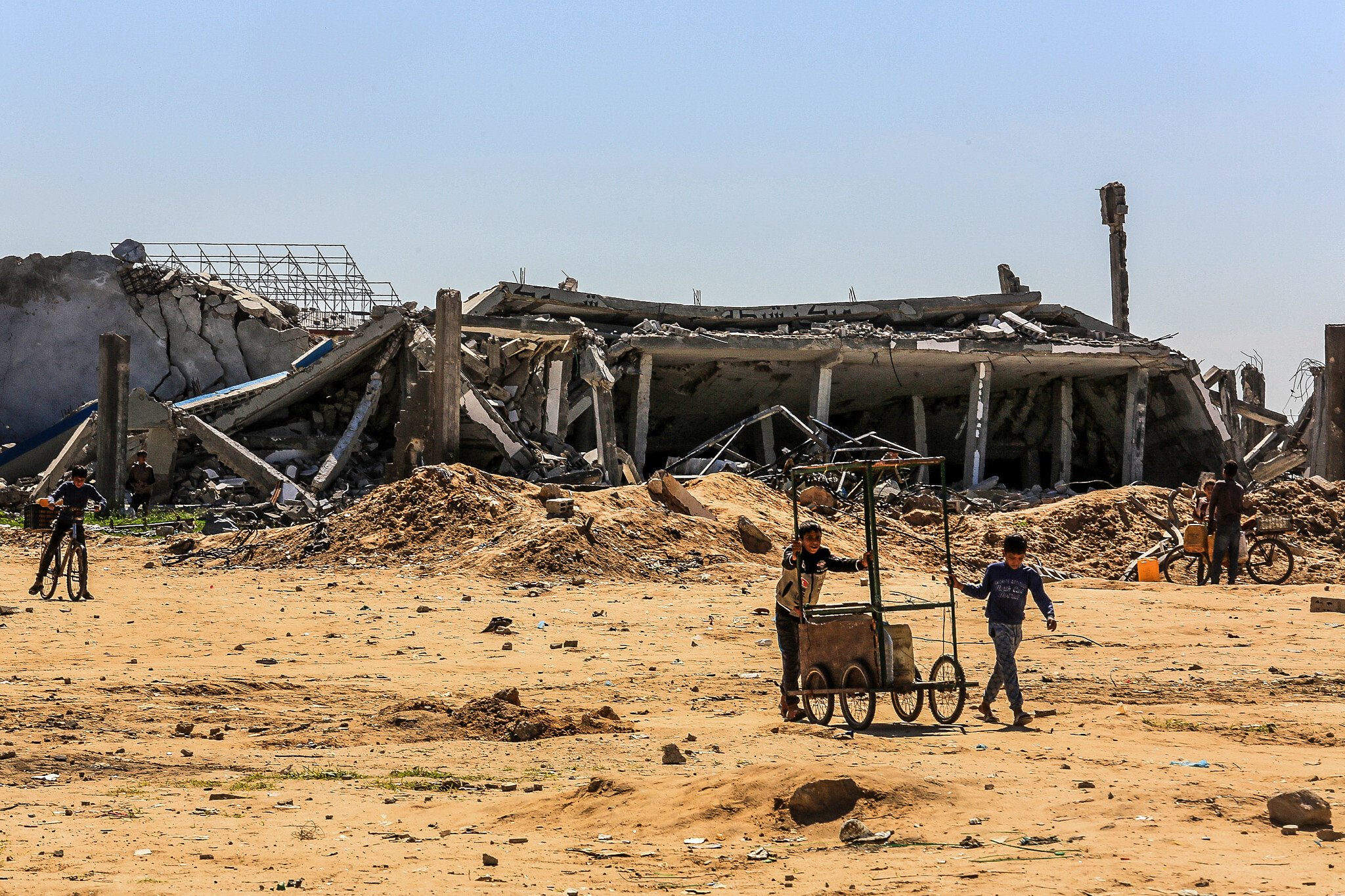
Al-Qur’an fears that Hamas will find and kill him due to his mother’s Israeli citizenship. “Every day they’re killing people, shooting them in the legs, in the head. I see it every day from afar and also hear it. It’s truly life or death,” he said.
He says he rarely leaves the temporary shelter he is residing in, aside from when he ventures out to approach the southern border with Egypt where IDF soldiers are stationed, begging them to return him to Israel.
Marwa, Basel’s mother, told The Times of Israel that she has received non-answers from nearly every government agency that she appealed to, including the IDF, Shin Bet and Israel Prison Service.
She also contacted the International Red Cross in hopes that it could help. The agency confirmed to The Times of Israel that al-Qur’an is currently in Gaza.
“Who is responsible for his return to Gaza? If all the agencies are saying, ‘We don’t have any knowledge,’ then who does have knowledge? Where is the accountability?” Marwa lamented.
Oded Feller, who works for the Association for Civil Rights Israel, told The Times of Israel that al-Qur’an’s deportation is legal on paper.
“The moment that somebody who holds temporary status gets tangled up in crimes and offenses, it is legal to cancel his status and deport him,” Feller told The Times of Israel. “Of course, it must be taken into account what will happen to him, to his children, to his family — but this [deportation] occurs.”
A temporary resident among a family of Israeli citizens
Though his mother, wife and children are Israeli citizens, al-Qur’an was never able to obtain permanent residency — much less citizenship — in Israel, due to a 2003 law largely barring Palestinians married to Israeli citizens from the naturalization process. Al-Qur’an began living in Israel in 2015.
The so-called Citizenship Law was originally instituted as a temporary order at the height of the Second Intifada with the aim of preventing terror attacks.
The measure was renewed each year, except for a brief lapse in 2021, when the opposition led by Benjamin Netanyahu voted down the law in hopes of sparking a coalition crisis. It was reinstated in 2022.
Al-Qur’an is one of the thousands of people who have in the past qualified as exceptions to this ban, living on precarious “stay permits” granted by COGAT, which can be issued for up to six months until the holder must renew it.
It is unclear whether he had one of these permits at the time of his arrest.
According to human rights organization HaMoked, some 9,700 people live in Israel on these military-issued permits.
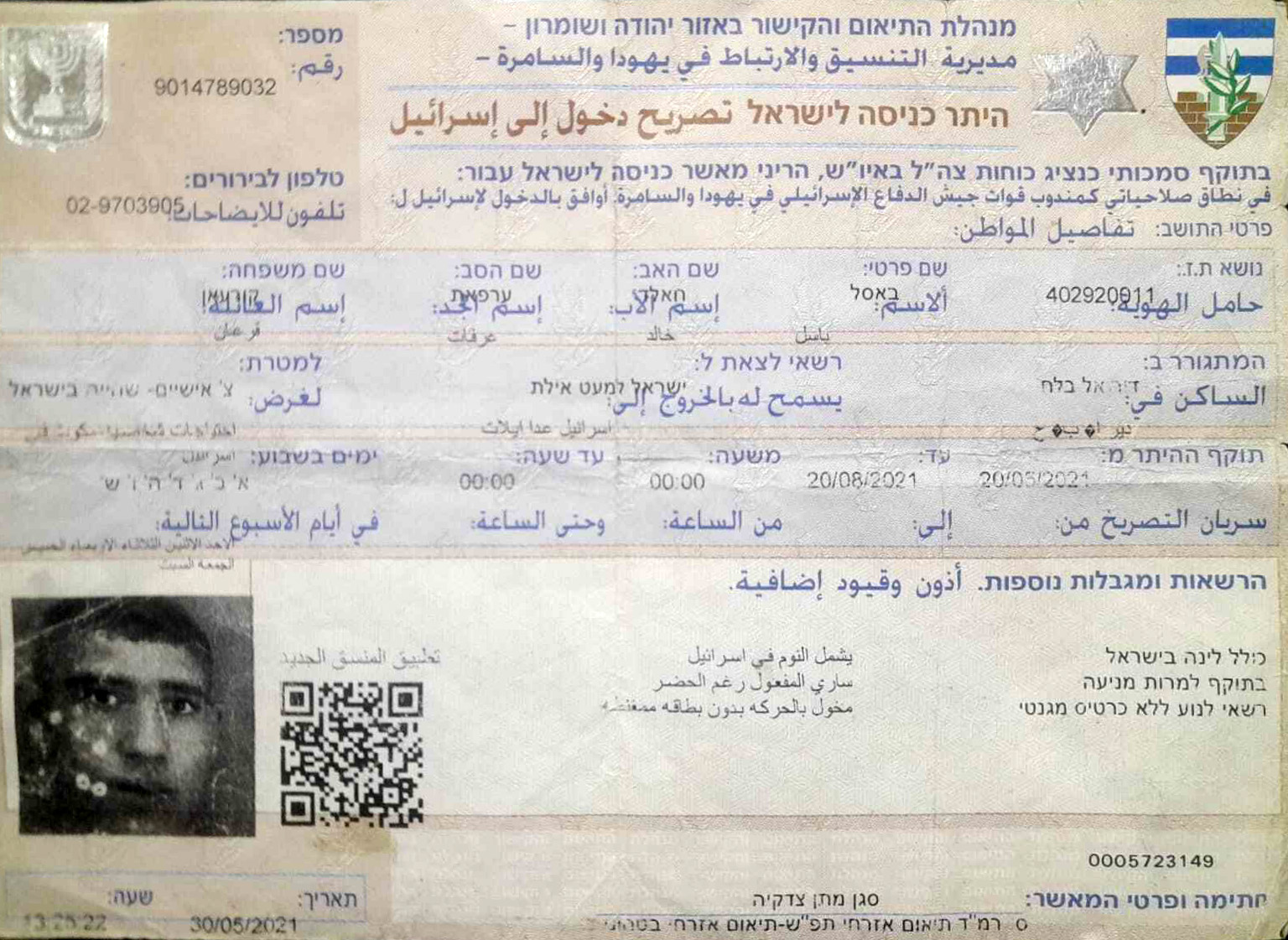
Permit holders cannot apply for an Israeli driver’s license, and can only in rare instances obtain driving “permits” that are valid for a year. COGAT grants these permits to temporary residents only on “humanitarian grounds” — such as in cases where a resident’s partner is unable to drive, according to HaMoked’s legal director Daniel Shenhar.
Despite his tenuous status, al-Qur’an went on to build his life in Israel, working at a car wash and later marrying Nawal, an Arab Israeli from Nazareth, with whom he is raising three young children, Adam, Marwa and Jana.
Then in June 2023, Qur’an was arrested and convicted of driving without a license — which he could not obtain because of his temporary status in Israel. His residency permit expired during the 20 months he spent in prison, leaving him without legal status in Israel.
Prior to his 2023 arrest, al-Qur’an had been jailed for a month on the same offense — driving without a license.
Al-Qur’an’s wife, Nawal, was averse to speaking about the incident over a phone call, but emphasized the difficulty of raising three children on her own.
“I’m not managing at all with the children. It’s extremely difficult,” she told The Times of Israel. She added that since al-Qur’an’s deportation, she has been telling their children that their father is at work, and will return home once he finishes.
A surprise deportation
Al-Qur’an claims that he was never told he would be deported to Gaza after being freed from prison.
He recounted that on February 1, the day he was released, Shin Bet agents brought him to the Kerem Shalom crossing and transferred him to two IDF soldiers. The soldiers then put him onto a truck carrying humanitarian aid. Upon exiting the truck, he found himself in the rubble-strewn city of Rafah.
That same day, Israel freed 150 Gazan security detainees back into the Strip as part of the hostage release-ceasefire deal between Israel and Hamas. However, al-Qur’an, who was incarcerated for a criminal, not security offense, said that he was transported separately. His name did not appear on the list of Palestinian prisoners slated for release that day.
“I was in shock… I had no clue where I was, what was going on, and what exactly had happened to me,” he recalled. Over a month has passed since he found himself stranded there.
His family faces an uphill battle in returning him from the Strip. Despite spotty cell service, al-Qur’an regularly calls his wife and children, who are struggling in light of his prolonged absence.
“My kids are ringing me up every day in school, crying every day, acting out in class, they’re missing me,” he said. “I would take care of everything [for them]. My entire life is there, you understand?”
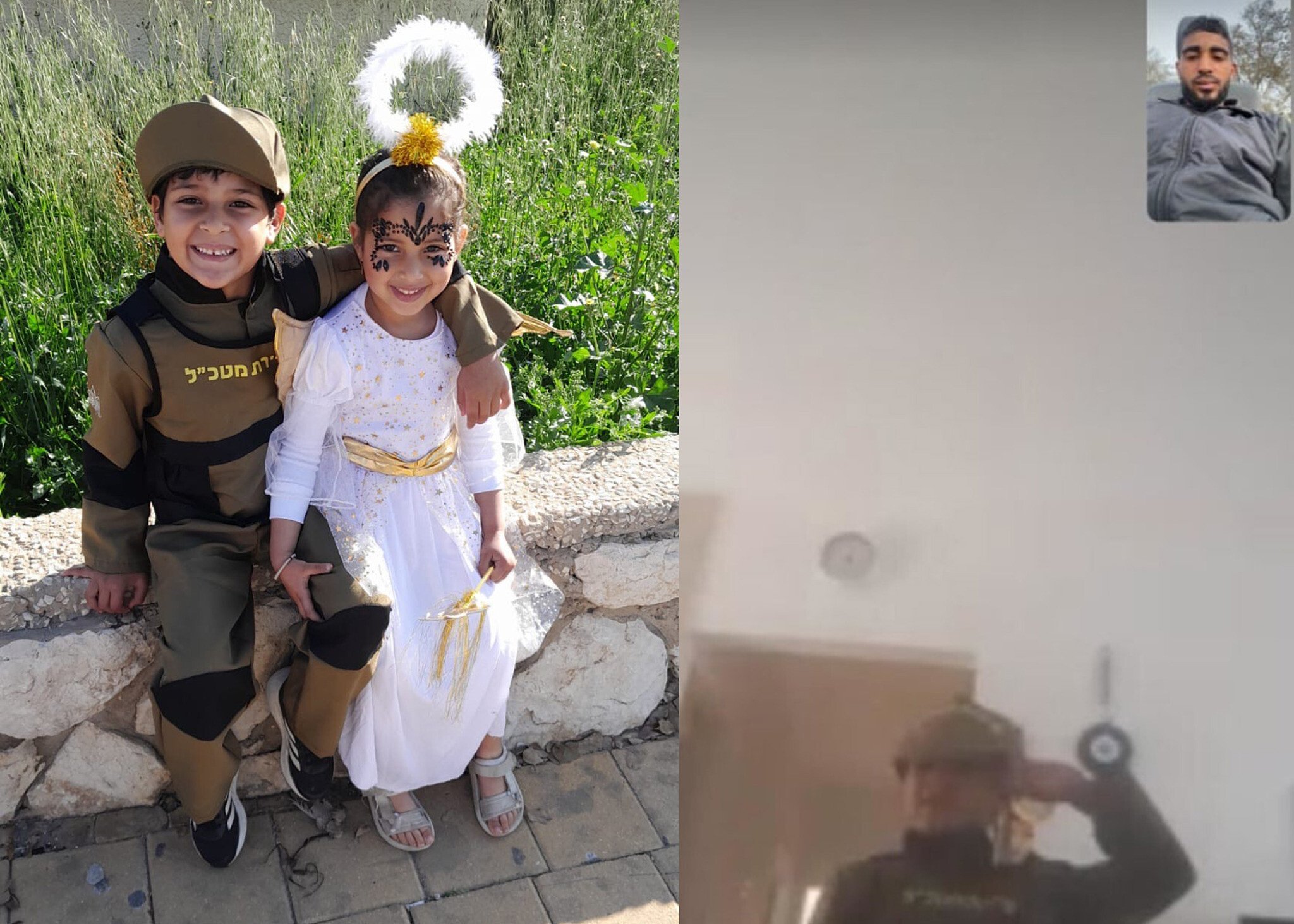
Al-Qur’an recently called his two eldest children on a Wednesday morning before they left for school decked out in costumes for their class Purim festivities.
Dressed up as a soldier in the elite special forces unit Sayeret Matkal, five-year-old Adam playfully saluted his father over video before heading to their majority-Jewish school. His four-year-old daughter, Marwa, went as a princess.
Al-Qur’an’s mother, who remarried and still has four children in the house, is stretched thin and rarely able to help his struggling wife.
“Who will raise his children? I have four children still in my house, I work, I can barely manage, how will I be able to raise three more?” she told The Times of Israel. “He’s my son, my heart aches for him.”
Editor’s note: This article has been updated to reflect information that has come to light about Basel al-Qur’an’s past criminal convictions and legal status in Israel.







The Times of Israel Community.