

Lapid: We may have to coerce the Palestinians into statehood
‘The Palestinians are treating independence as a zero-sum game,’ finance minister tells The Times of Israel

 Add ToI as a Preferred Source on Google
David Horovitz is the founding editor of The Times of Israel. He is the author of "Still Life with Bombers" (2004) and "A Little Too Close to God" (2000), and co-author of "Shalom Friend: The Life and Legacy of Yitzhak Rabin" (1996). He previously edited The Jerusalem Post (2004-2011) and The Jerusalem Report (1998-2004).
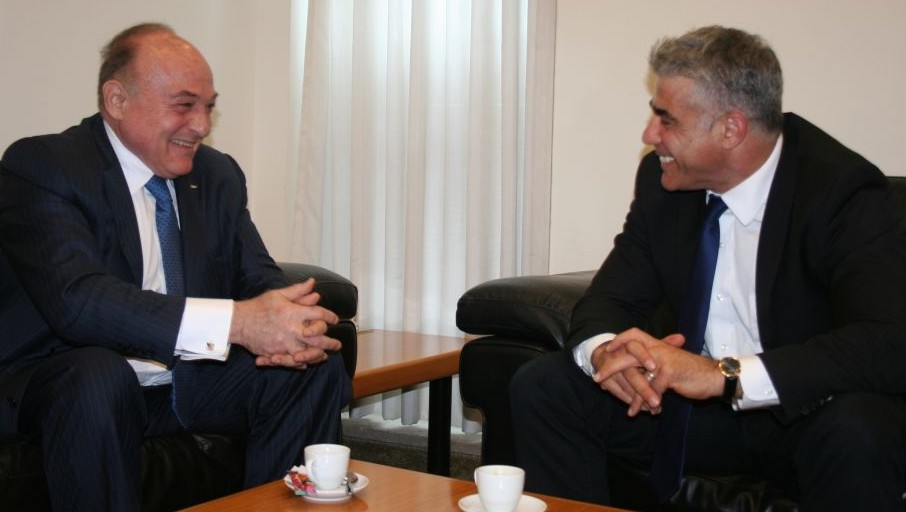
In bitter comments on the collapsing peace effort with the Palestinians, Finance Minister Yair Lapid questioned whether the Palestinian leadership of Mahmoud Abbas is genuinely interested in statehood, suggesting that the Palestinians may instead prefer “to play the eternal victim.” Ultimately, he said, Israel might have to coerce the Palestinians into statehood — “to twist their arm in order to make them establish the free Palestine.”
Lapid, head of the centrist Yesh Atid party, told The Times of Israel that he was “haunted” by the question of “whether the Palestinians really want to have their own state. I’m not sure about it.”
He called the Palestinians “the first nation in history that are treating independence as a zero-sum game. They say either you give us 100 percent of what we want or we don’t want it at all.”
Whereas the US “was established as a shaky confederation of 13 states,” and Israel reluctantly accepted the UN partition of mandatory Palestine even though its leadership was far from satisfied with the allocation of territory, he went on, “the Palestinians are saying: They’ve only offered us 94 percent of what we want territorially. We’re not going to take it. They’ve only offered us 94 percent of the self-government that we’ve asked for. We’re not going to take it. It’s either 100 percent or we’re not taking it at all. You look at this and you ask yourself, maybe they don’t want it so much.”
Lapid, who was speaking to The Times of Israel in an interview precisely as Fatah and Hamas were finalizing their unity agreement on Wednesday afternoon, stressed that he regarded Palestinian statehood as “a good idea” for Israel. “It allows us to separate from them completely. Unlike the Israeli right, I don’t think this is a fight between our god and theirs. Unlike the Israeli left, I don’t want a lower wall. I want a higher wall.”
He also said he was sure there was both a Knesset and a national majority in favor of an agreement so long as it fully protected Israel’s security interests.
But his dealings with Shukri Bishara, the Palestinian Authority minister of finance, he said, were not encouraging “in terms of their ability and willingness to establish, build and run a state.”
Offering an example, Lapid said he worked for a long time to get the necessary backing, including from Prime Minister Benjamin Netanyahu, to propose to the PA that it set up its own electricity company. (The PA owes Israel more than a billion shekels — some $285 million — and goes another 80 million shekels into debt each month for the electricity it buys from Israel, he noted.) “I got all the authorizations and I happily announced that now we can start. [The Palestinians] looked at me and said, you know, we’re not sure we know how to do this.”
Citing the Palestinians’ refusal to accept peace offers from Ehud Barak in 2000 and Ehud Olmert in 2008, Lapid asked: “How come they always refuse?”
And he noted that “the even less comforting thought” as regards the Palestinian position is not that they don’t want a state, but that, perhaps, “they don’t want to have a state alongside the state of Israel, because they have never given up on their original vision which is having a state instead of Israel… And if this is the case, they just have to know that this will never happen.”







The Times of Israel Community.