

Lawmaker raises alarm over deportations of US Jews who help West Bank harvest
Chair of Knesset Diaspora Affairs Committee blasts police minister for ‘illegally’ boycotting hearing, alleges ‘selective enforcement’ of closed military zones in West Bank
 Add ToI as a Preferred Source on Google
Jeremy Sharon is The Times of Israel’s legal affairs and settlements reporter

The head of the Knesset Aliyah, Absorption, and Diaspora Committee accused the police of “apparent” selective enforcement of closed military zone orders in the West Bank during a hearing on Monday, and blasted National Security Minister Itamar Ben Gvir for ordering the police not to send a representative to the committee to present the relevant facts on the matter.
Gilad Kariv, a Labor MK whose party is now part of The Democrats, also expressed surprise that the Population and Immigration Authority of the Interior Ministry had not taken into account the fact that two Jewish women who were recently deported from Israel for violating a closed military zone order were participating in programs of Zionist organizations and were members of Diaspora Jewish communities.
During the hearing, the attorney for the two women also told the committee of a police document demonstrating that the IDF and police had automatically determined the presence of “left-wing activists” in the area to be “a violation of public order,” leading the police to send forces to the site in the first place.
The hearing was held to review an incident from October, when Rachel Beth Flamholz and Leila Stillman-Utterback, two American-Jewish women who were in Israel on a program organized by the Achvat Amim organization, volunteered through the Rabbis for Human Rights group to help Palestinians harvest their olives in the town of Burin in the West Bank.
The IDF imposed a closed military zone order on the entire town the exact day on which the olive-picking volunteer activity had been scheduled. Flamholz and Stillman-Utterback were part of a group of 11 activists in total who were detained and deported for entering, unwittingly, they maintain, the closed military zone where the olive harvesting was to be done.
They were issued with a deportation order by the immigration authority following a hearing and deported two days later, in a process that means they cannot re-enter Israel without having to request special permission to do so from PIBA through the Israeli embassy in the US.
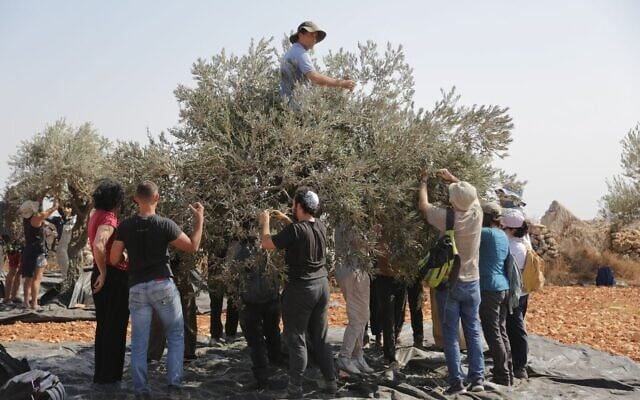
The deportation order has been appealed by the two women.
On Sunday, Ben Gvir, who heads the far-right Otzma Yehudit party, informed Kariv that he had barred officials in his office and police officers from participating in hearings in the committee, despite a legal requirement for state agencies to appear at Knesset hearings when summoned.
“Ben Gvir is a convicted criminal, so I’m not surprised that he ordered the police to violate the law,” said Kariv bitingly at the beginning of the hearing, in reference to the minister’s multiple criminal convictions.
The MK added that legal action would be taken against Ben Gvir’s instructions via the Knesset secretariat, the legal adviser to the Knesset, and the attorney general.
The committee had asked the police to present data on the number of arrests and detentions they have made in 2025 against residents of the West Bank settlements for violating closed military zone orders, in order to better understand the IDF’s practice of imposing such orders over rural Palestinian towns during the olive harvest season, in which it has become increasingly difficult for Palestinian olive growers to harvest their produce.
“I wanted to see how many Israeli citizens in the Judea and Samaria District were detained or arrested during last year and during the olive harvest season for entering a closed military zone, because it looks like there is selective enforcement [here],” Kariv said during the hearing.
Critics allege that the measure, ostensibly designed to allow the military or police to defuse frictions that arise when settlers attempt to stop Palestinians from harvesting olives, is actually being used to keep growers and their helpers from accessing their trees, even in cases when they are not near outposts or settlements.
Addressing the committee, Michal Pomeranz, an attorney who is representing Flamholz and Stillman-Utterback, drew attention to a police document from October 29, the date of the incident, in which an IDF officer from the Samaria Regional Brigade reported to the police that a “group of left-wing activists” had entered Burin, describing the incident as a “disturbance of the peace,” even though no actual disturbances were reported.
The description of the volunteers is striking given similar incidents during the olive harvest season in which other non-violent groups who sought to assist Palestinian olive farmers were also arrested and deported for having violated a closed military zone order.
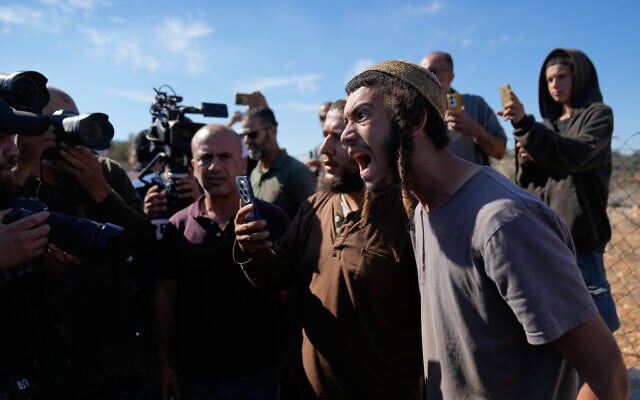
Addressing officials from the immigration authority present in the hearing, Kariv expressed concern that the agency had deported the two women despite their strong connections to Jewish life and Zionist organizations.
The committee chair acknowledged that some anti-Israel activists “who have no connection to Israel or a Jewish community” take advantage of the ease of access to Israel, and create problematic situations in the West Bank.
“It can’t be, though, that the same thing happens to such people as happens to someone who is a member of a Jewish community who came here in the framework of a Zionist organization, and who grew up with Zionist values,” said Kariv.
He asked the officials to examine the possibility of treating such cases differently, and whether it was necessary to ban Diaspora Jews from the country for extended periods of time, as had happened with Flamholz and Stillman-Utterback.






The Times of Israel Community.