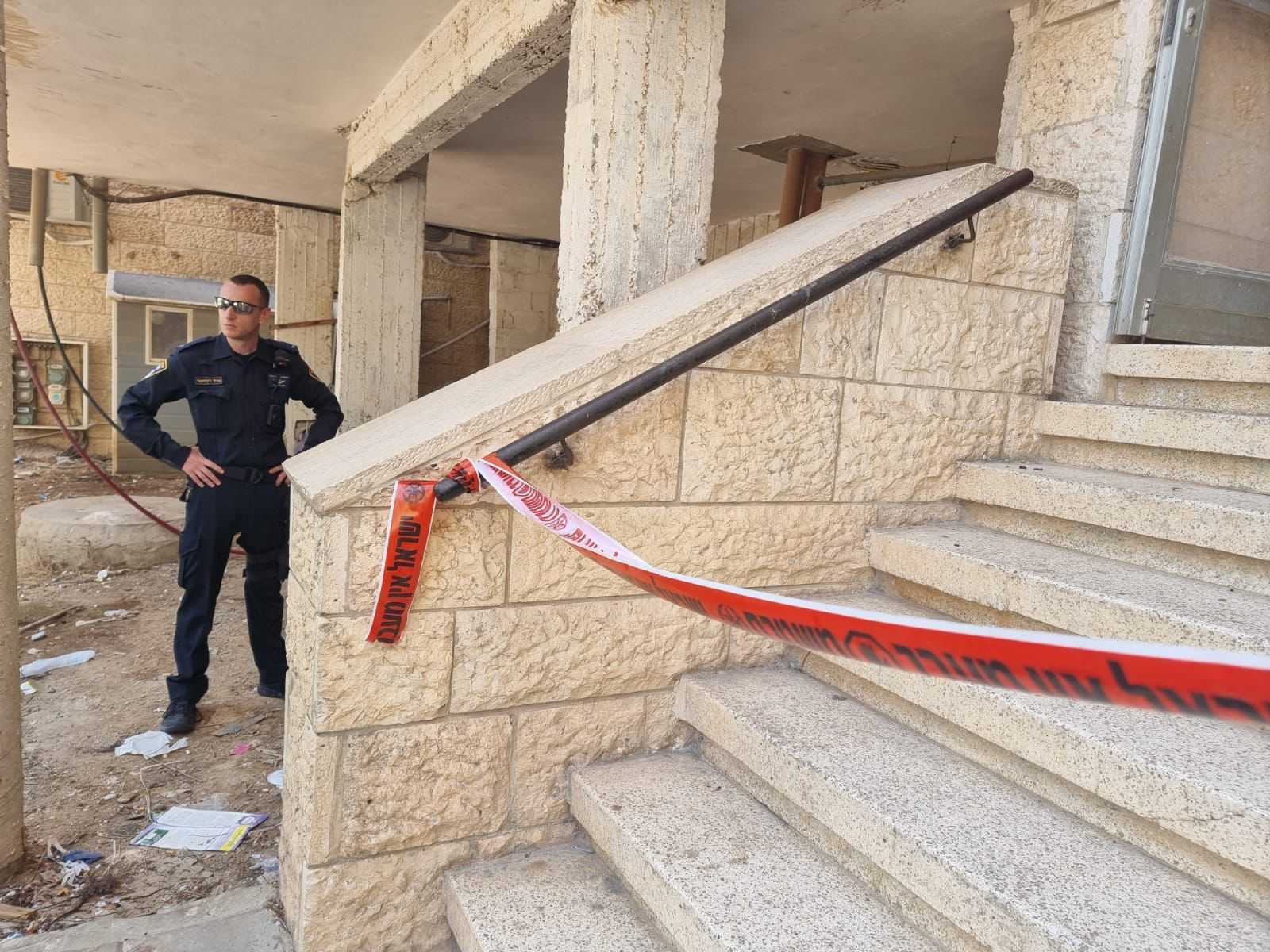
Police at a Ramot property August 13, 2022, after reports a young boy was found with strangulation marks on his neck. The boy was pronounced dead the following day. (Israel Police)
A man suspected of strangling his 4-year-old nephew to death earlier this month was charged with his murder Thursday at the Jerusalem District Court.
The court imposed a ban on identifying either the victim or the accused, age 27. The incident occurred in the capital’s Ramot neighborhood. The prosecution requested that the alleged killer remain in custody for the duration of the proceedings.
The prosecution alleged that the boy was strangled to death after he entered his uncle’s room. A motive for the alleged murder was not given, though the accused was known to have ongoing mental health issues.
Noticing his absence, the boy’s parents sent his grandparents to look for him in the house. The grandparents found the locked bedroom door, and after gaining entry found their grandson unconscious with strangulation marks on his neck.
After paramedics arrived on the scene, they were briefly able to restore the victim’s heartbeat, but he succumbed to his injuries the next day.
Get The Times of Israel's Daily Editionby email and never miss our top stories
Police scuffle with ultra-Orthodox men in the Jerusalem neighborhood of Ramot on August 15, 2022, during a protest over the autopsy of a 4-year-old boy who was allegedly strangled to death by his uncle a few days before. (Yonatan Sindel/Flash90)
Initially, the prosecution sought to conduct an autopsy on the victim. But after a request from the victim’s family as well as public backlash from sections of the ultra-Orthodox community, the court struck down the plans.
Jewish tradition generally opposes autopsies on the grounds that the human body is sacred and should not be tampered with after death. Exceptions are often made in murder or manslaughter cases and courts have in the past overruled the wishes of families.
Advertisement
Help us report truthfully on social media
As a multimedia journalist, my job is to take the quality, fact-based journalism produced by The Times of Israel newsroom and make it accessible across every platform — from Instagram posts to podcasts to short-form videos.
This is how many, especially young people, consume news these days. But misinformation is rampant on social media. Our team at ToI produces accurate, responsible short-form reporting on Israel and the Jewish world.
If you believe in the importance of factual social media journalism, please consider joining our reader support group, The Times of Israel Community. Your financial support is essential to sustain responsible multimedia reporting.
We’re really pleased that you’ve read X Times of Israel articles in the past month.
That’s why we started the Times of Israel - to provide discerning readers like you with must-read coverage of Israel and the Jewish world.
So now we have a request. Unlike other news outlets, we haven’t put up a paywall. But as the journalism we do is costly, we invite readers for whom The Times of Israel has become important to help support our work by joining The Times of Israel Community.
For as little as $6 a month you can help support our quality journalism while enjoying The Times of Israel AD-FREE, as well as accessing exclusive content available only to Times of Israel Community members.
Thank you, David Horovitz, Founding Editor of The Times of Israel


 Add ToI as a Preferred Source on Google