

Theater of the absurd
Israel’s culture wars reach new heights as an actor calls Likud voters ‘cud-chewing cattle’
 Add ToI as a Preferred Source on Google
Marissa Newman is The Times of Israel political correspondent.
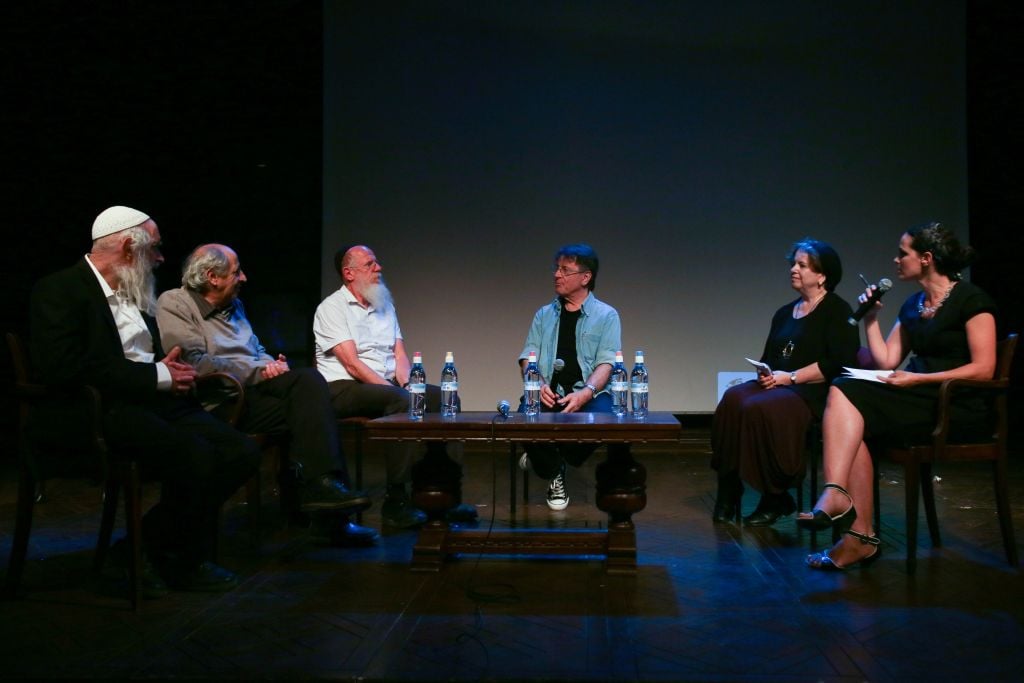
After a prominent Israeli actor dubs Likud voters “cud-chewing cattle” at a stormy cultural meeting, the Hebrew press on Monday has a cow.
The coverage of Oded Kotler’s remark (since retracted) at an emergency cultural meeting responding to a series of political steps by ministers Miri Regev and Naftali Bennett leads coverage in all three dailies, overshadowing the Israeli report on the Gaza summer conflict.
Over in Yedioth Ahronoth, columnist Raanan Shaked — who spares no criticism for the outspoken Regev, calling her a proverbial “pyromaniac” set on torching Israeli culture to the ground — terms Kotler “more Regev than Regev.”
Over 400 artists were present at the Jaffa meeting, Yedioth reports, “but when night fell and the participants went home, the local culture [industry] absorbed another hit to its image.”
The grand takeaway from the meeting, according to Yedioth, was Kotler’s comment, as well as the heckling of Ortal Tamam, the niece of slain soldier Moshe Tamam, who was present to protest “A Parallel Time,” a play based on the writings of Walid Daka, one of her uncle’s killers, playing at the state-funded Haifa Al-Midan theater.
In an attempt to clarify his remark, Kotler tells the paper :“I didn’t only mean Likud voters, but also myself and the rest of Israel. If they follow policies of censorship and no freedom of speech, voice, or democracy. It would be a world without culture, and a world without culture is an animal-like world. All consumers of culture will live in a world devoid of content and will be forced, therefore, to be like a herd of straw and cud-chewing cattle.”
Chiming into the debate and seeking to subdue the histrionic tone, Hanoch Daum argues that the issues at hand have nothing to do with censorship.
“The nuttiest thing is to see artists who don’t understand what censorship is,” he writes. “The frenzy in the past days is based on such a basic mistake that it’s almost embarrassing to address it, but there is likely no choice: silencing and censorship is to prevent plays from appearing on stage, and this, I am sorry to disappoint those who are upset, no one is doing,” he writes.
The problem is not that the government is intervening in the content produced; it is merely reevaluating whether it should fund such productions, he argues.
“You are not fighting censorship, darlings – you are fighting over money,” he writes. “You want the budget to go to you. Legitimate. But stop it with your holier-than-thou perspective.”
The paper also dedicates a story to the heckling of Tamam during the event, after which she ran offstage in tears. “It seems the champions of free speech only know how to hear their own opinions,” she says.
Taking it up a notch and proving Godwin’s law is not only confined to the internet, columnist Ben-Dror Yemini also condemns the screening of a film about Yigal Amir, the killer of former prime minister Yitzhak Rabin, at a Jerusalem festival. “It’s possible that the next stage will be a play about Hitler. He too did everything out of a ‘love of his homeland,’” he writes sardonically.
“So please, don’t confuse this with artistic freedom. Because this isn’t artistic freedom. This is the glorification of murder and murderers and rapists and madmen and racists. This is a political identity and identification. This is a cynical coopting of freedom of speech and expression in order to advance a murderous ideology. And it doesn’t matter where it comes from – from anti-Semites, from the hatred of leftists, of Arabs, of women or any other form of hatred…there is no need to give hate a stage. Not at the Haifa Al-Midan theater, not at the Jerusalem film festival, and not in Munich where a play on the tortured life of Hitler is likely to be produced, who was – how could we not know this – a wonderful soul.”
Haaretz reports that the artists’ convention failed to reach a resolution, after many of the participants refused to sign a prepared statement that was similar to comments made by Regev in past weeks.
In its editorial, the paper urges Israel’s cultural institutions not to cooperate with Regev, even at the cost of their state funding.
“Imposing compliant culture was always characteristic of despotic regimes that sought to bend artistic freedom to convey nationalist and, at times, racist messages. The culture minister must avoid the slippery slope to which she’s trying to lead Israeli culture,” it writes.
“In any case, purveyors of culture must not cooperate with Regev’s approach, even if it means giving up state support.”
Israel Hayom, meanwhile, features Regev’s response to Kotler’s response, which she says reveals the “ugly and patronizing face” of the actor, in its headline.
“The artists ought to remember that we live in Israel, not the Weimar republic: there are no Nazis here,” Aharon Lapidot writes in a column. “The culture minister must remember that citizens are not in the IDF, and culture is not a division that will stand at attention. To the contrary: the strength of culture is in its diversity, the challenges it presents, that it infuriates.”
With all the excitement about the culture wars, the Israeli report on the Gaza conflict, ahead of the UN inquiry later this month, is pushed to page 7 of Israel Hayom, page 10 of Yedioth, and is embedded halfway through an article on Haaretz’s page 4 – all after the Likud primaries reform vote. The dailies have little to say about the report other than its preemptive nature ahead of the inevitable international backlash.
“The decision to release the report preemptively came after lessons learned following the release of the Goldstone report that seriously damaged Israel after Operation Cast Lead – and in order to shape the media discussion in Israel’s favor,” Yedioth reports.










The Times of Israel Community.