

As bomb victims return, melancholy and a glimmer of hope
Papers are filled with sad accounts of a flight from Istanbul carrying the dead and badly injured, but also reflect hope for a reflowering of ties
 Add ToI as a Preferred Source on Google
Joshua Davidovich is The Times of Israel's Deputy Editor
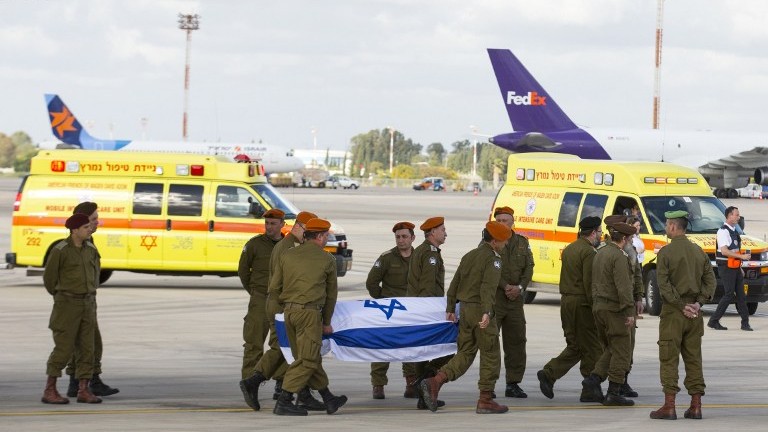
Two days after Saturday’s deadly bombing in Turkey, Israeli papers make the slight redshift from “the deaths of three Israelis was really sad and Islamic State probably did it” to “the transport of three bodies back to Israel is really, really sad and Islamic State almost definitely did it and maybe we can be friends with the Turks again.”
Both tabloids, Yedioth Ahronoth and Israel Hayom, are filled with heart-rending headlines like “Last journey,” “Flight of tears,” “Separated by death,” “’Till death do they part,” “Sad return home,” and “Returning without their other half.”
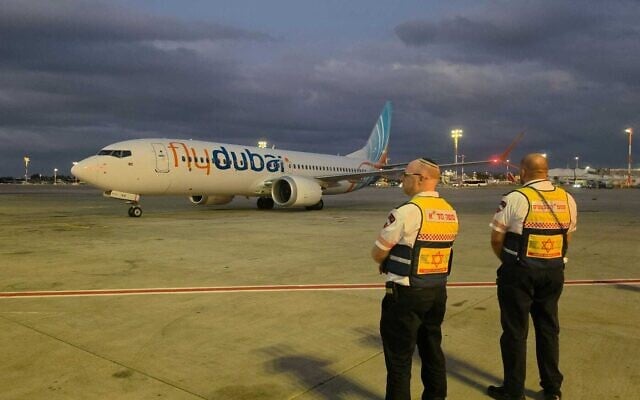
Those hoping to save their Kleenex won’t be helped by the stories contained within, which are filled with melancholy accounts of the return of the bodies of Simha Dimri, Yonathan Suher and Avraham Goldman, all killed in the bombing, and remembrances of their lives, as well as the return of all those injured in the blast.
“A few minutes before the Hercules took off from Turkey to Israel, Na’ama Goldman broke down. The young woman, who lost her father Avraham and whose mother Nitza was badly injured in the attack looked to the sky and when she looked down saw the coffin of her father being loaded onto the plane, and broke out in tears. This was a flight of sorrow,” Yedioth’s reporter on the scene writes.
He bookends his report with a similarly sorry scene, the bodies and the injured are taken off the plane, along with the families that flew to Turkey to be with their loved ones.
“The families hesitated. They were torn. They wanted to go with their injured loved ones making their way to various hospitals,” he writes. “But they were also unable to leave the dead. They went up to the coffins, touched them, kissed them, and only then continued on their painful way.”
As for Yonathan Suher, Israel Hayom reports he headed a company that distributed news for Hasidic Jews and loved to go on trips.
“Yoni had a lust for life, was driven for it,” his friend Doron Berger is quoted telling the paper. “He saw the beautiful sides of life. His customers loved him and the fact that he was secular didn’t bother them at all.”
Haaretz skips the sappy stuff and leads off its coverage with news that the Turks fingered a jihadist linked to the Islamic State as the bomber.
The paper’s Anshell Pfeffer notes that despite the Israeli ceremony in bringing the bodies home, the group was not targeted because of its origin but rather because they were tourists (the latest assessment is different), warning, though, that there are fears that will soon change.
“Until now Israelis who have met their end at the hands of IS have done so because of their love of travel, not their identity as Israelis,” he writes. “But among the IDF the fear is growing that it’s only a matter of time before some cell from the group in the Sinai or the Golan Heights tries to gain the adoration of the Arab world with an attack against Israelis.”
Yet even among the sadness and doom, there is a glimmer of hope that shines through in the papers, both in terms of Israeli pride over efforts to quickly bring the wounded and dead back home and signs that the tragedy may give way to a wider détente between Israel and Turkey.
“The best message we can send to the world on a difficult day like this is that we don’t leave our wounded behind,” Israel’s consul general in Istanbul Shai Cohen is quoted in Israel Hayom from the tarmac. “All the wounded were returned home and that’s how we’ll also act in the future.”
Even as the wounded flew home, those Israelis remaining in Turkey reported surprisingly warm feelings from their hosts, despite years of cool ties between Jerusalem and Ankara. “There was some fear before we got here last week, and it worsened after the attack, but I’ve been happily surprised by the Turks’ show of empathy,” one tourist tells Israel Hayom. “From everyone I speak to I only hear things against the attack, without any relation to the fact that it hurt Israelis.”
Even if the people are getting along great, things aren’t so hunky dunky on the diplomatic front, as evidenced by the paper’s report that the IDF plane flown to Turkey had to do so without any Israeli military markings. But Yedioth reports official ties may also be thawing in the wake of the attack, noting that between Foreign Ministry head Dore Gold’s visit and official correspondence between leaders in Jerusalem and Ankara, “there is no room for doubt that ties are warming up.”
If Israel and Turkey can become besties again, maybe the US Jewish community can also warm up to Donald Trump, who is slated to speak to AIPAC later Monday. That’s a legitimate concern, writes Haaretz’s Chemi Shalev, who writes that organizers should be wary not only of protests, but also of a crowd only too willing to hear the GOP front-runner and accused bigot.
“The organizers of the conference are preparing for various kinds of protest, including rabbis walking out, progressives brandishing signs, leftists standing in silence and possibly even radical revolutionaries who will shout their reservations out loud. But AIPAC shouldn’t only be concerned by the audience’s resistance to Trump. It should be concerned by their potential enthusiasm as well, which isn’t totally inconceivable, especially if Trump takes on President Obama. AIPAC has already faced criticism that its invitation legitimizes Trump’s candidacy; acclamation by the audience might be construed as outright endorsement.”
It’s hard to think of a person less like Trump than Meir Dagan, the former Mossad head whose legend only grew Sunday as he was laid to rest. The heroics and derring-do he became known for didn’t end when he took off his uniform, but also extended to his relations with his three children, writes daughter Noa Ravel Dagan in Yedioth.
“From the moment I was informed that my father was no more, many people called to ask how he was as a father, and my answer was very clear: The same as you knew him as a military man and head of the Mossad. Just forget the discipline part – that was not his strong suit at home, and also any direction our mom tried to give us during the week – rules, hours, sleeps, etc. — went out the window as soon as he came home Friday,” she writes. “Because dad was definitely not conventional and loved surprises and adventures. So our childhood was spent around tanks, a lot of them, and if we saw him during the week it meant he took us to a drill on the Golan Heights, and took us with him on a wild Jeep ride between the Centurion tanks, and we saw how Dad ran everything with a cool head and a lot of humor.”



The Times of Israel Community.