

Escaped tiger entertains drivers on Doha road
Owner manages to pull animal out from under vehicle; video clips expose plight of exotic pets prized in Gulf states
 Add ToI as a Preferred Source on Google
Sue Surkes is The Times of Israel's environment reporter
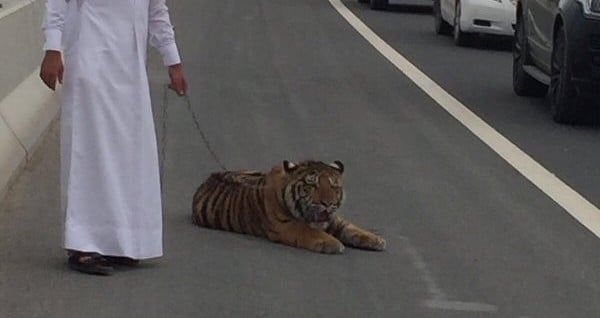
A humdrum Doha traffic jam was interrupted on Tuesday when a tiger cub wearing a collar and trailing a long, broken chain snaked its way between gridlocked cars in an apparent bid to find its way off the road.
Video clips show the animal alternately trotting and walking between the cars until it finally ends up beneath a vehicle, from which it is unceremoniously dragged by its apparent owner.
Local excitement aside, the incident highlighted a dubious fashion among super-rich Gulf residents of acquiring the ultimate macho accessory — a big cat.
In January, Gulf News reported that police had caught a one-year-old lioness roaming the streets of a residential neighborhood in Dubai.
https://www.youtube.com/watch?v=xYQHNWBSuu4
In 2014, the Kuwait Times covered the mauling and subsequent death of a Filipina maid by a lion kept at home by her employer.
Exotic animals of all kinds are smuggled in and often traded via social media, the Qatari newspaper Al Arab reported.
Tiger found roaming Doha streets a while ago & the video of it is all over social media nowhttps://t.co/z1790d3KxG pic.twitter.com/vtp9XxFCkw
— Qatar Living ® (@qatarliving) March 8, 2016
A leopard can cost $12,500, and a lion cub an average of $25,000, the paper said.
One home visited by a reporter for the newspaper had a lion, a chimpanzee and a leopard, all living among three children up to the age of 10.
Photos on social media often show big cats sitting on the passenger seats of flashy cars or boats.
The Gulf states forbid holding wild animals as pets. Qatari law, for example, provides for prison sentences of up to six months and fines that can reach $2,750 (NIS 10,750).
Dr. Al Syed Mohammad, regional director at the International Fund for Animal Welfare (IFAW) — Middle East and North Africa, told Gulf News in January that cats such as lions were kept in cages, and more often than not, their owners had no idea how to care for them.
“We are always against keeping exotic animals as pets based on five reasons: animal welfare, survival of the species, safety concerns due to the animal’s unpredictable behavior, risk of disease, and risk to native biodiversity if the animal escapes.”
Rozaan de Kock, carnivore curator at the Al Bustan Zoological Center in the United Arab Emirates, was quoted by Gulf News as saying: ““People really like them when they are small and cute. But they don’t stay small. They get bigger and can get rough.They are wild and even if they are friendly and seem to know you, they still have their wild instincts within them.”










The Times of Israel Community.