

France expects easing of Iran sanctions in December
Spokesman for EU foreign policy chief says deal addresses the international community’s ‘most serious and immediate concerns’
 Add ToI as a Preferred Source on Google
Stuart Winer is a breaking news editor at The Times of Israel.
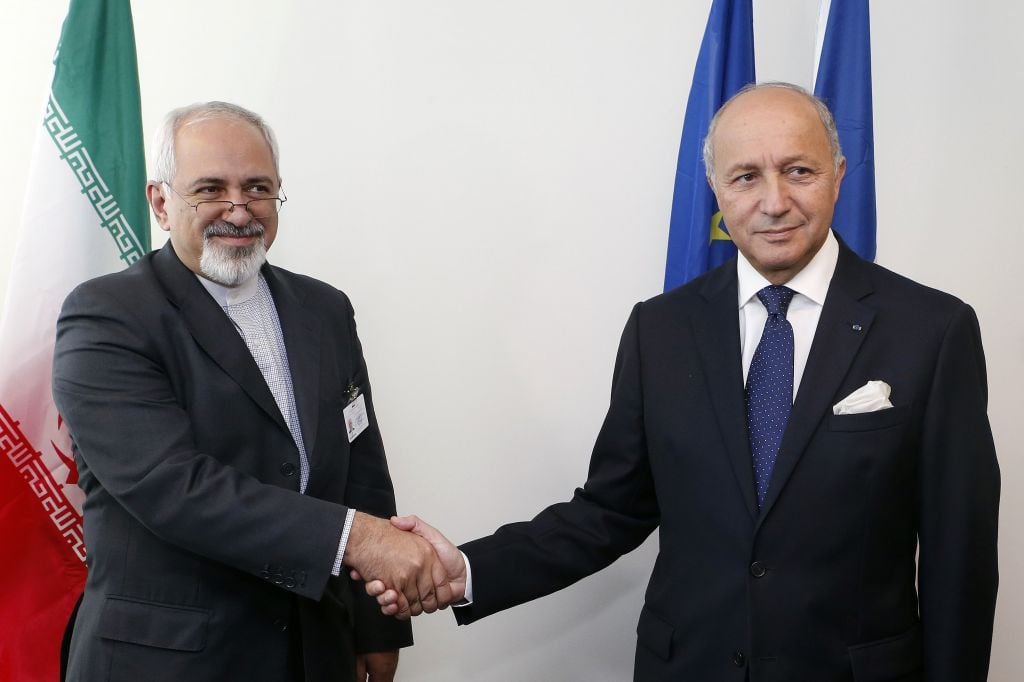
France’s foreign minister on Monday said sanctions against Iran could be partially lifted as soon as December, with a Europe-wide decision in coming weeks.
Laurent Fabius told Europe 1 radio that to start lifting the sanctions “a Europe-wide decision is necessary. That’s expected in several weeks, for a partial lifting that is targeted, reversible.”
Fabius participated in weekend talks between Iranian officials and world powers that ended with an agreement allowing Iran to keep the central elements of its uranium program while limiting its enrichment to a level lower than what is needed for nuclear arms.
In addition to a six-month window for Iran to allow more UN access to nuclear sites, the sanctions that have devastated the country’s economy will be eased, though not ended.
The nuclear talks came in the wake of several months of secret negotiations between American and Iranian officials. Israeli officials have blasted the deal as a “historic mistake.”
Michael Mann, spokesman for EU foreign policy chief Catherine Ashton, countered Israel’s alarm over the agreement and asserted that the deal was satisfactory.
“We always said that we would only do a deal that we felt to be a good deal,” Mann said in an interview with Army Radio on Monday. “We believe this is a good agreement — as a first step.”
Mann stressed that the current arrangement was only put in place to provide time to work on a full agreement that would guarantee that Iran’s nuclear program was for peaceful purposes only. He rejected concerns that the agreement only slowed down Iran’s uranium enrichment program without providing substantial curbs.
“What this does it address is the most serious and immediate concerns of the international community about the Iranian nuclear program,” he said, noting that the deal froze the process of creating the high-enriched uranium that isn’t required by a peaceful nuclear program. Under the terms of the agreement, Iran is to scale back its 20 percent enriched uranium activities and stockpiles and only enrich to below 5%.
Ensuring that Iran stays within the limitations of the deal is based on the assumption that the “checks and balances” in the agreement will be effective, Mann explained.
“Of course there are mechanisms in this agreement to make sure that the undertakings are actually respected, which is key to any agreement,” he said. “Iran has to verifiably and concretely prove to us and reassure us that this [nuclear] program is purely peaceful.”
The Associated Press contributed to this report.


The Times of Israel Community.